

2 euro – Cyprus
Add to wishlist
Circulating commemorative coins
Commemoration: Paphos 2017 - European Capital of Culture
Cyprus
Obverse
Description:
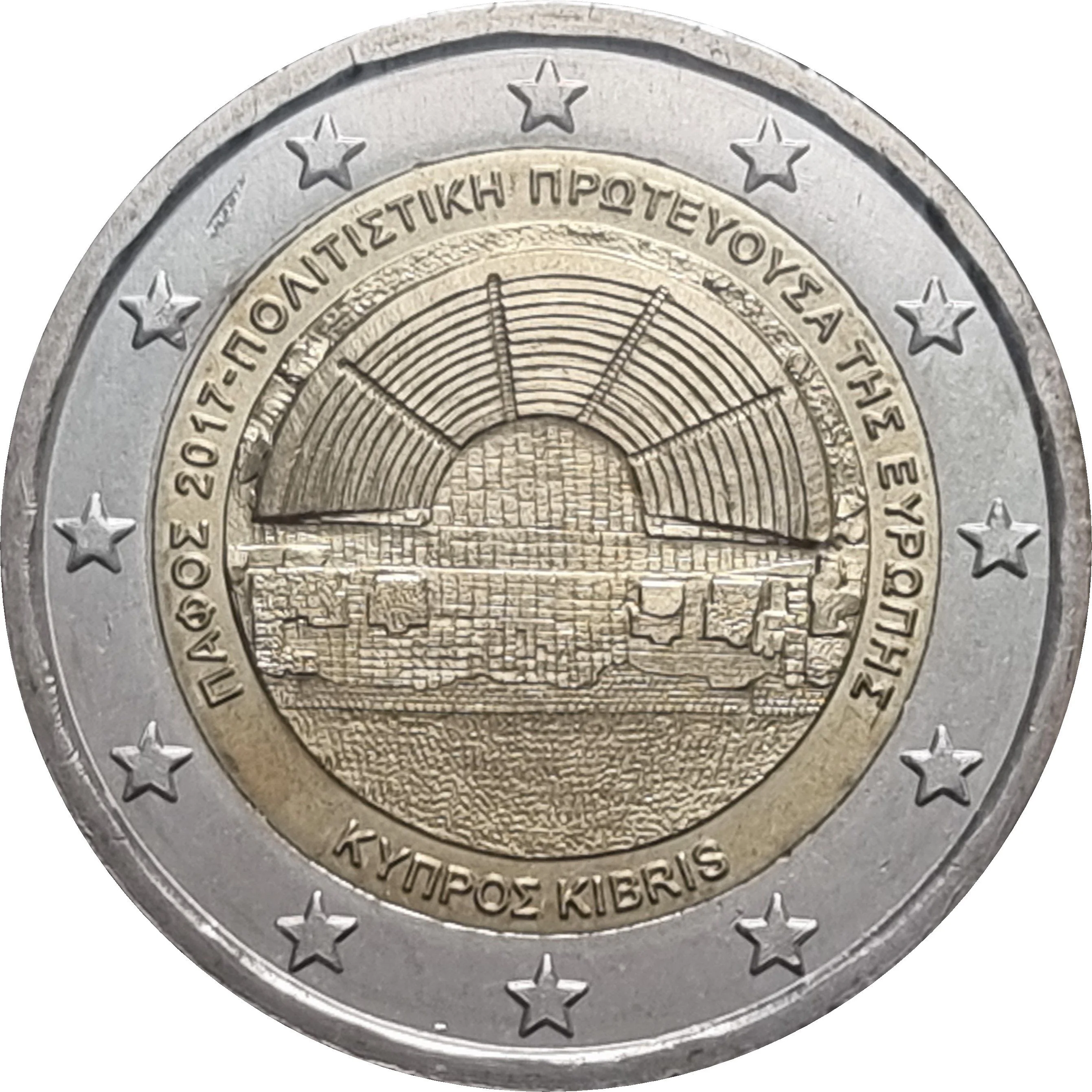
The design features the 2nd-century AD Paphos Ancient Odeon, a small amphitheatre used for summer performances and events for ‘Paphos 2017 – European Capital of Culture’. The national side includes ‘ΚΥΠΡΟΣ KIBRIS’ and the ‘Paphos 2017’ title. The coin’s outer ring bears the 12 stars of the European flag.
Inscription:
ΠΑΦΟΣ 2017 – ΠΟΛΙΤΙΣΤΙΚΗ ΠΡΩΤΕΥΟΥΣΑ ΤΗΣ ΕΥΡΟΠΗΣ
ΚΥΠΡΟΣ KIBRIS
ΚΥΠΡΟΣ KIBRIS
Translation:
Paphos 2017 – Cultural Capital of Europe
Cyprus Kıbrıs
Cyprus Kıbrıs
Engraver: Geórgios Stamatópoulos
Reverse
Mints
| Name | Mark |
|---|---|
| National Mint of the Bank of Greece | — |
Mintings
| Year | Mint Mark | Mintage | Quality | Collection |
|---|---|---|---|---|
| 2017 | — | 418,000 | ||
| 2017 | — | 7,000 | BU | |
| 2017 | — | 5,000 | Proof |
Historical background
In 2017, Cyprus was in a period of significant economic recovery and stabilization following the severe 2012-2013 financial crisis, which had culminated in a contentious international bailout. That bailout famously included the "bail-in" of uninsured depositors in the country's two largest banks, leading to capital controls and a profound loss of trust in the banking system. By 2017, these emergency capital controls had been fully lifted in April 2015, marking a symbolic return to financial normalcy. The country remained under a strict macroeconomic adjustment program, but its economy was showing positive growth for the third consecutive year, and the banking sector had undergone substantial restructuring and deleveraging.
The currency situation was defined by Cyprus's membership in the Eurozone; the official currency was, and remains, the euro (€). This meant monetary policy was set by the European Central Bank (ECB), providing stability and eliminating exchange rate risk with other member states. The primary focus in 2017 was not on currency volatility but on continuing to repair bank balance sheets, reduce high levels of non-performing loans (NPLs)—which were among the highest in the EU—and restore the sector's credibility. The government was also working to exit the post-bailout surveillance framework, which it successfully did in the first half of 2016, though enhanced monitoring continued.
Overall, the currency landscape in 2017 was one of regained stability underpinned by the euro, but with the legacy of the crisis still shaping economic policy. The challenges were structural rather than monetary: fostering sustainable growth, further consolidating public finances, and completing the cleanup of the banking system. The year represented a continued, albeit cautious, transition from crisis management to a focus on long-term competitiveness and the reduction of public and private debt, all within the secure framework of the single currency.
The currency situation was defined by Cyprus's membership in the Eurozone; the official currency was, and remains, the euro (€). This meant monetary policy was set by the European Central Bank (ECB), providing stability and eliminating exchange rate risk with other member states. The primary focus in 2017 was not on currency volatility but on continuing to repair bank balance sheets, reduce high levels of non-performing loans (NPLs)—which were among the highest in the EU—and restore the sector's credibility. The government was also working to exit the post-bailout surveillance framework, which it successfully did in the first half of 2016, though enhanced monitoring continued.
Overall, the currency landscape in 2017 was one of regained stability underpinned by the euro, but with the legacy of the crisis still shaping economic policy. The challenges were structural rather than monetary: fostering sustainable growth, further consolidating public finances, and completing the cleanup of the banking system. The year represented a continued, albeit cautious, transition from crisis management to a focus on long-term competitiveness and the reduction of public and private debt, all within the secure framework of the single currency.
Series: Cyprus 2 euro commemoratives
🌱 Very Common