

20 perpera – Montenegro
Add to wishlist
Montenegro
Context
Year: 1910
Issuer: Montenegro
Ruler: Nicholas I
Currency:
(1906—1918)
Demonetized: Yes
Total mintage: 30,000
Material
References
KM: #
Numista: #73816
Value
Bullion value: $931.01
Obverse
Description:
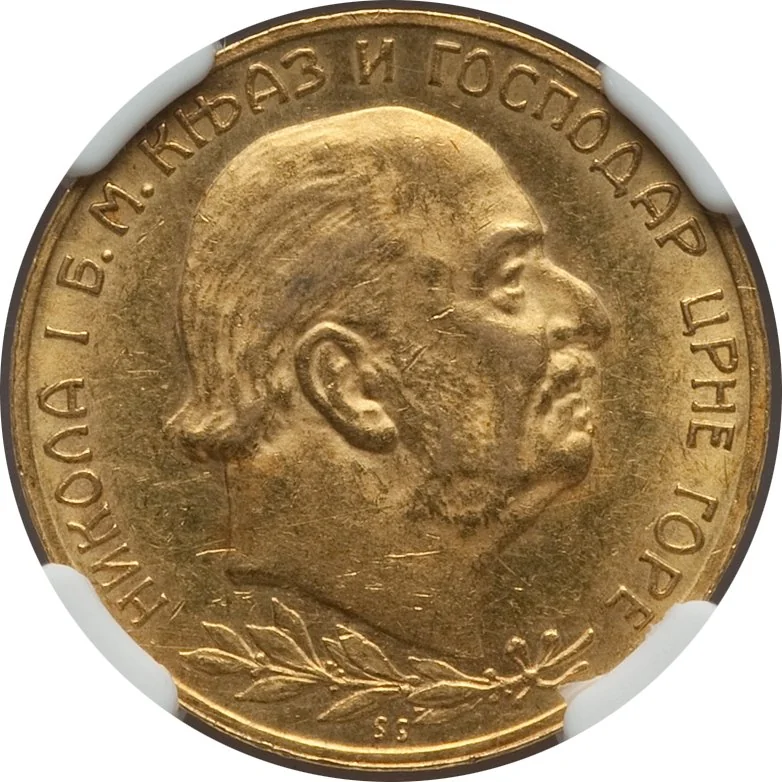
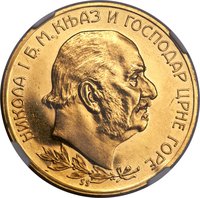
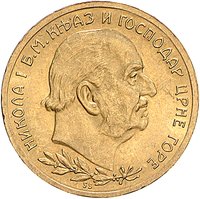
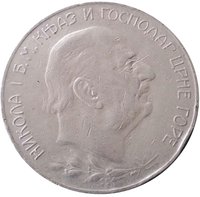
Bare head right, legend encircling, dates beneath.
Inscription:
НИКОЛА I Б. М. КЊАЗ И ГОСПОДАР ЦРНЕ ГОРЕ
SS
SS
Translation:
NICHOLAS I BY THE GRACE OF GOD PRINCE AND LORD OF MONTENEGRO
Language: Serbian
Engraver: Stephan Schwartz
Reverse
Description:
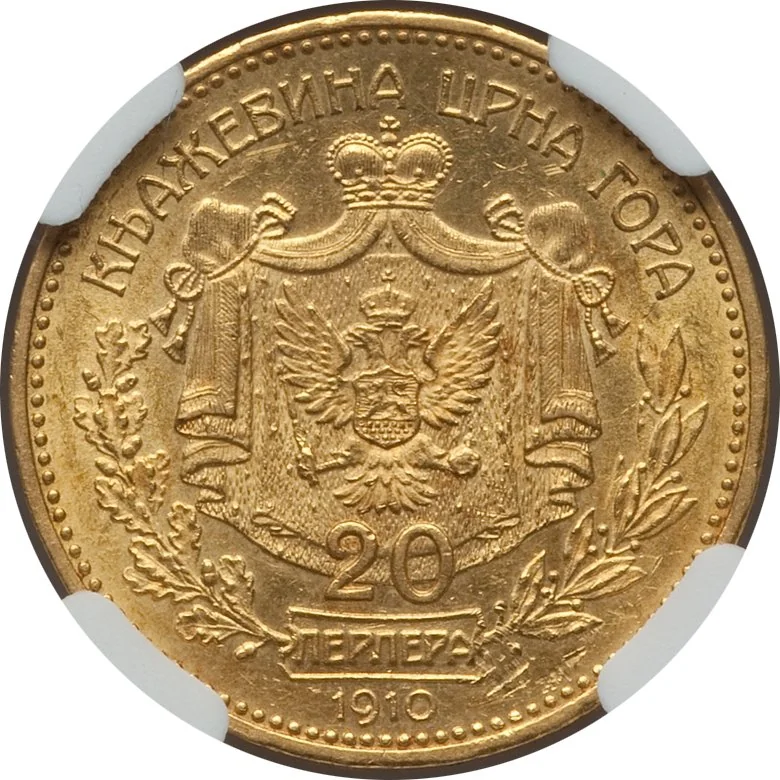
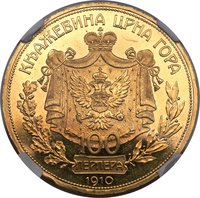
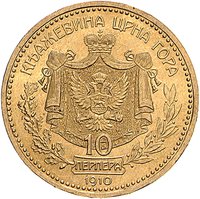
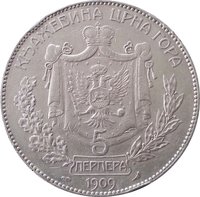
Arms with crown and sprigs above date and value.
Inscription:
КЊАЖЕВИНА ЦРНА ГОРА
20
ПЕРПЕРA
1910
20
ПЕРПЕРA
1910
Translation:
PRINCIPALITY OF MONTENEGRO
20
PERPER
1910
20
PERPER
1910
Script: Cyrillic
Languages: Serbian, Montenegrin
Engraver: Stephan Schwartz
Edge
Inscribed in hollow
Categories
| Object> Globus cruciger |
| Person> Monarch |
| Mustache/Beard |
| Animal> Bird |
| Symbol> Crown |
| Symbols> Coat of Arms |
| Symbol> Double-headed eagle |
Mintings
| Year | Mint Mark | Mintage | Quality | Collection |
|---|---|---|---|---|
| 1910 | — | 30,000 |
Historical background
In 1910, Montenegro's currency situation reflected its complex political and economic position as a newly elevated kingdom within a region dominated by great powers. The Montenegrin perper, introduced in 1906, was the official national currency, divided into 100 para. However, its circulation was limited and it functioned alongside a plethora of foreign coins and notes that dominated everyday commerce. The country lacked its own central bank, and the perper's value was pegged to the French franc at a rate of 1 perper = 1 franc, adhering to the Latin Monetary Union standards, which provided a semblance of stability but tied Montenegro's economy to external financial systems.
Practically, the monetary landscape was a mosaic of competing currencies. Alongside the perper, the Austrian crown was overwhelmingly prevalent, especially in the northern and coastal areas, due to Austria-Hungary's dominant economic and political influence in the Balkans. Russian rubles, Italian lire, and Turkish piastres also circulated freely, a testament to Montenegro's reliance on foreign subsidies, remittances from emigrants, and trade with its neighbours. This created an informal dual-currency system where state finances were nominally in perper, but much private business and daily life were conducted in Austrian crowns.
This fragmented system underscored Montenegro's economic vulnerabilities on the eve of the Balkan Wars and World War I. While the establishment of the perper was a symbolic act of sovereignty following independence in 1878 and the proclamation of the kingdom in 1910, the pervasive use of foreign money highlighted the nation's limited economic autonomy and integration into the spheres of influence of larger empires. The currency situation thus mirrored the kingdom's precarious independence, caught between the ambitions of Austria-Hungary, Russia, and the rising nationalist forces in the region.
Practically, the monetary landscape was a mosaic of competing currencies. Alongside the perper, the Austrian crown was overwhelmingly prevalent, especially in the northern and coastal areas, due to Austria-Hungary's dominant economic and political influence in the Balkans. Russian rubles, Italian lire, and Turkish piastres also circulated freely, a testament to Montenegro's reliance on foreign subsidies, remittances from emigrants, and trade with its neighbours. This created an informal dual-currency system where state finances were nominally in perper, but much private business and daily life were conducted in Austrian crowns.
This fragmented system underscored Montenegro's economic vulnerabilities on the eve of the Balkan Wars and World War I. While the establishment of the perper was a symbolic act of sovereignty following independence in 1878 and the proclamation of the kingdom in 1910, the pervasive use of foreign money highlighted the nation's limited economic autonomy and integration into the spheres of influence of larger empires. The currency situation thus mirrored the kingdom's precarious independence, caught between the ambitions of Austria-Hungary, Russia, and the rising nationalist forces in the region.
💎 Extremely Rare