

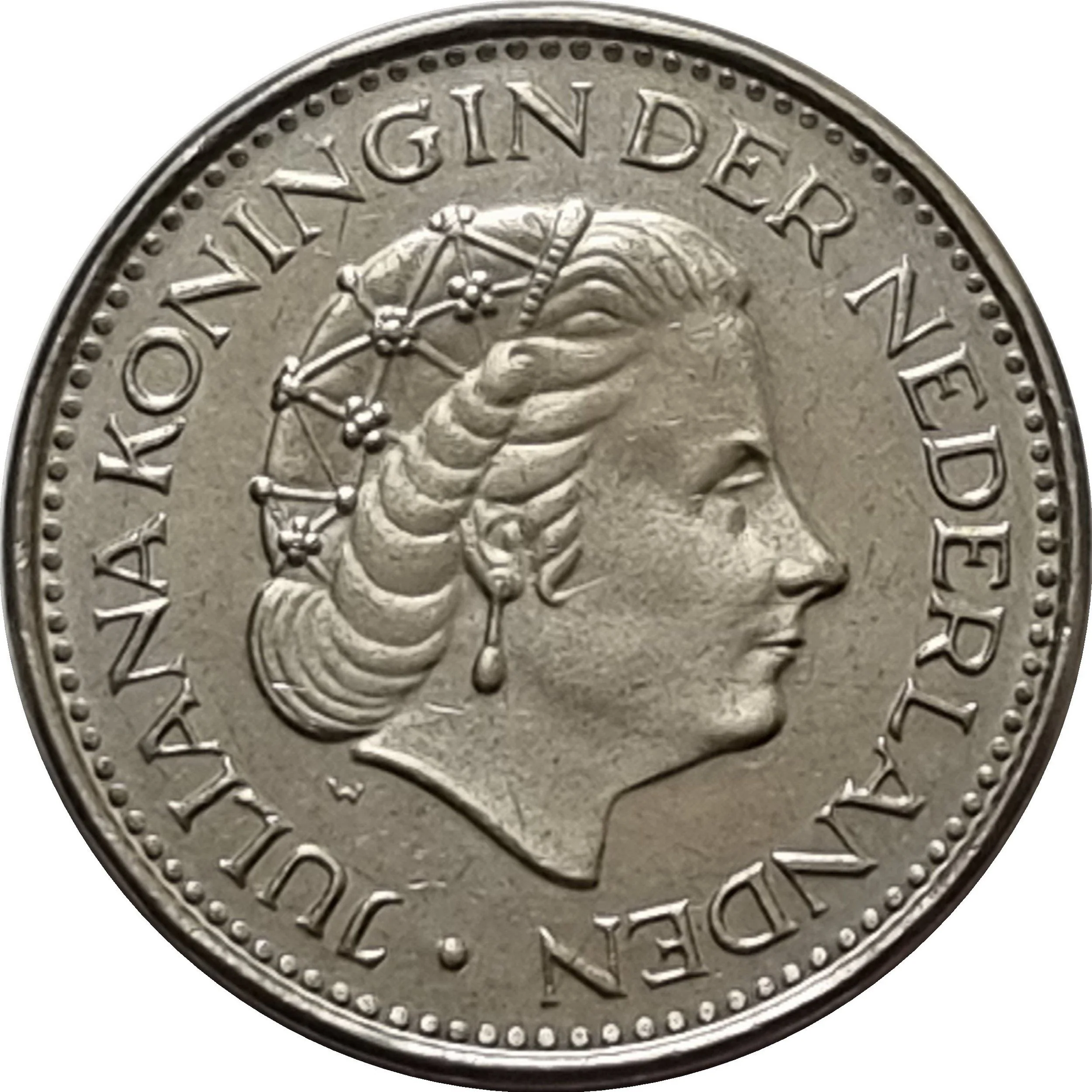
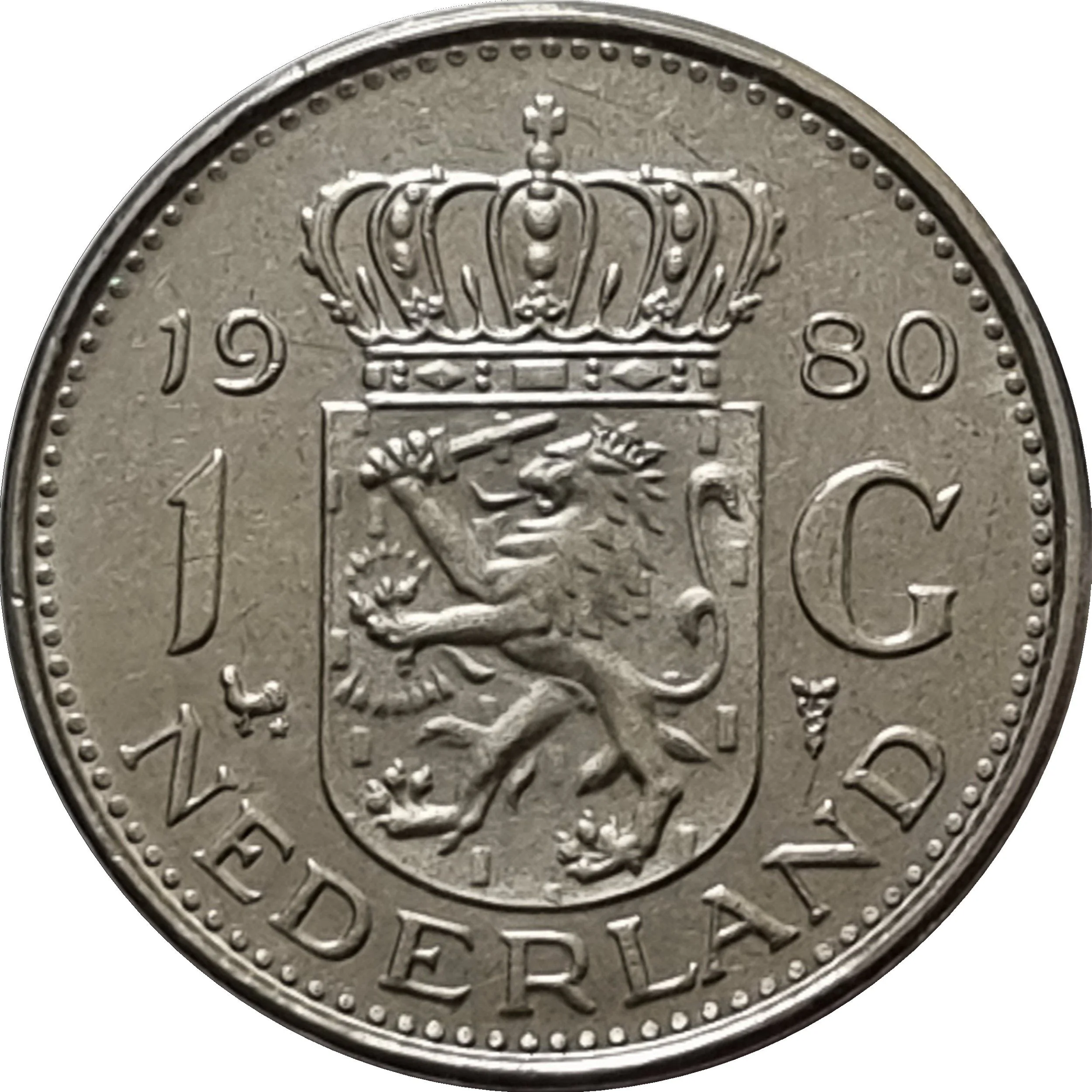
1 gulden – Netherlands
Add to wishlist
Netherlands
Context
Years: 1967–1980
Issuer: Netherlands
Ruler: Juliana
Currency:
(1817—2001)
Demonetization: 28 February 2002
Total mintage: 514,800,000
Material
References
KM: #
Numista: #738
Value
Exchange value: 1 NLG
Inflation-adjusted value: 6.72 NLG
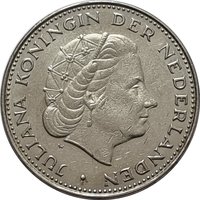
Obverse
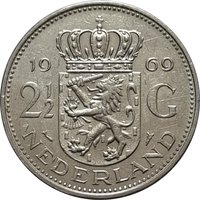
Reverse
Edge
Plain with incuse lettering
Legend:
★ GOD ★ ZIJ ★ MET ★ ONS ★
Translation:
GOD BE WITH US
Language: Dutch
Mints
| Name | Mark |
|---|---|
| Royal Dutch Mint | — |
Mintings
| Year | Mint Mark | Mintage | Quality | Collection |
|---|---|---|---|---|
| 1967 | — | 31,000,000 | ||
| 1967 | — | — | Proof | |
| 1968 | — | 61,000,000 | ||
| 1969 | — | — | Proof | |
| 1969 | — | 15,500,000 | ||
| 1970 | — | — | Proof | |
| 1970 | — | 18,000,000 | ||
| 1971 | — | 50,000,000 | ||
| 1972 | — | 60,000,000 | ||
| 1973 | — | 27,000,000 | ||
| 1975 | — | 9,000,000 | ||
| 1976 | — | 32,000,000 | ||
| 1977 | — | 38,000,000 | ||
| 1978 | — | 30,000,000 | ||
| 1979 | — | 25,000,000 | ||
| 1980 | — | 118,300,000 |
Historical background
In 1967, the Netherlands operated within the Bretton Woods system of fixed exchange rates, with the Dutch guilder (NLG) pegged to the US dollar. This period was characterized by a strong and stable guilder, often referred to as a "hard currency," which was a point of national pride and a reflection of the country's robust post-war economic recovery and disciplined fiscal policies. The Nederlandsche Bank (the central bank) maintained strict monetary control, and the country enjoyed consistent balance-of-payments surpluses, bolstered by significant natural gas exports from the Groningen field, discovered in 1959.
However, this stability was under growing international strain. The Bretton Woods system itself was beginning to show cracks due to US balance-of-payments deficits and inflationary pressures. For the Netherlands, the strong guilder and persistent trade surpluses created domestic political tension, particularly with labor unions. They argued that the guilder's strength made Dutch exports less competitive and that the focus on currency stability came at the expense of higher wages and social spending. This led to periods of social unrest, notably the disruptive "Het is genoeg!" (It is enough!) strikes in the mid-1960s.
Consequently, 1967 was a transitional year, setting the stage for a significant revaluation. Facing intense speculative capital inflows betting on a currency adjustment, and under pressure to cool the overheating economy, the Dutch government and central bank reluctantly agreed to a revaluation. On March 7, 1967, the guilder was revalued by 5%, a move intended to curb inflation and ease international imbalances. This decision, while solidifying the guilder's hard-currency status, was a defensive action within a faltering global monetary order that would ultimately lead to the collapse of the Bretton Woods system in the early 1970s.
However, this stability was under growing international strain. The Bretton Woods system itself was beginning to show cracks due to US balance-of-payments deficits and inflationary pressures. For the Netherlands, the strong guilder and persistent trade surpluses created domestic political tension, particularly with labor unions. They argued that the guilder's strength made Dutch exports less competitive and that the focus on currency stability came at the expense of higher wages and social spending. This led to periods of social unrest, notably the disruptive "Het is genoeg!" (It is enough!) strikes in the mid-1960s.
Consequently, 1967 was a transitional year, setting the stage for a significant revaluation. Facing intense speculative capital inflows betting on a currency adjustment, and under pressure to cool the overheating economy, the Dutch government and central bank reluctantly agreed to a revaluation. On March 7, 1967, the guilder was revalued by 5%, a move intended to curb inflation and ease international imbalances. This decision, while solidifying the guilder's hard-currency status, was a defensive action within a faltering global monetary order that would ultimately lead to the collapse of the Bretton Woods system in the early 1970s.
🌱 Very Common