

2½ gulden – Netherlands
Add to wishlist
Netherlands
Context
Years: 1969–1980
Issuer: Netherlands
Ruler: Juliana
Currency:
(1817—2001)
Demonetization: 28 February 2002
Total mintage: 107,906,000
Material
References
KM: #
Numista: #736
Value
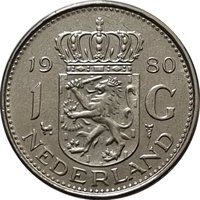
Exchange value: 2.5 NLG
Inflation-adjusted value: 15.66 NLG
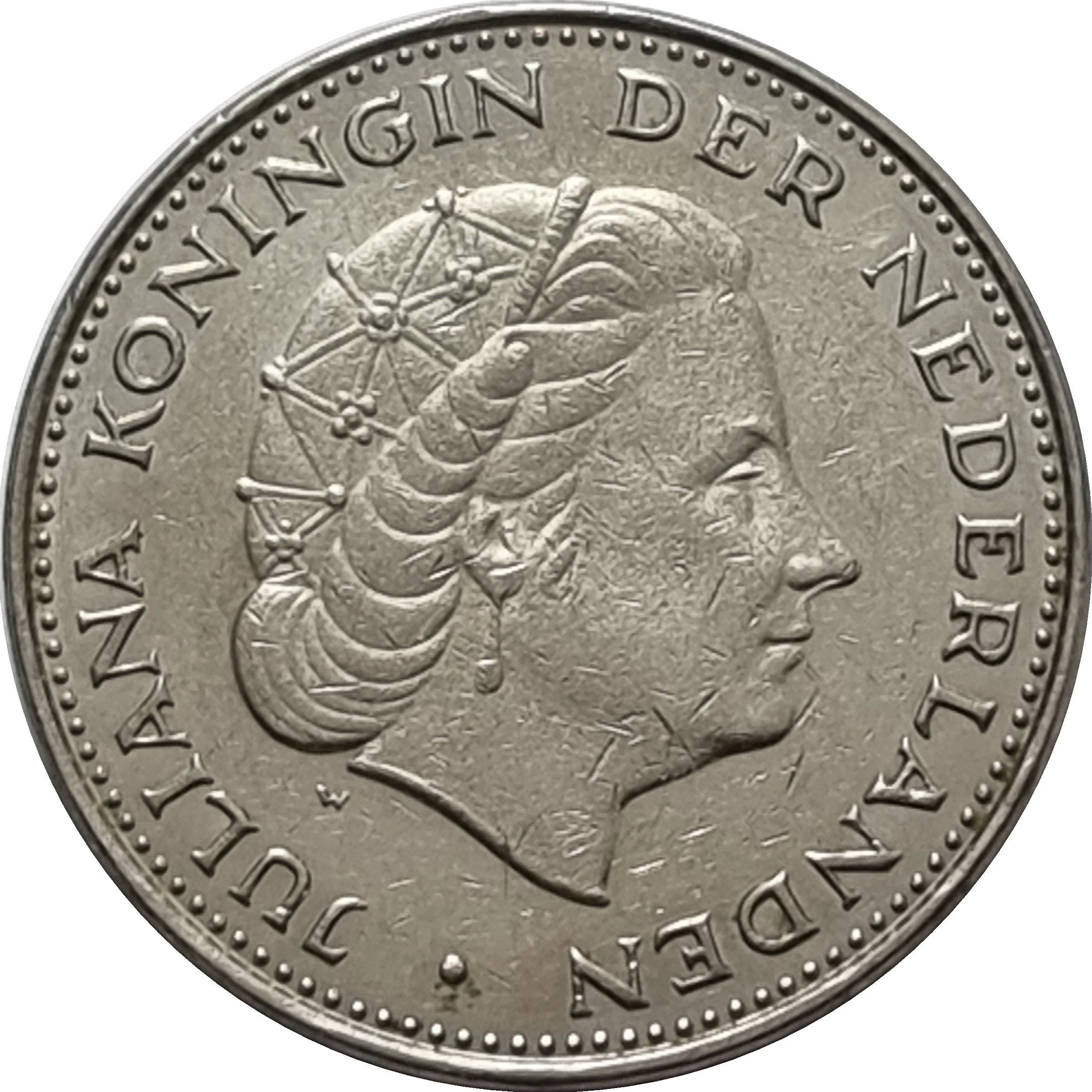
Obverse
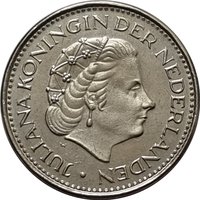
Description:
Queen Juliana facing right
Inscription:
JULIANA KONINGIN DER NEDERLANDEN •
W
W
Translation:
Juliana Queen of the Netherlands •
Script: Latin
Language: Dutch
Engraver: Ludwig Oswald Wenckebach
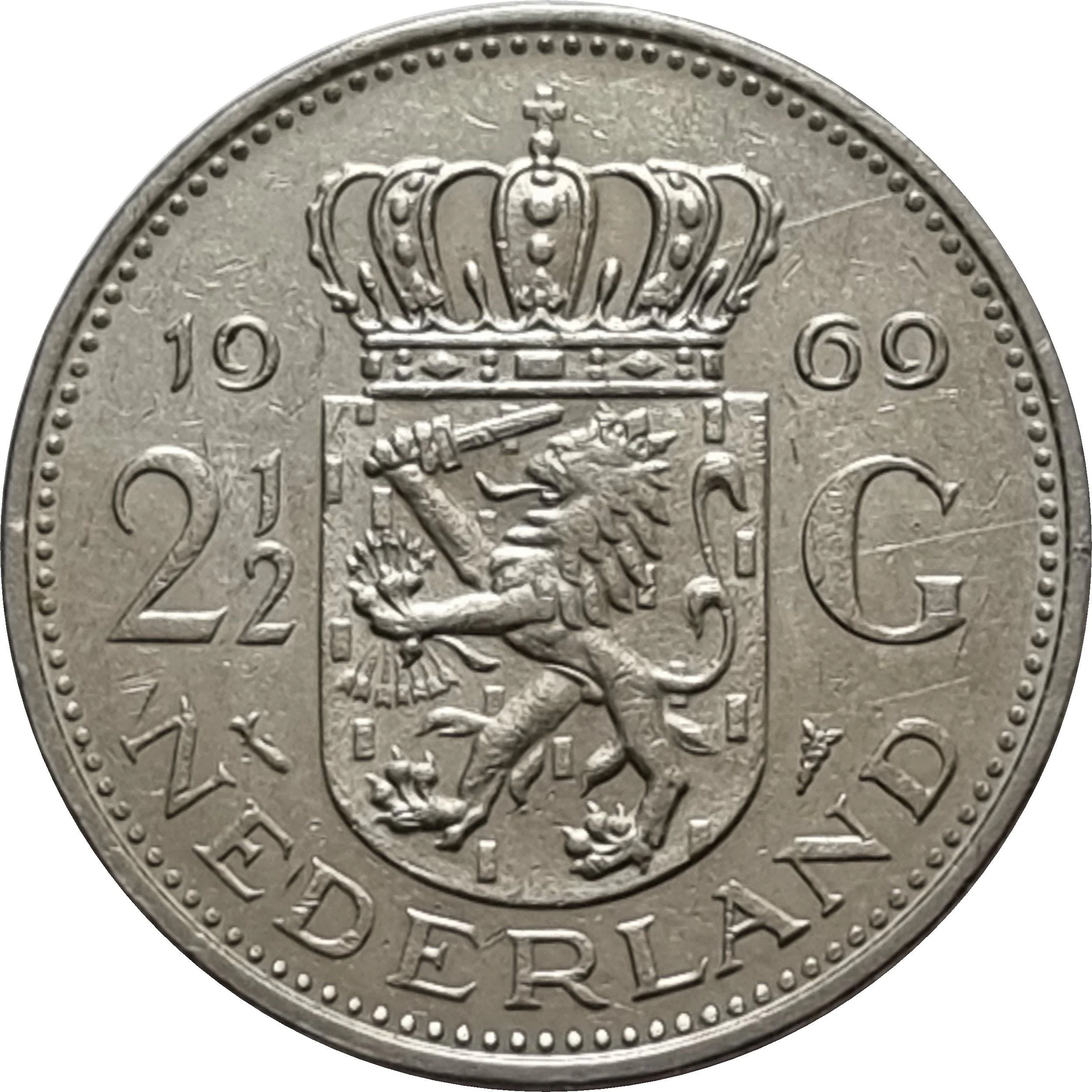
Reverse
Edge
Plain with incuse lettering
Legend:
★ GOD ★ ZIJ ★ MET ★ ONS
Translation:
God be with us
Language: Dutch
Mints
| Name | Mark |
|---|---|
| Royal Dutch Mint | — |
Mintings
| Year | Mint Mark | Mintage | Quality | Collection |
|---|---|---|---|---|
| 1969 | — | 15,600,000 | ||
| 1969 | — | 500 | Proof | |
| 1970 | — | 500 | Proof | |
| 1970 | — | 22,000,000 | ||
| 1971 | — | 8,000,000 | ||
| 1971 | — | 500 | Proof | |
| 1972 | — | 500 | Proof | |
| 1972 | — | 20,000,000 | ||
| 1973 | — | 500 | Proof | |
| 1974 | — | 500 | Proof | |
| 1975 | — | 500 | Proof | |
| 1976 | — | 500 | Proof | |
| 1977 | — | 500 | Proof | |
| 1978 | — | 5,000,000 | ||
| 1978 | — | 500 | Proof | |
| 1979 | — | 500 | Proof | |
| 1980 | — | 37,300,000 | ||
| 1980 | — | 500 | Proof |
Historical background
In 1969, the Netherlands operated within the Bretton Woods system of fixed exchange rates, with the Dutch guilder officially pegged to the US dollar. This system, established after World War II, required the De Nederlandsche Bank (DNB) to maintain the guilder's value within a narrow band. However, the period was marked by significant international monetary strain, primarily due to persistent US balance-of-payments deficits and rising inflation, which undermined confidence in the dollar's gold convertibility. This created recurring speculative pressures on European currencies, including the guilder, which was considered one of the continent's strongest.
Domestically, the Netherlands experienced robust economic growth and low unemployment, but this was accompanied by rising wage demands and inflationary pressures—a phenomenon common in the late 1960s. The strong guilder, a point of national pride and a symbol of monetary stability, began to be seen by some exporters as a slight handicap, making Dutch goods more expensive abroad. Nevertheless, the prevailing policy orthodoxy, led by the influential DNB President Jelle Zijlstra, was unwavering commitment to the fixed parity and price stability, prioritizing this over potential short-term competitive advantages.
The year 1969 was a calm before the storm. While the German Deutsche Mark faced intense speculation and was revalued in October, the guilder remained stable, bolstered by the Netherlands' strong current account surplus and conservative fiscal policies. However, the tensions within Bretton Woods were becoming untenable. The events of 1969 set the stage for the monetary crises of the early 1970s, which would ultimately lead to the collapse of the Bretton Woods system itself. In 1971, following the US suspension of dollar-gold convertibility, the guilder, along with other major currencies, would eventually be set afloat in a new era of managed exchange rate flexibility.
Domestically, the Netherlands experienced robust economic growth and low unemployment, but this was accompanied by rising wage demands and inflationary pressures—a phenomenon common in the late 1960s. The strong guilder, a point of national pride and a symbol of monetary stability, began to be seen by some exporters as a slight handicap, making Dutch goods more expensive abroad. Nevertheless, the prevailing policy orthodoxy, led by the influential DNB President Jelle Zijlstra, was unwavering commitment to the fixed parity and price stability, prioritizing this over potential short-term competitive advantages.
The year 1969 was a calm before the storm. While the German Deutsche Mark faced intense speculation and was revalued in October, the guilder remained stable, bolstered by the Netherlands' strong current account surplus and conservative fiscal policies. However, the tensions within Bretton Woods were becoming untenable. The events of 1969 set the stage for the monetary crises of the early 1970s, which would ultimately lead to the collapse of the Bretton Woods system itself. In 1971, following the US suspension of dollar-gold convertibility, the guilder, along with other major currencies, would eventually be set afloat in a new era of managed exchange rate flexibility.
🌱 Very Common