

1 Cent – Cayman Islands
United Kingdom
Context
Years: 1992–1996
Country: United Kingdom 
Issuer: Cayman Islands 
Issuing organization: Cayman Islands Currency Board
Ruler: Elizabeth II
Currency:
(since 1972)
Total mintage: 8,000,000
Material
References
KM: #Click to copy to clipboard87a
Numista: #7365
Value
Exchange value: 0.01 KYD
Inflation-adjusted value: 0.03 KYD
Obverse
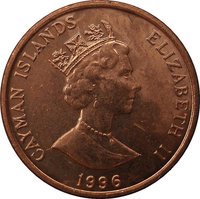
Description:
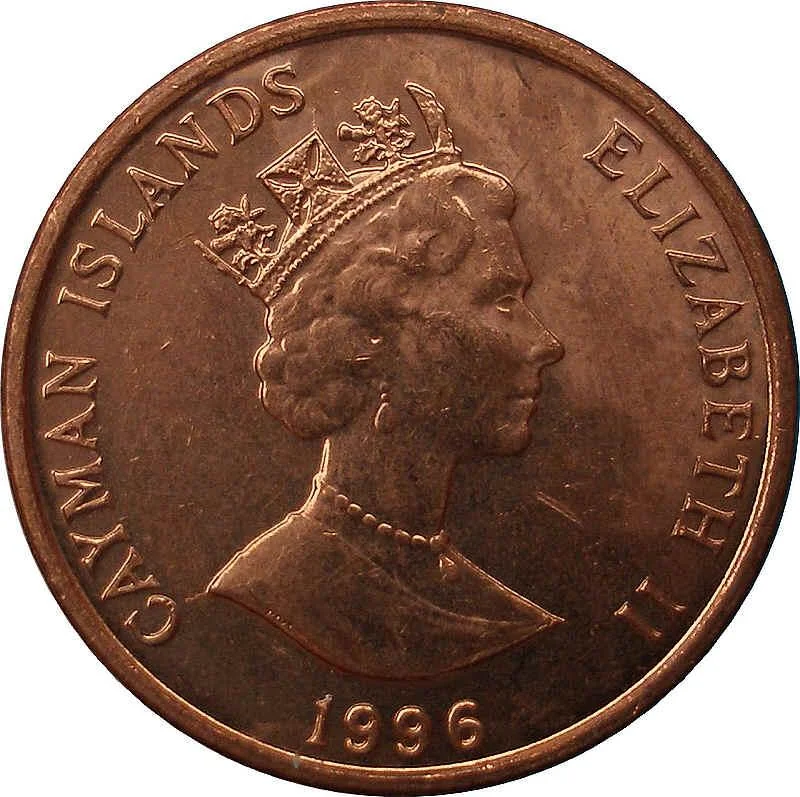
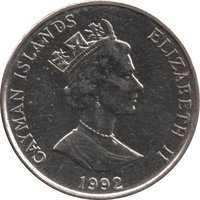
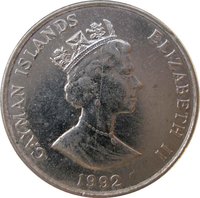
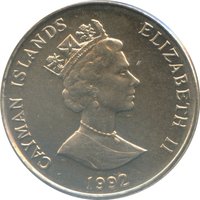
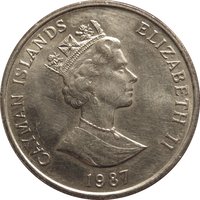
Queen Elizabeth III crowned right, wearing George IV State Diadem, legend around, date below.
Inscription:
CAYMAN ISLANDS ELIZABETH II
1992
RDM
1992
RDM
Script: Latin
Engraver: Raphael David Maklouf
Reverse
Edge
Plain
Mints
| Name | Mark |
|---|---|
| Royal Mint | — |
Mintings
| Year | Mint Mark | Mintage | Quality | Collection |
|---|---|---|---|---|
| 1992 | — | — | ||
| 1996 | — | 8,000,000 |
Historical background
In 1992, the currency situation in the Cayman Islands was characterized by stability and a firm commitment to its long-standing peg to the United States dollar. Since 1972, the Cayman Islands Dollar (KYD) had been officially fixed at a rate of CI$1.00 = US$1.20, a unique valuation that made it one of the few currencies in the world consistently worth more than the US dollar. This parity was strictly maintained by the Cayman Islands Currency Board, the predecessor to the Cayman Islands Monetary Authority, which held full foreign exchange reserves to back the entire domestic currency issue, ensuring unwavering confidence in its convertibility.
This monetary framework was a cornerstone of the territory's burgeoning development as a premier offshore financial centre. The fixed exchange rate, combined with the absence of direct taxation and political stability, provided a predictable and secure environment for international banking, captive insurance, and investment funds. By 1992, the financial services sector was well-established as the dominant pillar of the economy, and the strong, dollar-pegged currency was essential for facilitating the vast cross-border transactions and capital flows that defined the industry.
Consequently, there were no significant currency crises or debates about monetary policy shift in 1992. The system functioned precisely as intended, insulating the local economy from exchange rate volatility and inflation. The year was one of quiet continuity, reinforcing the islands' reputation for financial reliability. Discussions were more focused on consolidating the regulatory framework for the financial sector rather than on altering the successful currency peg, which was universally viewed as a critical asset for the nation's economic prosperity.
This monetary framework was a cornerstone of the territory's burgeoning development as a premier offshore financial centre. The fixed exchange rate, combined with the absence of direct taxation and political stability, provided a predictable and secure environment for international banking, captive insurance, and investment funds. By 1992, the financial services sector was well-established as the dominant pillar of the economy, and the strong, dollar-pegged currency was essential for facilitating the vast cross-border transactions and capital flows that defined the industry.
Consequently, there were no significant currency crises or debates about monetary policy shift in 1992. The system functioned precisely as intended, insulating the local economy from exchange rate volatility and inflation. The year was one of quiet continuity, reinforcing the islands' reputation for financial reliability. Discussions were more focused on consolidating the regulatory framework for the financial sector rather than on altering the successful currency peg, which was universally viewed as a critical asset for the nation's economic prosperity.
🌱 Very Common