

5 escudos – Portugal
Add to wishlist
Circulating commemorative coins
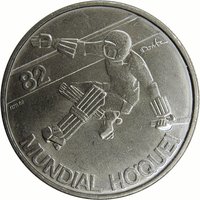
Commemoration: World Roller Hockey Championship Games
Series: System 1981-2001
Portugal
Context
Year: 1982
Issuer: Portugal
Period:
(since 1974)
Currency:
(1911—2001)
Demonetized: Yes
Total mintage: 1,990,000
Material
Diameter: 24.5 mm
Weight: 7 g
Thickness: 2 mm
Shape: Round
Composition: Copper-nickel
Technique: Milled
Alignment: Coin alignment
flip
References
KM: #
Numista: #7337
Value
Exchange value: 5 PTE
Inflation-adjusted value: 53.79 PTE
Obverse
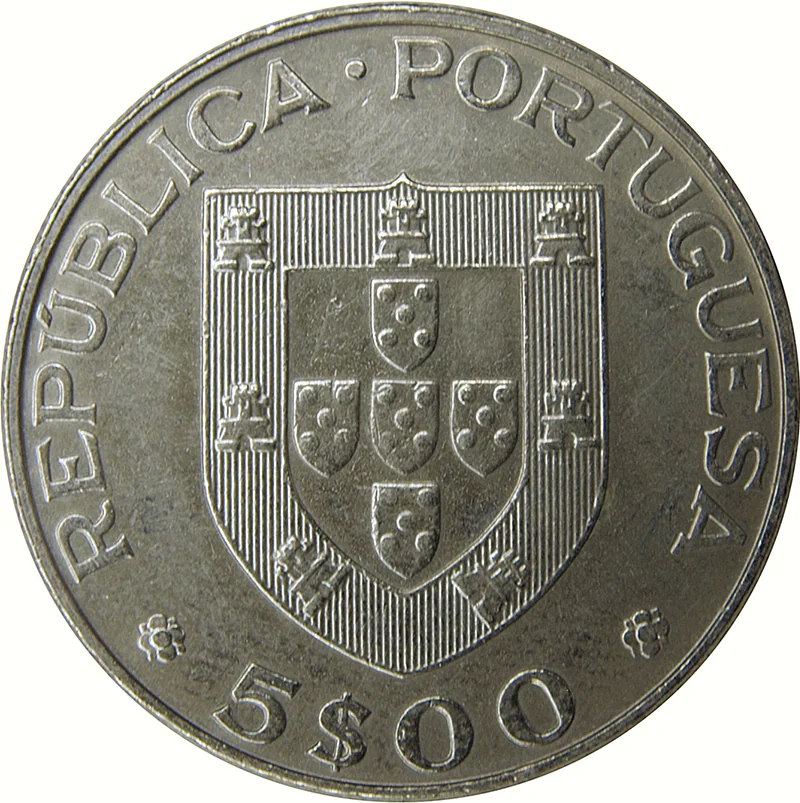
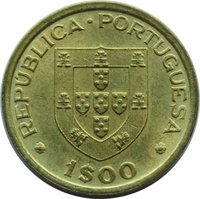
Description:
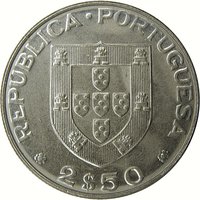
Portuguese shield encircled by lettering.
Inscription:
REPÚBLICA PORTUGUESA
5$00
5$00
Translation:
Portuguese Republic
5$00
5$00
Script: Latin
Language: Portuguese
Engraver: Marcelino Norte de Almeida
Reverse
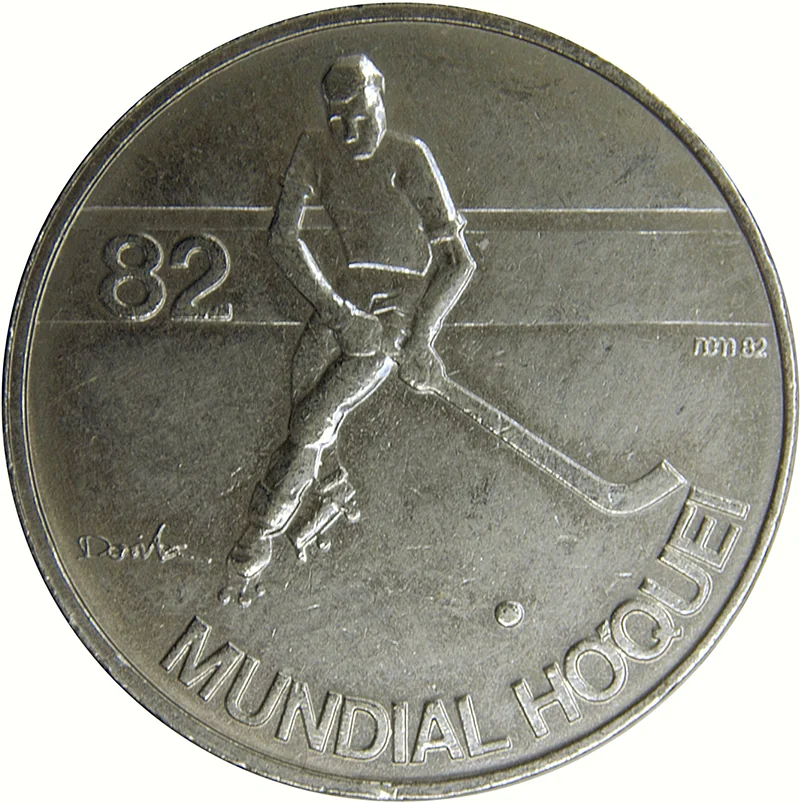
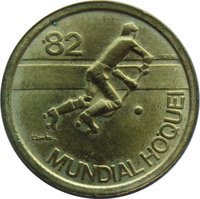
Description:
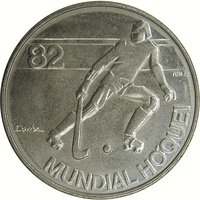
Charging forward.
Inscription:
82
incm 82
Dorita
MUNDIAL HÓQUEI
incm 82
Dorita
MUNDIAL HÓQUEI
Translation:
World Cup Hockey
Script: Latin
Languages: Spanish, Portuguese
Engraver: Dorita Castal-Branco
Edge
Reeded
Categories
| Symbols> Coat of Arms |
Mints
| Name | Mark |
|---|---|
| Imprensa Nacional - Casa da Moeda | — |
Mintings
| Year | Mint Mark | Mintage | Quality | Collection |
|---|---|---|---|---|
| 1982 | — | 1,990,000 |
Historical background
In 1982, Portugal’s currency situation was defined by its recent transition to democracy and its struggle with economic instability. Following the 1974 Carnation Revolution, the country faced high inflation, large public deficits, and a burdensome external debt. The national currency, the Portuguese escudo (PTE), was under significant pressure, managed within a crawling peg system that allowed for periodic devaluations to maintain export competitiveness. These devaluations, however, imported inflation and eroded purchasing power, creating a challenging cycle for economic policymakers.
The broader context was Portugal's preparation for European Economic Community (EEC) membership, which it would join in 1986. This goal necessitated greater monetary stability and alignment with European partners. Consequently, 1982 was a year of austerity and structural adjustment under a stabilization program agreed with the International Monetary Fund (IMF). The government implemented strict measures, including credit controls, fiscal tightening, and wage restraints, aimed at reducing the balance of payments deficit and curbing inflation, which exceeded 20% annually.
Ultimately, the currency policy of 1982 was a difficult balancing act. The deliberate devaluation of the escudo sought to protect the fragile industrial sector and boost exports, but at the cost of living standards for the Portuguese people. This period represented a painful but necessary phase of convergence, laying the groundwork for the eventual integration into the European Monetary System and, decades later, the adoption of the euro. The escudo's managed decline was a tool to navigate the immediate crisis while steering the economy toward its European future.
The broader context was Portugal's preparation for European Economic Community (EEC) membership, which it would join in 1986. This goal necessitated greater monetary stability and alignment with European partners. Consequently, 1982 was a year of austerity and structural adjustment under a stabilization program agreed with the International Monetary Fund (IMF). The government implemented strict measures, including credit controls, fiscal tightening, and wage restraints, aimed at reducing the balance of payments deficit and curbing inflation, which exceeded 20% annually.
Ultimately, the currency policy of 1982 was a difficult balancing act. The deliberate devaluation of the escudo sought to protect the fragile industrial sector and boost exports, but at the cost of living standards for the Portuguese people. This period represented a painful but necessary phase of convergence, laying the groundwork for the eventual integration into the European Monetary System and, decades later, the adoption of the euro. The escudo's managed decline was a tool to navigate the immediate crisis while steering the economy toward its European future.
Series: System 1981-2001
🌱 Very Common