

2.50 escudos – Portugal
Add to wishlist
Portugal
Context
Year: 1983
Issuer: Portugal
Period:
(since 1974)
Currency:
(1911—2001)
Demonetized: Yes
Total mintage: 995,000
Material
Diameter: 20 mm
Weight: 3.5 g
Thickness: 1.6 mm
Shape: Round
Composition: Copper-nickel
Technique: Milled
Alignment: Coin alignment
flip
References
KM: #
Numista: #9829
Value
Exchange value: 2.5 PTE
Inflation-adjusted value: 22.10 PTE
Obverse
Description:
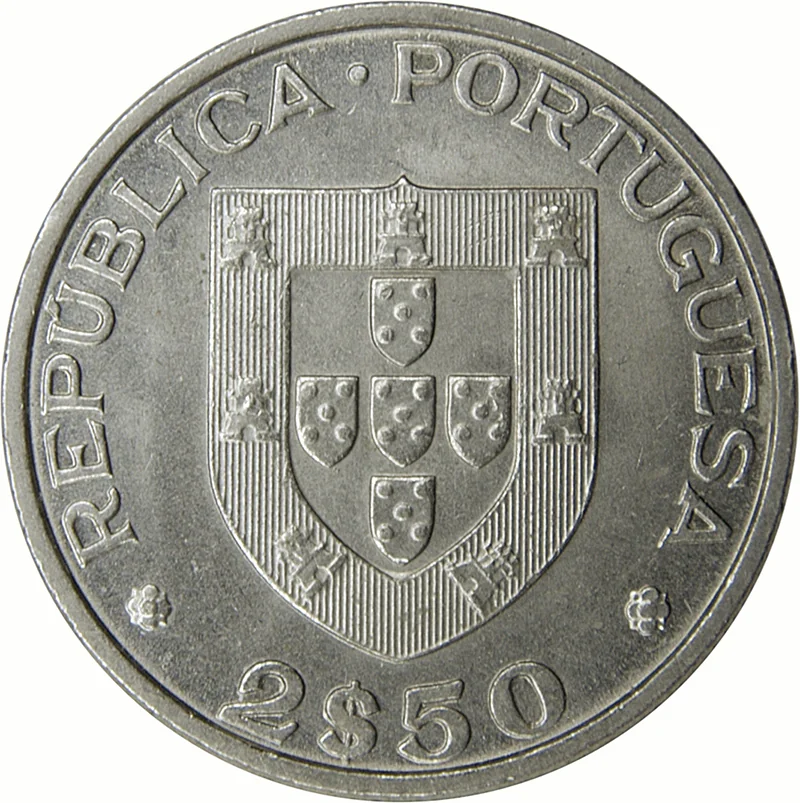
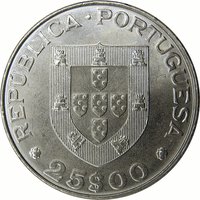
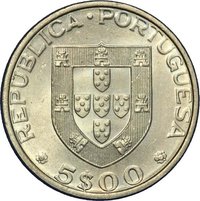
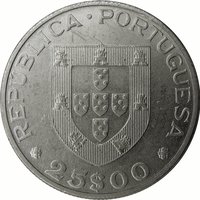
Lesser Coat of Arms: the Portuguese shield with five escutcheons in a cross and seven castles.
Inscription:
REPUBLICA PORTUGUESA
2$50
2$50
Translation:
Portuguese Republic
2.50 Escudos
2.50 Escudos
Script: Latin
Language: Portuguese
Engraver: Marcelino Norte de Almeida
Reverse
Edge
Reeded
Categories
| Symbols> Coat of Arms |
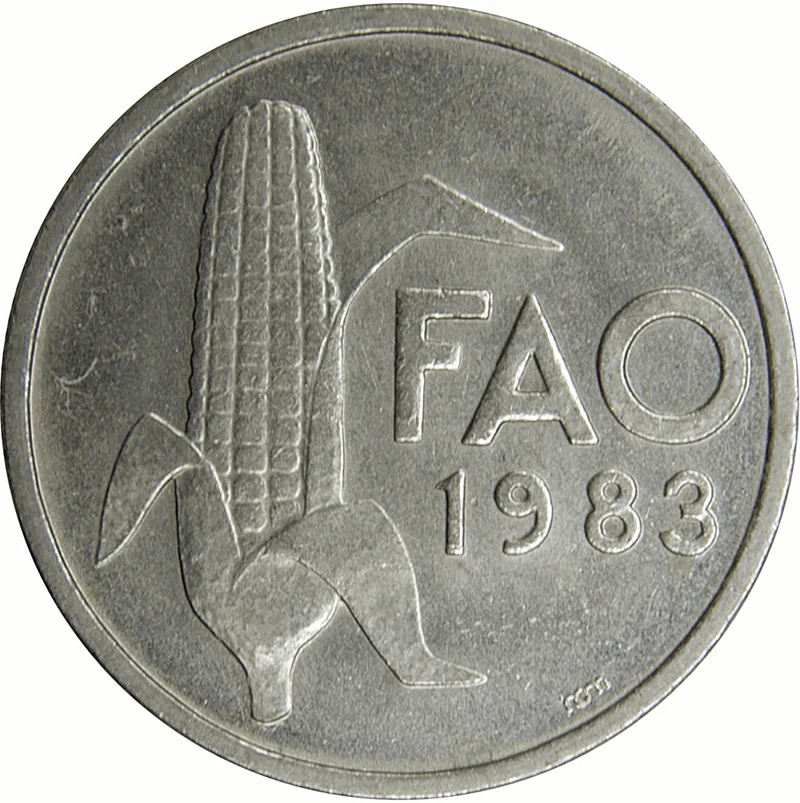
| Organization> FAO |
Mints
| Name | Mark |
|---|---|
| Imprensa Nacional - Casa da Moeda | — |
Mintings
| Year | Mint Mark | Mintage | Quality | Collection |
|---|---|---|---|---|
| 1983 | — | 995,000 |
Historical background
In 1983, Portugal was in the midst of a severe economic and political crisis, with its currency, the escudo, under immense pressure. The country was grappling with the destabilizing aftermath of the 1974 Carnation Revolution, which had ushered in a period of nationalization, agrarian reform, and social upheaval. Two oil shocks had exposed the structural weaknesses of Portugal's economy, leading to soaring inflation, large budget deficits, and a massive external debt burden. This precarious situation eroded confidence in the escudo, prompting rampant capital flight and placing it under persistent devaluation risk.
The currency's instability was a central concern for the center-right coalition government led by Prime Minister Francisco Pinto Balsemão, and later from June 1983 by the broad "Central Bloc" coalition under Prime Minister Mário Soares. To defend the escudo and stabilize the economy, the government maintained a crawling peg exchange rate regime, where the currency was periodically devalued by small, pre-announced amounts against a basket of currencies. However, this system struggled to keep pace with Portugal's high inflation, which consistently outstripped that of its major trading partners, eroding competitiveness and worsening the trade deficit.
This untenable currency situation forced a major policy shift. In October 1983, the Soares government, facing depleted foreign reserves, applied for membership in the European Monetary System (EMS) and, crucially, sought a stabilization loan from the International Monetary Fund (IMF). The subsequent IMF agreement imposed strict austerity measures, including further escudo devaluations, sharp cuts in public spending, and wage controls. These painful steps, while socially difficult, were the prelude to deeper European integration, setting Portugal on a path toward eventual euro adoption and ending the era of chronic escudo vulnerability.
The currency's instability was a central concern for the center-right coalition government led by Prime Minister Francisco Pinto Balsemão, and later from June 1983 by the broad "Central Bloc" coalition under Prime Minister Mário Soares. To defend the escudo and stabilize the economy, the government maintained a crawling peg exchange rate regime, where the currency was periodically devalued by small, pre-announced amounts against a basket of currencies. However, this system struggled to keep pace with Portugal's high inflation, which consistently outstripped that of its major trading partners, eroding competitiveness and worsening the trade deficit.
This untenable currency situation forced a major policy shift. In October 1983, the Soares government, facing depleted foreign reserves, applied for membership in the European Monetary System (EMS) and, crucially, sought a stabilization loan from the International Monetary Fund (IMF). The subsequent IMF agreement imposed strict austerity measures, including further escudo devaluations, sharp cuts in public spending, and wage controls. These painful steps, while socially difficult, were the prelude to deeper European integration, setting Portugal on a path toward eventual euro adoption and ending the era of chronic escudo vulnerability.
Series: System 1981-2001
🌱 Very Common