

Obverse
Description:
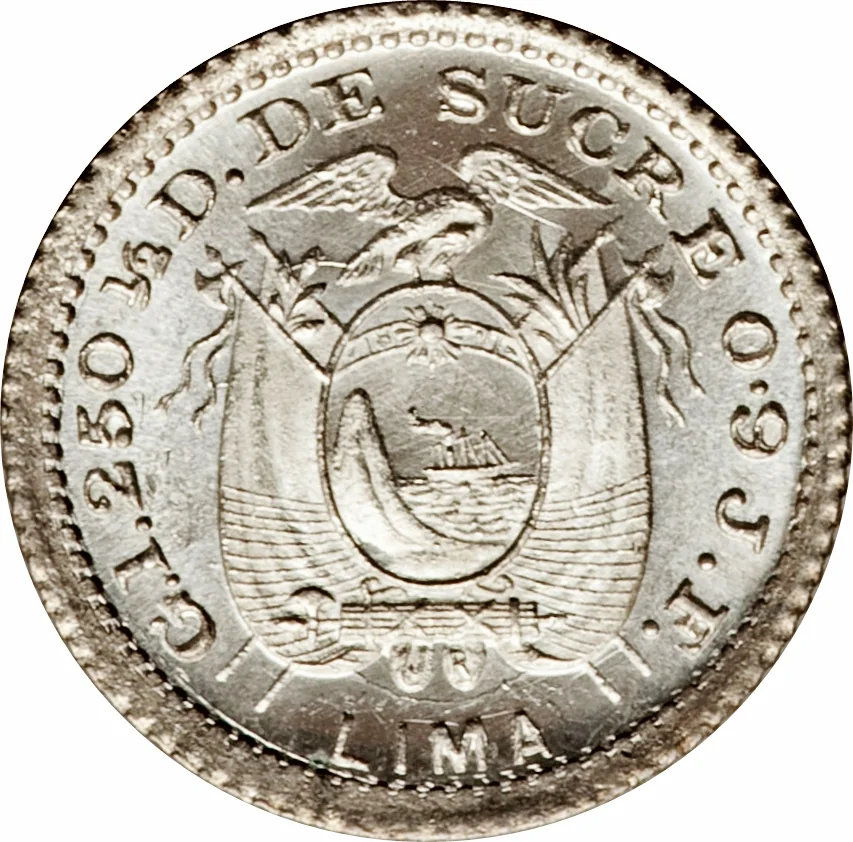
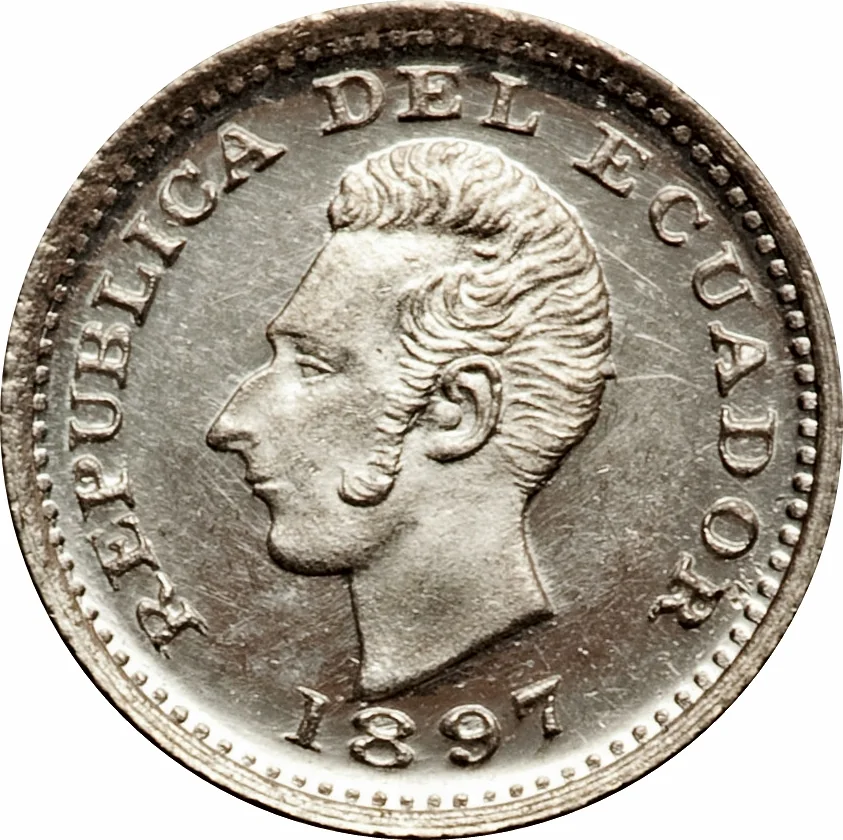
Silver coin details: weight, denomination, purity, mint, and a flag-draped coat of arms.
Inscription:
G.1.250 1/2 D.DE SUCRE 0.9 F.C.
LIMA
or
G.1.250 1/2 D.DE SUCRE 0.9 H.
BIRMṂ
LIMA
or
G.1.250 1/2 D.DE SUCRE 0.9 H.
BIRMṂ
Translation:
Two Hundred and Fifty Grams, One Half Decigram of Sugar, 0.9 Fine.
LIMA
or
Two Hundred and Fifty Grams, One Half Decigram of Sugar, 0.9 Fine.
BIRMṂ
LIMA
or
Two Hundred and Fifty Grams, One Half Decigram of Sugar, 0.9 Fine.
BIRMṂ
Script: Latin
Reverse
Edge
Reeded
Categories
| Symbols> Coat of Arms |
| Person> Politician |
Mints
| Name | Mark |
|---|---|
| Heaton and Sons / The Mint Birmingham | BIRMm |
| Lima | LIMA |
Mintings
Historical background
In 1893, Ecuador was in the midst of a profound and chaotic monetary crisis, a direct consequence of the collapse of the "sucre fuerte" (strong sucre) established just two decades prior. President Gabriel García Moreno had introduced this silver standard in 1871, pegging the sucre to the French franc and creating a period of rare stability. However, following his assassination in 1875, successive liberal governments, facing fiscal shortfalls and political instability, began financing deficits by authorizing private banks to issue their own paper money with insufficient metallic backing. This led to a rapid devaluation of the currency and a loss of public confidence.
The situation by 1893 was characterized by a severe depreciation of the sucre against gold and silver, rampant inflation, and a confusing circulation of multiple private banknotes of dubious value. The government, led by President Luis Cordero, struggled to control the money supply as the proliferation of unbacked banknotes continued. This monetary anarchy crippled foreign trade, as international merchants demanded payment in scarce gold or silver, and created economic hardship for the populace, whose savings in paper currency eroded daily.
This crisis set the stage for a major monetary reform. The pressures of the 1893 situation ultimately compelled the government to seek a radical solution, which would be realized under President Eloy Alfaro with the creation of the Banco del Ecuador in 1894 and, more decisively, the establishment of the Banco Comercial y Agrícola in 1895. These institutions were granted exclusive rights to issue currency, marking the beginning of the end for private banknotes and laying the foundational framework for a centralized and government-controlled monetary system in the years that followed.
The situation by 1893 was characterized by a severe depreciation of the sucre against gold and silver, rampant inflation, and a confusing circulation of multiple private banknotes of dubious value. The government, led by President Luis Cordero, struggled to control the money supply as the proliferation of unbacked banknotes continued. This monetary anarchy crippled foreign trade, as international merchants demanded payment in scarce gold or silver, and created economic hardship for the populace, whose savings in paper currency eroded daily.
This crisis set the stage for a major monetary reform. The pressures of the 1893 situation ultimately compelled the government to seek a radical solution, which would be realized under President Eloy Alfaro with the creation of the Banco del Ecuador in 1894 and, more decisively, the establishment of the Banco Comercial y Agrícola in 1895. These institutions were granted exclusive rights to issue currency, marking the beginning of the end for private banknotes and laying the foundational framework for a centralized and government-controlled monetary system in the years that followed.
🌱 Fairly Common