

Obverse
Description:
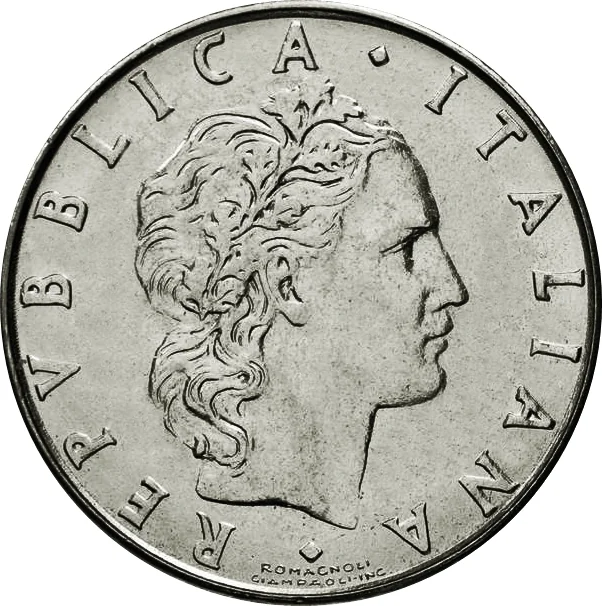
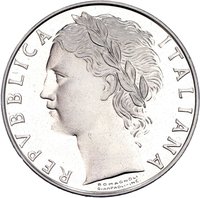
Woman facing right with oak wreath. Names below.
Inscription:
REPVBBLICA·ITALIANA·
ROMAGNOLI
GIAMPAOLI-INC.
ROMAGNOLI
GIAMPAOLI-INC.
Translation:
Italian Republic
Romagnoli
Giampaoli Inc.
Romagnoli
Giampaoli Inc.
Script: Latin
Engraver: Giuseppe Romagnoli
Designer: Pietro Giampaoli
Reverse
Description:
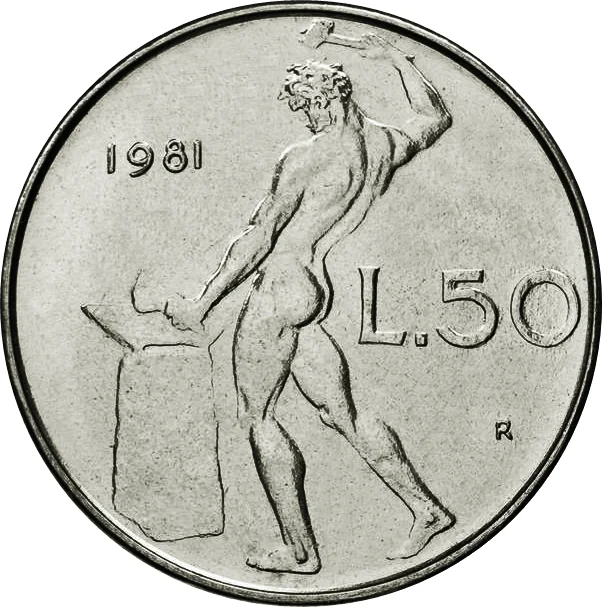
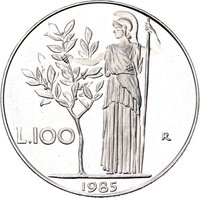
Vulcan forging iron on an anvil. Date left, denomination right, mint mark below.
Inscription:
1981
L.50
R
L.50
R
Script: Latin
Engraver: Giuseppe Romagnoli
Designer: Pietro Giampaoli
Edge
Reeded
Categories
| Mythology |
Mints
| Name | Mark |
|---|---|
| Rome | R |
Mintings
| Year | Mint Mark | Mintage | Quality | Collection |
|---|---|---|---|---|
| 1954 | R | 17,600,000 | ||
| 1955 | R | 70,500,000 | ||
| 1956 | R | 69,400,000 | ||
| 1957 | R | 8,925,000 | ||
| 1958 | R | 825,000 | ||
| 1959 | R | 8,800,000 | ||
| 1960 | R | 2,025,000 | ||
| 1961 | R | 11,100,000 | ||
| 1962 | R | 17,700,000 | ||
| 1963 | R | 31,600,000 | ||
| 1964 | R | 37,900,000 | ||
| 1965 | R | 25,300,000 | ||
| 1966 | R | 27,400,000 | ||
| 1967 | R | 28,000,000 | ||
| 1968 | R | 17,800,000 | ||
| 1969 | R | 310,000 | BU | |
| 1969 | R | 23,010,000 | ||
| 1970 | R | 21,411,000 | ||
| 1971 | R | 32,400,000 | ||
| 1972 | R | 39,000,000 | ||
| 1973 | R | 48,700,000 | ||
| 1974 | R | 63,300,000 | ||
| 1975 | R | — | ||
| 1976 | R | 180,600,000 | ||
| 1977 | R | 293,800,000 | ||
| 1978 | R | 416,808,000 | ||
| 1979 | R | 315,000,000 | ||
| 1980 | R | 94,800,000 | ||
| 1981 | R | 140,000,000 | ||
| 1982 | R | 54,500,000 | ||
| 1983 | R | 20,000,000 | ||
| 1984 | R | 10,000,000 | ||
| 1985 | R | 10,000,000 | ||
| 1985 | R | 20,345 | Proof | |
| 1986 | R | 17,500 | Proof | |
| 1986 | R | 15,000,000 | ||
| 1987 | R | 14,700,000 | ||
| 1987 | R | 10,000 | Proof | |
| 1988 | R | 20,000,000 | ||
| 1988 | R | 9,000 | Proof | |
| 1989 | R | 26,500,000 | ||
| 1989 | R | 9,200 | Proof |
Historical background
In 1954, Italy's currency situation was fundamentally defined by its participation in the European Payments Union (EPU) and the controlled stability of the lira. The post-war "economic miracle" was gaining momentum, fueled by industrial growth and exports, but the lira was not yet a fully convertible currency on the international market. Its exchange rate was fixed at 625 lire to the US dollar, a parity established in 1949 and maintained through strict capital controls managed by the Bank of Italy and the Italian Exchange Office (UIC). This system prevented capital flight and protected the country's growing but still vulnerable foreign exchange reserves.
Domestically, the lira was stable, with low inflation by the standards of the early 1950s. This internal stability was a key achievement of the economic policies of Luigi Einaudi and subsequent governments, which had tamed the hyperinflation of the immediate post-war period. However, this stability was somewhat artificial, underpinned by administrative controls rather than pure market confidence. The economy was increasingly outward-looking, with rising exports from industries like automobiles and machinery, but the non-convertibility of the lira created friction and complexity for international trade settlements, which had to be channeled through the EPU's multilateral clearing system.
Looking forward, 1954 was a year of transition within this controlled framework. Italy was accumulating a strong surplus within the EPU, reflecting its growing economic strength and export competitiveness. This success was building pressure for a move toward greater currency liberalization. The situation set the stage for the critical monetary reforms that would follow later in the decade, culminating in the declaration of external convertibility for the lira for non-residents in 1958, a move that integrated Italy more fully into the budding European common market and the Bretton Woods international monetary system.
Domestically, the lira was stable, with low inflation by the standards of the early 1950s. This internal stability was a key achievement of the economic policies of Luigi Einaudi and subsequent governments, which had tamed the hyperinflation of the immediate post-war period. However, this stability was somewhat artificial, underpinned by administrative controls rather than pure market confidence. The economy was increasingly outward-looking, with rising exports from industries like automobiles and machinery, but the non-convertibility of the lira created friction and complexity for international trade settlements, which had to be channeled through the EPU's multilateral clearing system.
Looking forward, 1954 was a year of transition within this controlled framework. Italy was accumulating a strong surplus within the EPU, reflecting its growing economic strength and export competitiveness. This success was building pressure for a move toward greater currency liberalization. The situation set the stage for the critical monetary reforms that would follow later in the decade, culminating in the declaration of external convertibility for the lira for non-residents in 1958, a move that integrated Italy more fully into the budding European common market and the Bretton Woods international monetary system.
🌱 Very Common