

Obverse
Description:
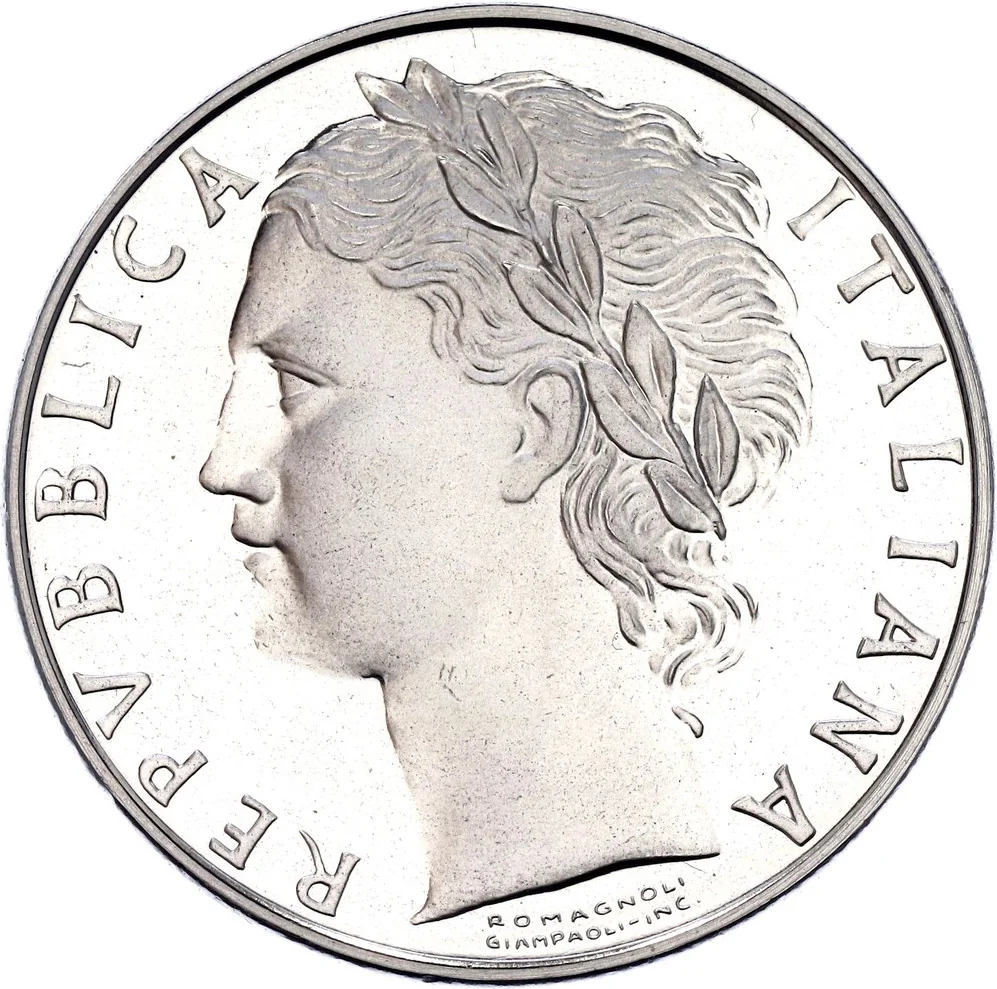
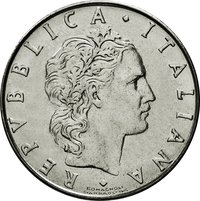
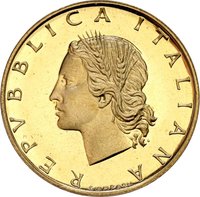
Female laureate head left, flanked by country name. Designer and engraver names below.
Inscription:
REPVBBLICA ITALIANA
ROMAGNOLI
GIAMPAOLI-INC.
ROMAGNOLI
GIAMPAOLI-INC.
Translation:
Italian Republic
Romagnoli
Giampaoli - Inc.
Romagnoli
Giampaoli - Inc.
Script: Latin
Engraver: Pietro Giampaoli
Designer: Giuseppe Romagnoli
Reverse
Description:
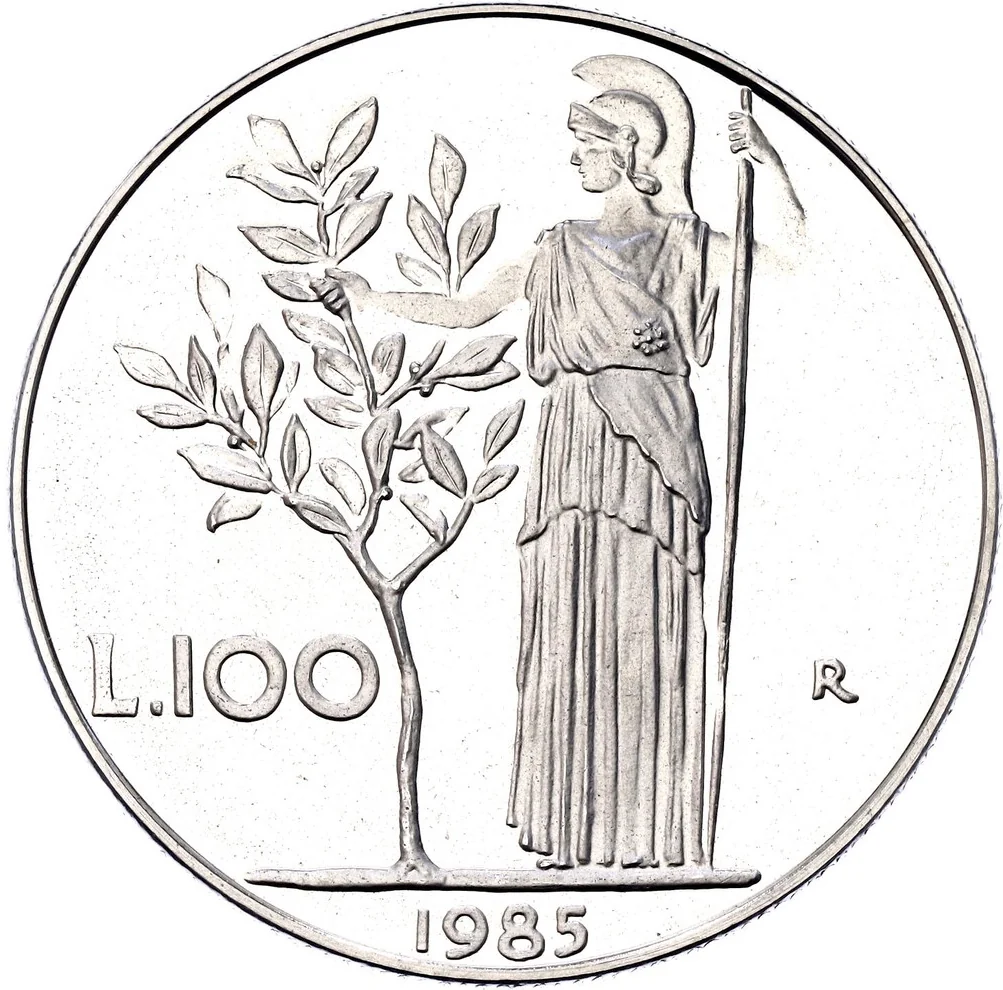
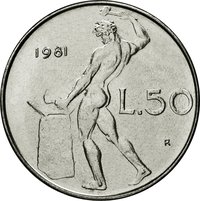
Minerva faces left, her right hand reaching toward an olive tree and her left holding a spear. Value left of the trunk; mintmark right. Date in exergue.
Inscription:
L.100 R
1967
1967
Script: Latin
Engraver: Giuseppe Romagnoli
Edge
Reeded
Mints
| Name | Mark |
|---|---|
| Rome | R |
Mintings
| Year | Mint Mark | Mintage | Quality | Collection |
|---|---|---|---|---|
| 1955 | R | 8,600,000 | ||
| 1956 | R | 99,800,000 | ||
| 1957 | R | 90,600,000 | ||
| 1958 | R | 25,640,000 | ||
| 1959 | R | 19,500,000 | ||
| 1960 | R | 20,700,000 | ||
| 1961 | R | 11,860,000 | ||
| 1962 | R | 21,700,000 | ||
| 1963 | R | 33,100,000 | ||
| 1964 | R | 31,300,000 | ||
| 1965 | R | 36,440,000 | ||
| 1966 | R | 52,500,000 | ||
| 1967 | R | 23,700,000 | ||
| 1968 | R | 34,200,000 | ||
| 1969 | R | 27,710,000 | ||
| 1969 | R | 310,000 | BU | |
| 1970 | R | 25,011,000 | ||
| 1971 | R | 24,900,000 | ||
| 1972 | R | 31,170,000 | ||
| 1973 | R | 30,780,000 | ||
| 1974 | R | 62,000,000 | ||
| 1975 | R | 106,000,000 | ||
| 1976 | R | 160,000,000 | ||
| 1977 | R | 253,980,000 | ||
| 1978 | R | 343,600,000 | ||
| 1979 | R | 351,583,600 | ||
| 1980 | R | 69,938,500 | ||
| 1981 | R | 122,280,000 | ||
| 1982 | R | 39,500,000 | ||
| 1983 | R | 25,000,000 | ||
| 1984 | R | 10,000,000 | ||
| 1985 | R | 10,000,000 | ||
| 1985 | R | 20,345 | Proof | |
| 1986 | R | 18,000,000 | ||
| 1986 | R | 17,500 | Proof | |
| 1987 | R | 10,000 | Proof | |
| 1987 | R | — | ||
| 1988 | R | 23,000,000 | ||
| 1988 | R | 9,000 | Proof | |
| 1989 | R | 9,260 | Proof | |
| 1989 | R | 34,000,000 |
Historical background
In 1955, Italy's currency situation was defined by the postwar "economic miracle" (il miracolo economico), yet remained under the strict control of the Bretton Woods system. The Italian lira was a stable, fixed-exchange-rate currency, pegged at 625 lire to the US dollar under the auspices of the International Monetary Fund. This external stability was crucial for the booming export-led growth, as industries like automotive and appliance manufacturing gained a competitive edge in international markets. Domestically, however, the Bank of Italy maintained a policy of "dear money" (denaro caro), keeping interest rates high to curb inflation and manage the balance of payments, a necessary discipline for a rapidly industrializing nation.
This monetary stability was hard-won, following the severe devaluation and near-collapse of the lira after World War II. The success of the European Payments Union (1950) and Marshall Plan aid had been instrumental in rebuilding reserves and integrating Italy into European trade. By 1955, confidence in the lira was growing, but the economy still exhibited a sharp duality: the prosperous industrial north benefited from strong currency and investment, while the agrarian south lagged behind, with many citizens relying on remittances from emigrants sent in harder foreign currencies.
Looking ahead, the 1955 position was a pivot point. The strong lira and accumulating reserves provided a foundation for further liberalization. In 1958, Italy would declare formal external convertibility of the lira, a major step toward full integration into the global economy and a precursor to the country's role as a founding member of the European Economic Community. Thus, the currency situation in 1955 reflected both the triumphs of postwar reconstruction and the ongoing challenges of balanced national development within a framework of international monetary discipline.
This monetary stability was hard-won, following the severe devaluation and near-collapse of the lira after World War II. The success of the European Payments Union (1950) and Marshall Plan aid had been instrumental in rebuilding reserves and integrating Italy into European trade. By 1955, confidence in the lira was growing, but the economy still exhibited a sharp duality: the prosperous industrial north benefited from strong currency and investment, while the agrarian south lagged behind, with many citizens relying on remittances from emigrants sent in harder foreign currencies.
Looking ahead, the 1955 position was a pivot point. The strong lira and accumulating reserves provided a foundation for further liberalization. In 1958, Italy would declare formal external convertibility of the lira, a major step toward full integration into the global economy and a precursor to the country's role as a founding member of the European Economic Community. Thus, the currency situation in 1955 reflected both the triumphs of postwar reconstruction and the ongoing challenges of balanced national development within a framework of international monetary discipline.
🌱 Very Common