

Obverse
Description:
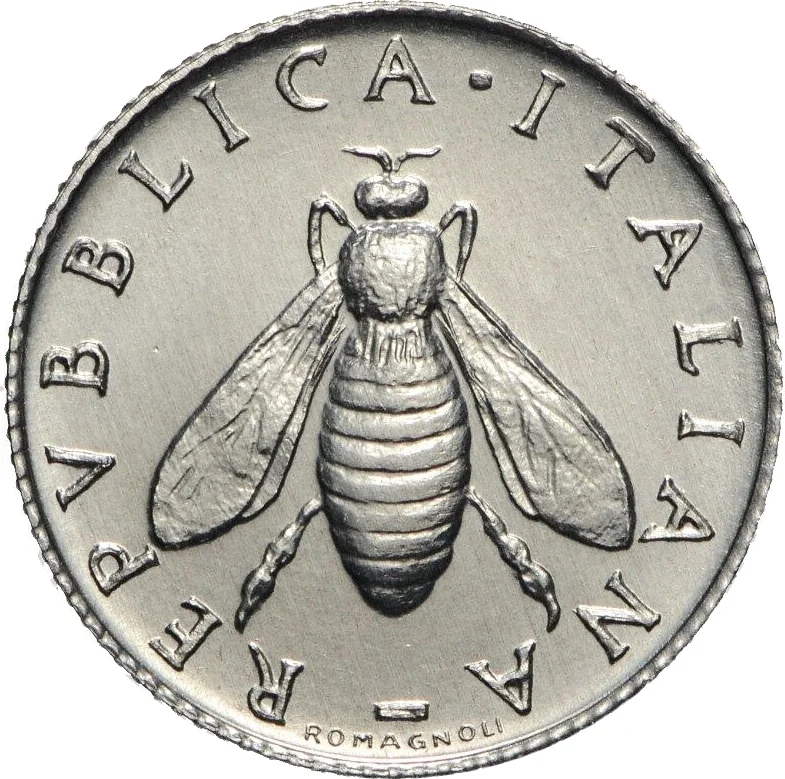
Honey-making insect.
Inscription:
REPVBBLICA · ITALIANA
ROMAGNOLI
ROMAGNOLI
Translation:
Italian Republic
Romagnoli
Romagnoli
Script: Latin
Engraver: Pietro Giampaoli
Designer: Giuseppe Romagnoli
Reverse
Description:
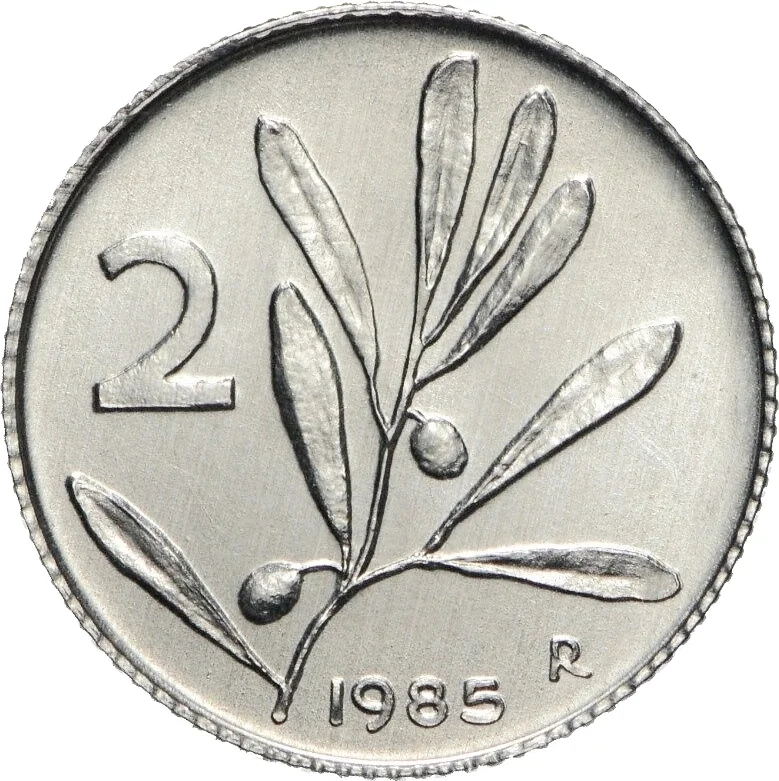
Olive branch. Value left. Mintmark and date right.
Inscription:
2
1985 R
1985 R
Script: Latin
Engraver: Pietro Giampaoli
Designer: Giuseppe Romagnoli
Edge
Reeded
Mints
| Name | Mark |
|---|---|
| Rome | R |
Mintings
| Year | Mint Mark | Mintage | Quality | Collection |
|---|---|---|---|---|
| 1953 | R | 4,125,000 | ||
| 1954 | R | 22,500,000 | ||
| 1955 | R | 2,750,000 | ||
| 1956 | R | 1,500,050 | ||
| 1957 | R | 6,312,500 | ||
| 1958 | R | 125,000 | ||
| 1959 | R | 2,000,000 | ||
| 1968 | R | 100,000 | BU | |
| 1969 | R | 310,000 | BU | |
| 1970 | R | 1,140,000 | BU | |
| 1980 | R | 257,272 | BU | |
| 1981 | R | 162,794 | BU | |
| 1982 | R | 119,950 | BU | |
| 1983 | R | 76,552 | BU | |
| 1984 | R | 77,041 | BU | |
| 1985 | R | 93,218 | BU | |
| 1985 | R | 20,345 | Proof | |
| 1986 | R | 17,500 | Proof | |
| 1986 | R | 73,200 | BU | |
| 1987 | R | 10,000 | Proof | |
| 1987 | R | 57,500 | BU | |
| 1988 | R | 51,050 | BU | |
| 1988 | R | 9,000 | Proof | |
| 1989 | R | 51,200 | BU | |
| 1989 | R | 9,260 | Proof | |
| 1990 | R | 52,300 | BU | |
| 1990 | R | 9,400 | Proof | |
| 1991 | R | 11,000 | Proof | |
| 1991 | R | 54,000 | BU | |
| 1992 | R | 52,000 | BU | |
| 1992 | R | 9,500 | Proof | |
| 1993 | R | 50,200 | BU | |
| 1993 | R | 8,500 | Proof | |
| 1994 | R | 8,500 | Proof | |
| 1994 | R | 44,500 | BU | |
| 1995 | R | 7,960 | Proof | |
| 1995 | R | 44,558 | BU | |
| 1996 | R | 45,000 | BU | |
| 1996 | R | 8,000 | Proof | |
| 1997 | R | 43,600 | BU | |
| 1997 | R | 8,440 | Proof | |
| 1998 | R | 9,000 | Proof | |
| 1998 | R | 55,200 | BU | |
| 1999 | R | 51,800 | BU | |
| 1999 | R | 8,500 | Proof | |
| 2000 | R | 61,400 | BU | |
| 2000 | R | 8,960 | Proof | |
| 2001 | R | 100,000 | BU | |
| 2001 | R | 10,000 | Proof |
Historical background
In 1953, Italy's currency situation was defined by the Italian Lira (ITL) operating within a complex framework of post-war reconstruction and controlled convertibility. The country was a member of the European Payments Union (EPU), established in 1950, which facilitated multilateral trade and payments among Western European nations without using scarce US dollars. This system was crucial for Italy, as it allowed the lira to be used for settling trade balances with other member countries, helping to stabilize its external position after the volatility of the immediate post-war years. Domestically, the lira's value was managed by the Bank of Italy, with exchange rates fixed but subject to adjustment, reflecting a period of transition from a heavily controlled war economy.
Economically, the period was one of remarkable growth, known as the "Italian economic miracle," which began to accelerate around 1953. Industrial production was rising rapidly, fueled by exports and internal demand. This growth provided underlying strength for the lira, as Italy began to accumulate foreign exchange reserves. However, the currency was not yet fully convertible for all transactions; capital controls remained in place to prevent destabilizing flows of money. Inflation, while a concern, was being managed more effectively than in the late 1940s, contributing to a gradual increase in both domestic and international confidence in the lira's stability.
Despite the positive trends, underlying vulnerabilities persisted. Italy's economic expansion was geographically uneven, creating a stark divide between the industrialized North and the agrarian South. The balance of payments could be sensitive to shifts in trade or remittances from Italian emigrants. Furthermore, the lira's fixed parity within the EPU system meant that Italy's monetary policy was partly influenced by the need to maintain external equilibrium. Thus, while 1953 represented a point of relative stability and growing strength for the lira, it remained within a protected international system, not yet ready for the full convertibility and free capital movements that would come in later decades.
Economically, the period was one of remarkable growth, known as the "Italian economic miracle," which began to accelerate around 1953. Industrial production was rising rapidly, fueled by exports and internal demand. This growth provided underlying strength for the lira, as Italy began to accumulate foreign exchange reserves. However, the currency was not yet fully convertible for all transactions; capital controls remained in place to prevent destabilizing flows of money. Inflation, while a concern, was being managed more effectively than in the late 1940s, contributing to a gradual increase in both domestic and international confidence in the lira's stability.
Despite the positive trends, underlying vulnerabilities persisted. Italy's economic expansion was geographically uneven, creating a stark divide between the industrialized North and the agrarian South. The balance of payments could be sensitive to shifts in trade or remittances from Italian emigrants. Furthermore, the lira's fixed parity within the EPU system meant that Italy's monetary policy was partly influenced by the need to maintain external equilibrium. Thus, while 1953 represented a point of relative stability and growing strength for the lira, it remained within a protected international system, not yet ready for the full convertibility and free capital movements that would come in later decades.
🌱 Very Common