

100 lire – Italy
Add to wishlist
Circulating commemorative coins
Commemoration: FAO
Italy
Context
Material
References
KM: #
Numista: #723
Value
Exchange value: 100 ITL
Inflation-adjusted value: 810.80 ITL
Obverse
Description:
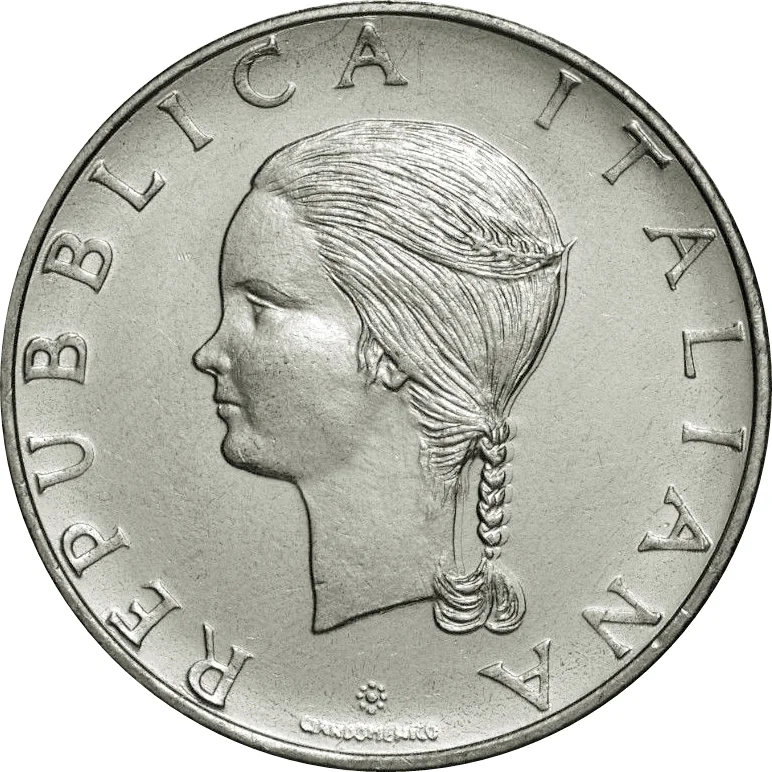
Left-facing young woman with a braid and wheat sprigs (Ceres). Country above, engraver and a flower below.
Inscription:
REPUBBLICA ITALIANA
GIANDOMENICO
GIANDOMENICO
Translation:
Italian Republic
Giandomenico
Giandomenico
Script: Latin
Language: Italian
Engraver: Sergio Giandomenico
Reverse
Description:
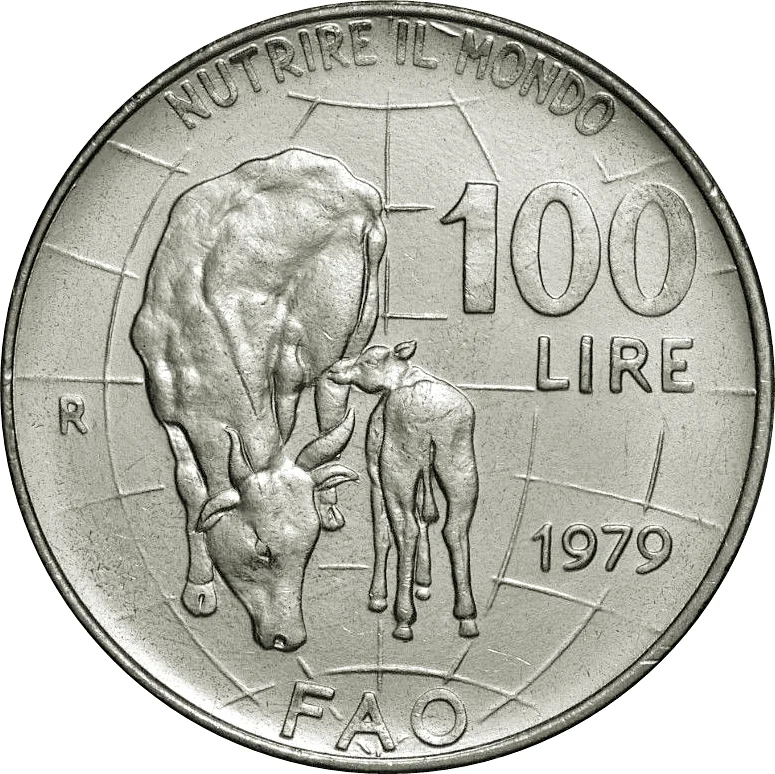
Left: cow nursing calf, mintmark near rim. Right: value on two lines, date. Background: global meridians and parallels.
Inscription:
NUTRIRE IL MONDO
100
LIRE
R
1979
FAO
100
LIRE
R
1979
FAO
Translation:
FEED THE WORLD
100
LIRE
R
1979
FAO
100
LIRE
R
1979
FAO
Script: Latin
Language: Italian
Engraver: Sergio Giandomenico
Edge
Reeded
Categories
| Animal> Cow |
| Organization> FAO |
Mints
| Name | Mark |
|---|---|
| Rome | R |
Mintings
| Year | Mint Mark | Mintage | Quality | Collection |
|---|---|---|---|---|
| 1979 | R | 78,340,000 |
Historical background
In 1979, Italy’s currency situation was defined by its participation in the European Monetary System (EMS), launched that March. The EMS aimed to create a "zone of monetary stability" in Europe by reducing exchange rate fluctuations between member currencies. Italy, with its historically weak and inflation-prone lira, joined but under a special concession: it was allowed a wider fluctuation band of ±6%, compared to the ±2.25% band for stronger currencies like the German Deutsche Mark. This reflected the acknowledged fragility of the lira and the significant economic challenges Italy faced.
Domestically, these challenges were severe. Italy was grappling with persistently high inflation, which peaked at around 21% in 1980, driven by the second oil shock and powerful wage-indexation mechanisms (scala mobile). The country also carried a massive public debt and faced chronic political instability. These factors placed the lira under constant downward pressure, as markets doubted Italy's ability to maintain its EMS parity. Maintaining the lira within its band required frequent and costly interventions by the Banca d'Italia, draining foreign currency reserves and keeping interest rates high.
Thus, the lira in 1979 was caught in a tense duality. On one hand, Italy was formally committed to European monetary discipline and stability through the EMS, a political choice to anchor its economy to stronger partners. On the other, its domestic economic reality made it the system's weakest link, testing the very mechanisms of the EMS. This precarious position foreshadowed the recurring crises that would force multiple lira devaluations within the EMS throughout the 1980s and early 1990s, ultimately leading to its exit in 1992.
Domestically, these challenges were severe. Italy was grappling with persistently high inflation, which peaked at around 21% in 1980, driven by the second oil shock and powerful wage-indexation mechanisms (scala mobile). The country also carried a massive public debt and faced chronic political instability. These factors placed the lira under constant downward pressure, as markets doubted Italy's ability to maintain its EMS parity. Maintaining the lira within its band required frequent and costly interventions by the Banca d'Italia, draining foreign currency reserves and keeping interest rates high.
Thus, the lira in 1979 was caught in a tense duality. On one hand, Italy was formally committed to European monetary discipline and stability through the EMS, a political choice to anchor its economy to stronger partners. On the other, its domestic economic reality made it the system's weakest link, testing the very mechanisms of the EMS. This precarious position foreshadowed the recurring crises that would force multiple lira devaluations within the EMS throughout the 1980s and early 1990s, ultimately leading to its exit in 1992.
🌱 Very Common