

200 lire – Italy
Add to wishlist
Circulating commemorative coins
Commemoration: FAO - International Women's Year
Series: International Women's Year
Italy
Context
Material
References
KM: #
Numista: #718
Value
Exchange value: 200 ITL
Inflation-adjusted value: 1412.55 ITL
Obverse
Description:
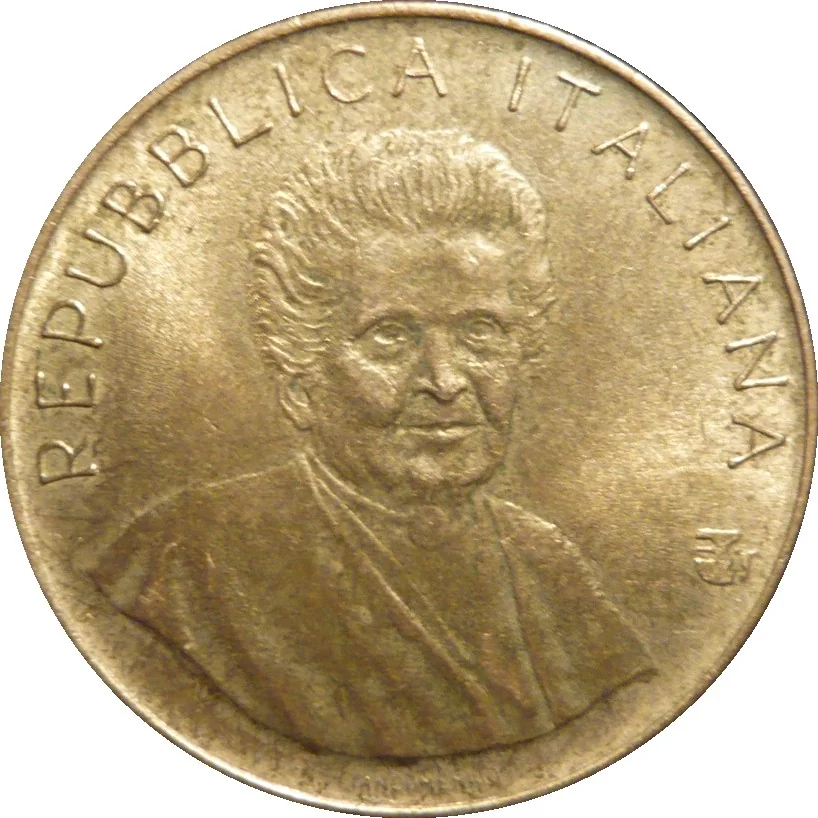
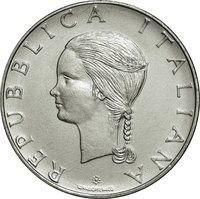
Maria Montessori, bust right. Engraver's name below.
Inscription:
REPUBBLICA ITALIANA
GIANDOMENICO
GIANDOMENICO
Translation:
Italian Republic
Giandomenico
Giandomenico
Script: Latin
Language: Italian
Engraver: Sergio Giandomenico
Reverse
Description:
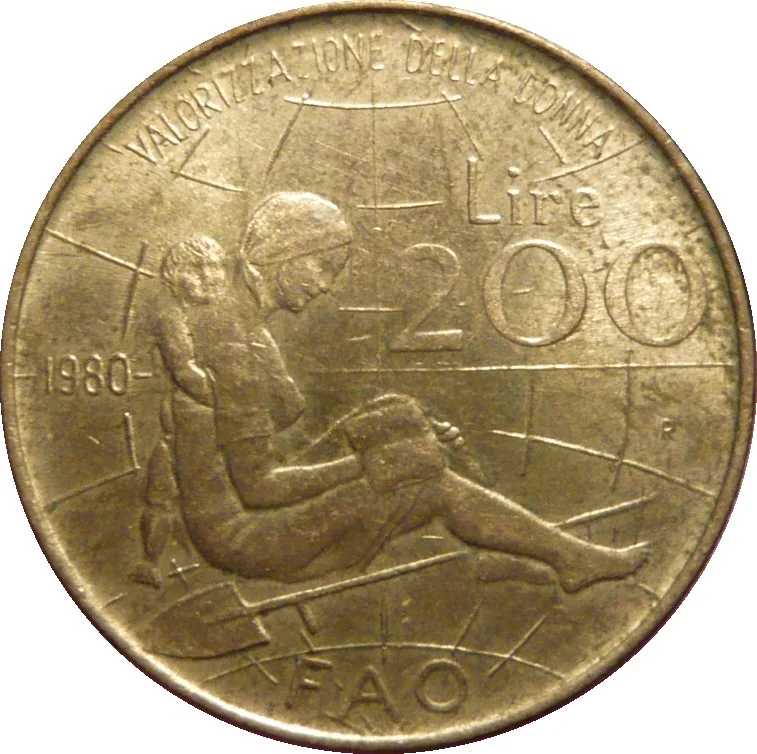
Seated woman reading, child behind, spade below. Globe lines in background. Date left, value and mintmark right.
Inscription:
VALORIZZAZIONE DELLA DONNA
LIRE
200
1980
R
FAO
LIRE
200
1980
R
FAO
Translation:
Valuation of Woman
Lire
200
1980
R
FAO
Lire
200
1980
R
FAO
Script: Latin
Language: Italian
Engraver: Sergio Giandomenico
Edge
Reeded
Categories
| Education |
| Organization> FAO |
Mints
| Name | Mark |
|---|---|
| Rome | R |
Mintings
| Year | Mint Mark | Mintage | Quality | Collection |
|---|---|---|---|---|
| 1980 | R | 48,500,000 |
Historical background
Italy entered the 1980s in a state of profound economic instability, with its currency, the Lira, under severe pressure. The decade prior had been defined by the twin shocks of the 1973 oil crisis and the collapse of the Bretton Woods system, leading to high inflation, rampant public spending, and significant industrial unrest. By 1980, Italy was experiencing "stagflation"—a toxic combination of stagnant economic growth and soaring consumer prices, with inflation peaking at over 21% that year. This environment severely eroded the Lira's value, both domestically and on international markets, placing it among the weakest currencies within the European Monetary System (EMS), a framework designed to reduce exchange rate volatility.
The currency situation was intrinsically linked to Italy's political and fiscal landscape. The government, facing immense social pressure, relied heavily on deficit spending, leading to a rapidly expanding public debt. The Banca d'Italia, under Governor Carlo Azeglio Ciampi, was often forced to raise interest rates dramatically to defend the Lira's official EMS parity and combat inflation, a move that further stifled economic investment. This period was marked by frequent "divergences" and realignments within the EMS, where the Lira was devalued several times against stronger currencies like the German Deutsche Mark, acknowledging its chronic weakness and the country's divergent economic performance from its Northern European partners.
By the end of 1980, the stage was set for a long and painful decade of adjustment. The relentless pressure on the Lira exposed the structural flaws in Italy's economy: an inefficient public sector, a widening north-south divide, and indexation of wages to inflation (scala mobile) that perpetuated a wage-price spiral. While the immediate crisis would see temporary stabilizations, the fundamental vulnerabilities required a harsh policy shift in the coming years, moving towards fiscal austerity and a stronger commitment to European monetary integration, which would ultimately lead to Italy's entry into the Euro decades later.
The currency situation was intrinsically linked to Italy's political and fiscal landscape. The government, facing immense social pressure, relied heavily on deficit spending, leading to a rapidly expanding public debt. The Banca d'Italia, under Governor Carlo Azeglio Ciampi, was often forced to raise interest rates dramatically to defend the Lira's official EMS parity and combat inflation, a move that further stifled economic investment. This period was marked by frequent "divergences" and realignments within the EMS, where the Lira was devalued several times against stronger currencies like the German Deutsche Mark, acknowledging its chronic weakness and the country's divergent economic performance from its Northern European partners.
By the end of 1980, the stage was set for a long and painful decade of adjustment. The relentless pressure on the Lira exposed the structural flaws in Italy's economy: an inefficient public sector, a widening north-south divide, and indexation of wages to inflation (scala mobile) that perpetuated a wage-price spiral. While the immediate crisis would see temporary stabilizations, the fundamental vulnerabilities required a harsh policy shift in the coming years, moving towards fiscal austerity and a stronger commitment to European monetary integration, which would ultimately lead to Italy's entry into the Euro decades later.
Series: International Women's Year


🌱 Very Common