

50 Francs – France
France
Context
Years: 1950–1958
Issuer: France 
Period:
(1946—1958)
Currency:
(1795—1959)
Demonetization: 3 August 1966
Total mintage: 263,401,138
Material
References
KM: #Click to copy to clipboard918
Numista: #712
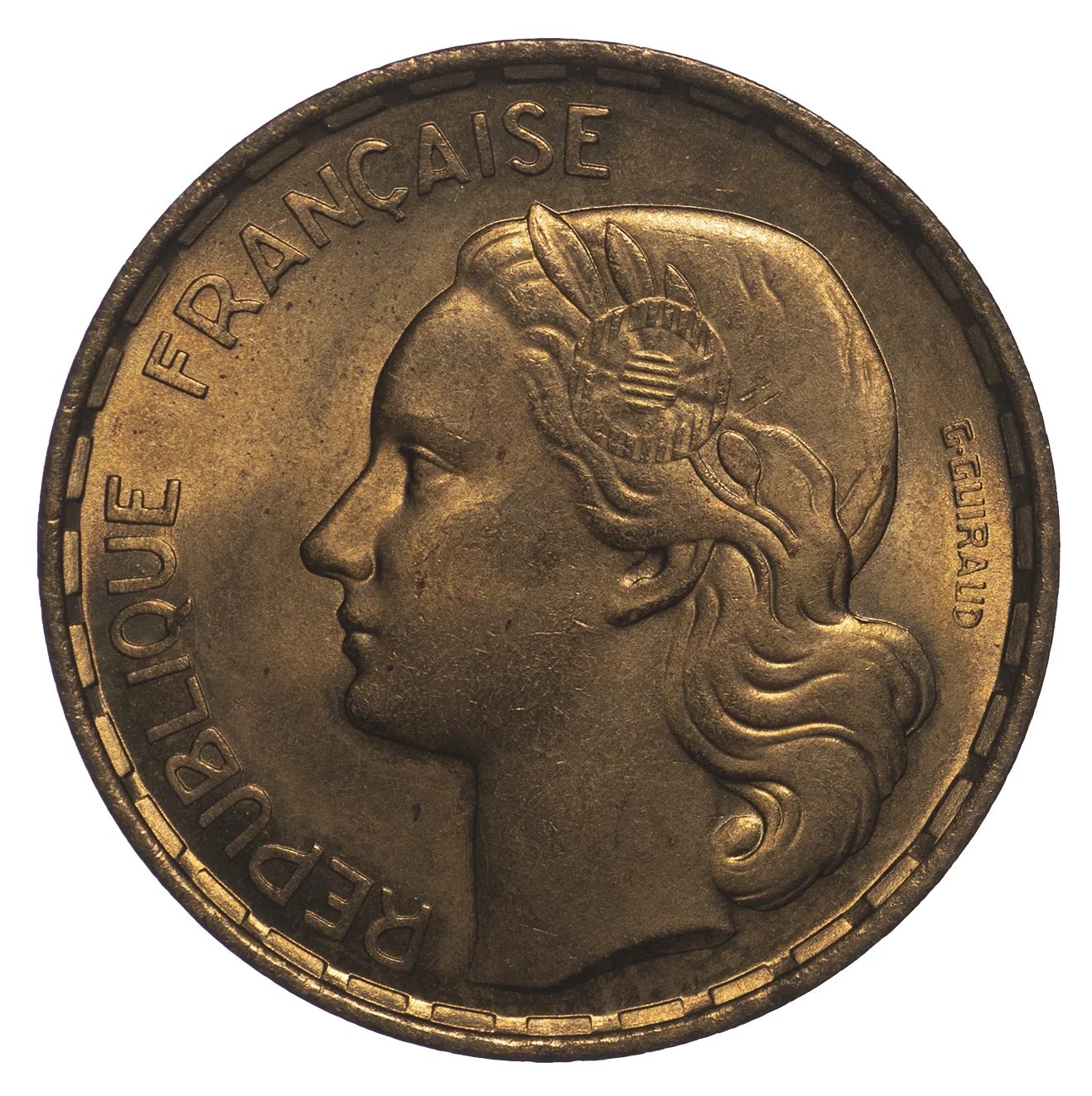
Obverse
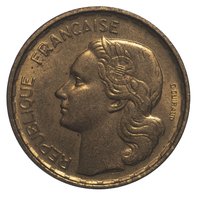
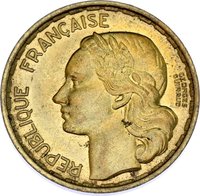
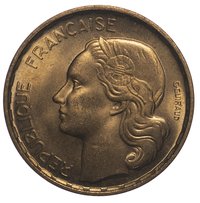
Description:
Designer icon, left profile.
Inscription:
REPUBLIQUE FRANÇAISE G GUIRAUD
Translation:
FRENCH REPUBLIC G GUIRAUD
Script: Latin
Language: French
Engraver: Georges Guiraud
Reverse
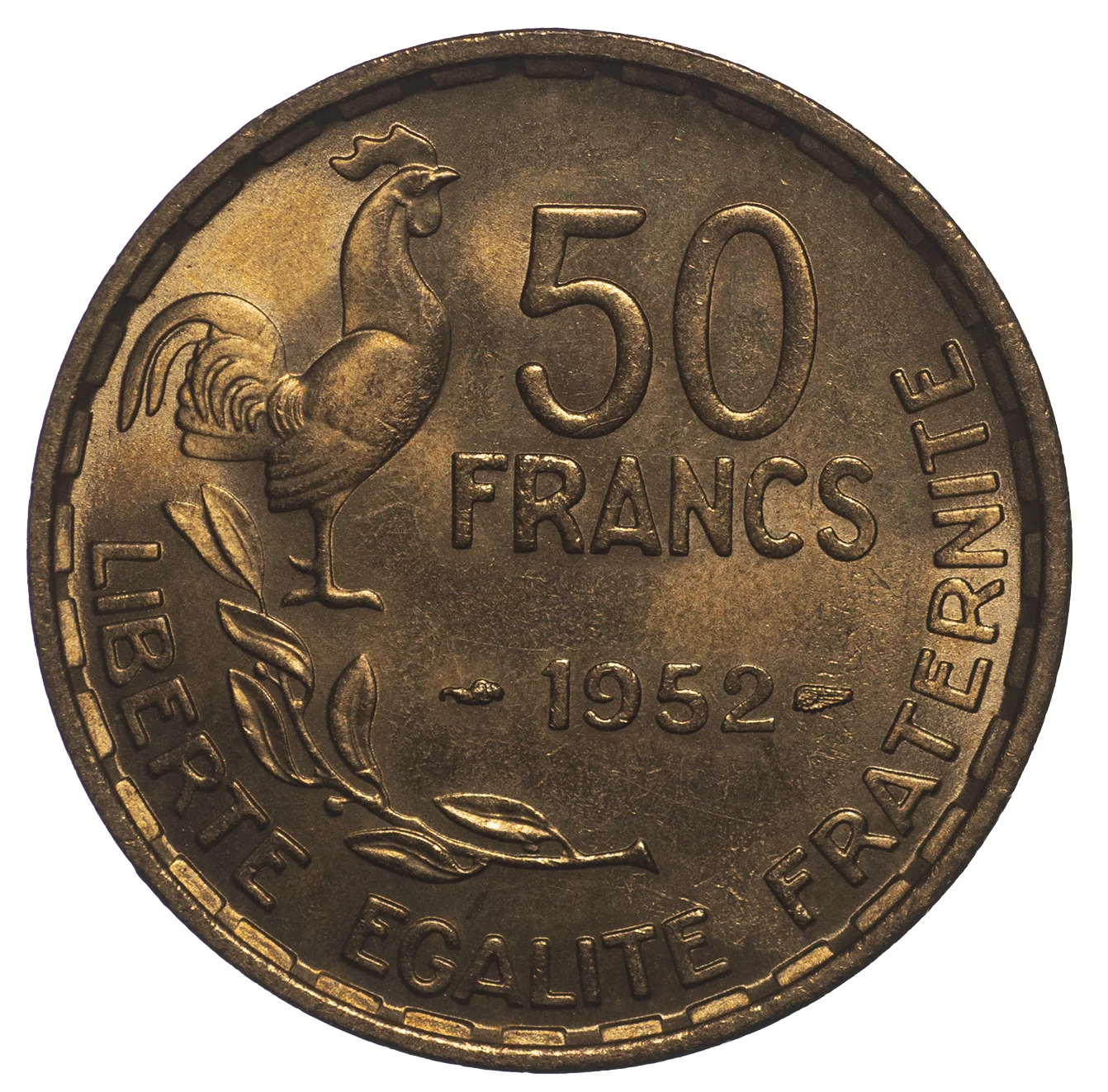
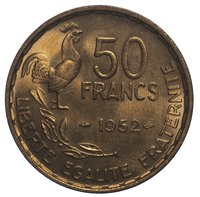
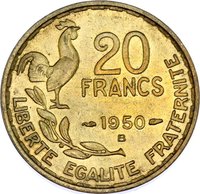
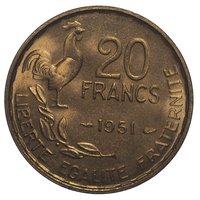
Description:
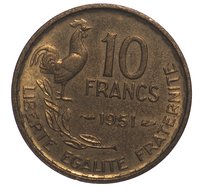
Rooster facing right, laurel branch, value, year, dashed border, mintmark below date.
Inscription:
50
FRANCS
1952
LIBERTE EGALITE FRATERNITE
FRANCS
1952
LIBERTE EGALITE FRATERNITE
Translation:
Fifty Francs
1952
Liberty Equality Fraternity
1952
Liberty Equality Fraternity
Script: Latin
Language: French
Engraver: Georges Guiraud
Edge
Plain
Mints
| Name | Mark |
|---|---|
| Monnaie de Paris | — |
| Beaumont-le-Roger | B |
Mintings
Historical background
In 1950, France was navigating a fragile post-war economic landscape dominated by the franc, a currency struggling with persistent weakness and inflation. The immediate post-liberation period had seen drastic devaluations and monetary reforms, including the introduction of the new franc (franc lourd) in 1945, but confidence remained low. The economy was still characterized by reconstruction needs, price controls, and a substantial black market, all of which undermined the currency's stability and international value.
The franc's situation was intrinsically linked to France's position within the emerging European payment systems and its dependence on American aid. The country was a beneficiary of the Marshall Plan, which provided crucial dollars to finance imports and stabilize the balance of payments. Furthermore, France was a key participant in the European Payments Union (EPU), established in 1950, which aimed to facilitate multilateral trade and settlements among European nations by moving away from scarce dollar reserves. This membership provided a temporary buffer for the franc within Europe but did not resolve its fundamental lack of convertibility into gold or strong currencies like the US dollar.
Domestically, the government pursued a policy of "dirigisme," with significant state intervention in the economy and periodic devaluations to maintain export competitiveness. Inflation, though lower than the hyperinflation of the late 1940s, remained a concern, eroding purchasing power. Thus, in 1950, the franc was a managed and protected currency, not yet fully stable, and its value was largely sustained by international cooperation mechanisms and capital controls rather than robust economic fundamentals or market confidence.
The franc's situation was intrinsically linked to France's position within the emerging European payment systems and its dependence on American aid. The country was a beneficiary of the Marshall Plan, which provided crucial dollars to finance imports and stabilize the balance of payments. Furthermore, France was a key participant in the European Payments Union (EPU), established in 1950, which aimed to facilitate multilateral trade and settlements among European nations by moving away from scarce dollar reserves. This membership provided a temporary buffer for the franc within Europe but did not resolve its fundamental lack of convertibility into gold or strong currencies like the US dollar.
Domestically, the government pursued a policy of "dirigisme," with significant state intervention in the economy and periodic devaluations to maintain export competitiveness. Inflation, though lower than the hyperinflation of the late 1940s, remained a concern, eroding purchasing power. Thus, in 1950, the franc was a managed and protected currency, not yet fully stable, and its value was largely sustained by international cooperation mechanisms and capital controls rather than robust economic fundamentals or market confidence.
🌱 Very Common