

100 francs – France
Add to wishlist
France
Context
Years: 1954–1959
Issuer: France
Period:
(1946—1958)
Currency:
(1795—1959)
Demonetization: 3 August 1966
Total mintage: 495,829,034
Material
References
KM: #
Numista: #688
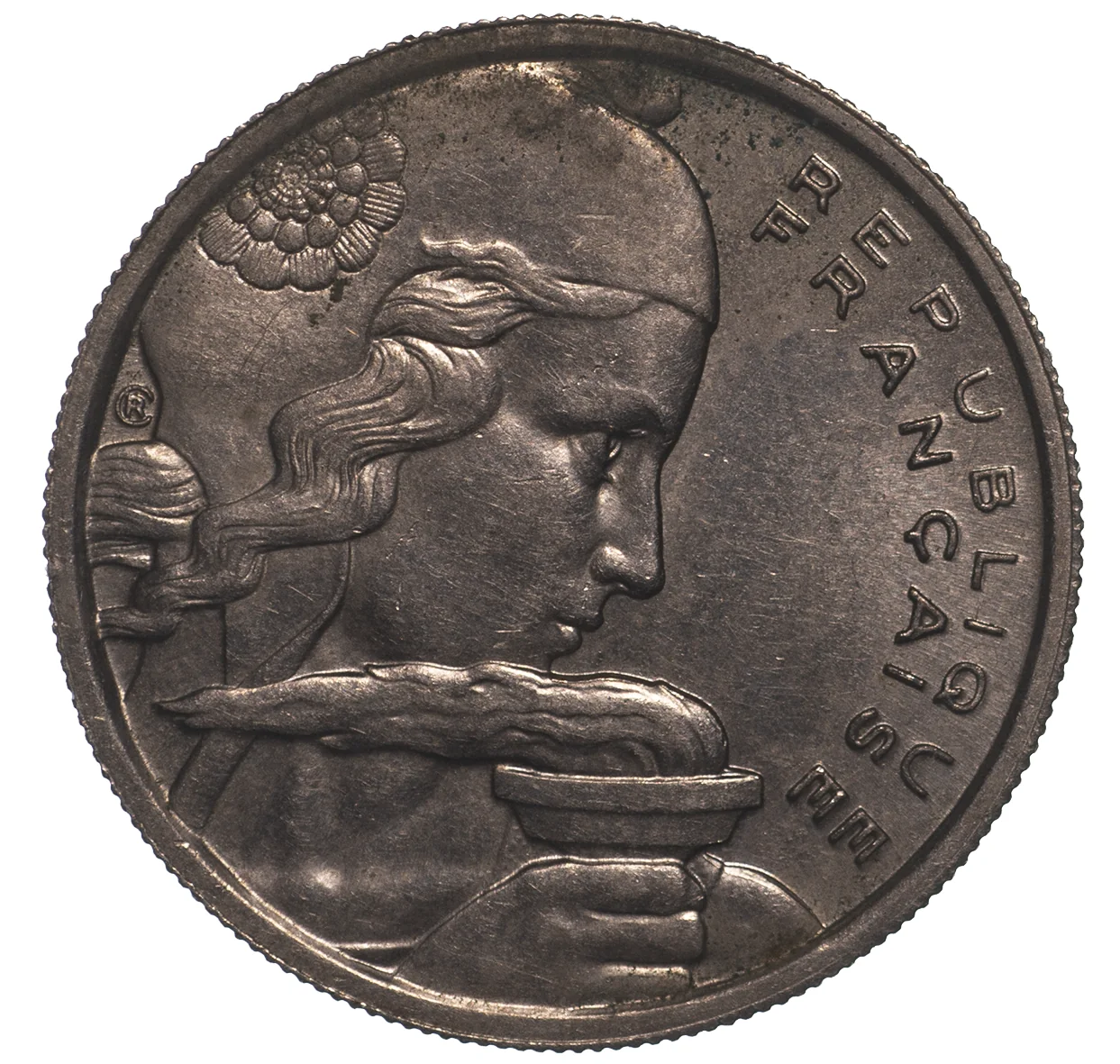
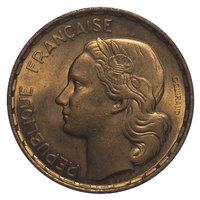
Obverse
Description:
Liberty's torch-bearing bust facing right.
Inscription:
REPUBLIQUE
FRANÇAISE
CR
FRANÇAISE
CR
Translation:
FRENCH REPUBLIC
CR
CR
Script: Latin
Language: French
Engraver: Robert Cochet
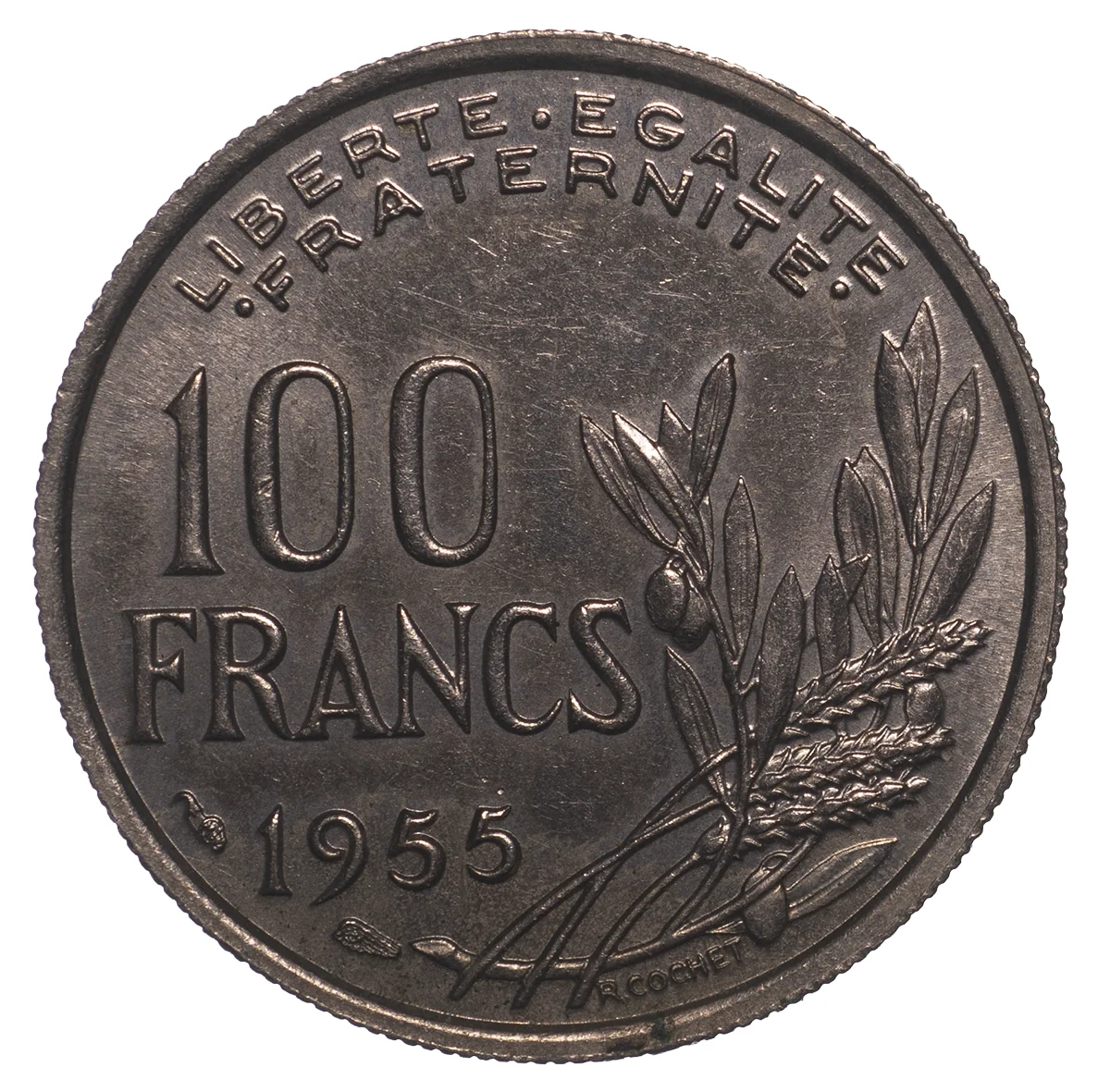
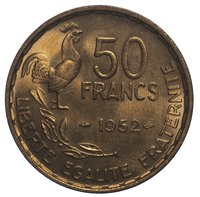
Reverse
Description:
Value and date left, mintmark between olive branches. Fruit and wheat right. Lettering above.
Inscription:
LIBERTE EGALITE
FRATERNITE
100
FRANCS
1958
R COCHET
FRATERNITE
100
FRANCS
1958
R COCHET
Translation:
LIBERTY EQUALITY
FRATERNITY
100
FRANCS
1958
R COCHET
FRATERNITY
100
FRANCS
1958
R COCHET
Script: Latin
Language: French
Engraver: Robert Cochet
Edge
Reeded
Mints
| Name | Mark |
|---|---|
| Monnaie de Paris | — |
| Beaumont-le-Roger | B |
Mintings
Historical background
In 1954, France was navigating a fragile post-war economic recovery under the Fourth Republic, with its currency, the franc, facing significant challenges. The period was marked by persistent inflation, a substantial budget deficit, and a weak balance of payments. These issues were rooted in the costly reconstruction after World War II, the financial burdens of the First Indochina War (which ended that same year), and the beginnings of colonial conflict in Algeria. The government frequently resorted to devaluations and exchange controls to manage the currency's value, but these were often temporary fixes that eroded public and international confidence.
The franc operated within the Bretton Woods system, pegged to the US dollar, but maintaining this fixed parity was a constant struggle. France's gold and dollar reserves were under pressure, leading to a reliance on short-term credits and support from international institutions. Domestically, prices continued to rise, undermining purchasing power and contributing to social unrest. The political instability of the Fourth Republic, with its rapidly changing coalition governments, prevented the consistent implementation of the tough fiscal and monetary policies needed to stabilize the currency long-term.
This precarious monetary environment set the stage for the profound reforms that would follow later in the decade. The economic weaknesses exposed in 1954 contributed to the political crises that brought Charles de Gaulle to power in 1958. His government would subsequently introduce the "nouveau franc" (New Franc) in 1960, redenominating the currency at a rate of 100 old francs to 1 new franc to restore confidence and symbolically break with a period of chronic monetary instability. Thus, 1954 represents a point in the final chapter of the "old franc's" troubled history.
The franc operated within the Bretton Woods system, pegged to the US dollar, but maintaining this fixed parity was a constant struggle. France's gold and dollar reserves were under pressure, leading to a reliance on short-term credits and support from international institutions. Domestically, prices continued to rise, undermining purchasing power and contributing to social unrest. The political instability of the Fourth Republic, with its rapidly changing coalition governments, prevented the consistent implementation of the tough fiscal and monetary policies needed to stabilize the currency long-term.
This precarious monetary environment set the stage for the profound reforms that would follow later in the decade. The economic weaknesses exposed in 1954 contributed to the political crises that brought Charles de Gaulle to power in 1958. His government would subsequently introduce the "nouveau franc" (New Franc) in 1960, redenominating the currency at a rate of 100 old francs to 1 new franc to restore confidence and symbolically break with a period of chronic monetary instability. Thus, 1954 represents a point in the final chapter of the "old franc's" troubled history.

🌱 Very Common