

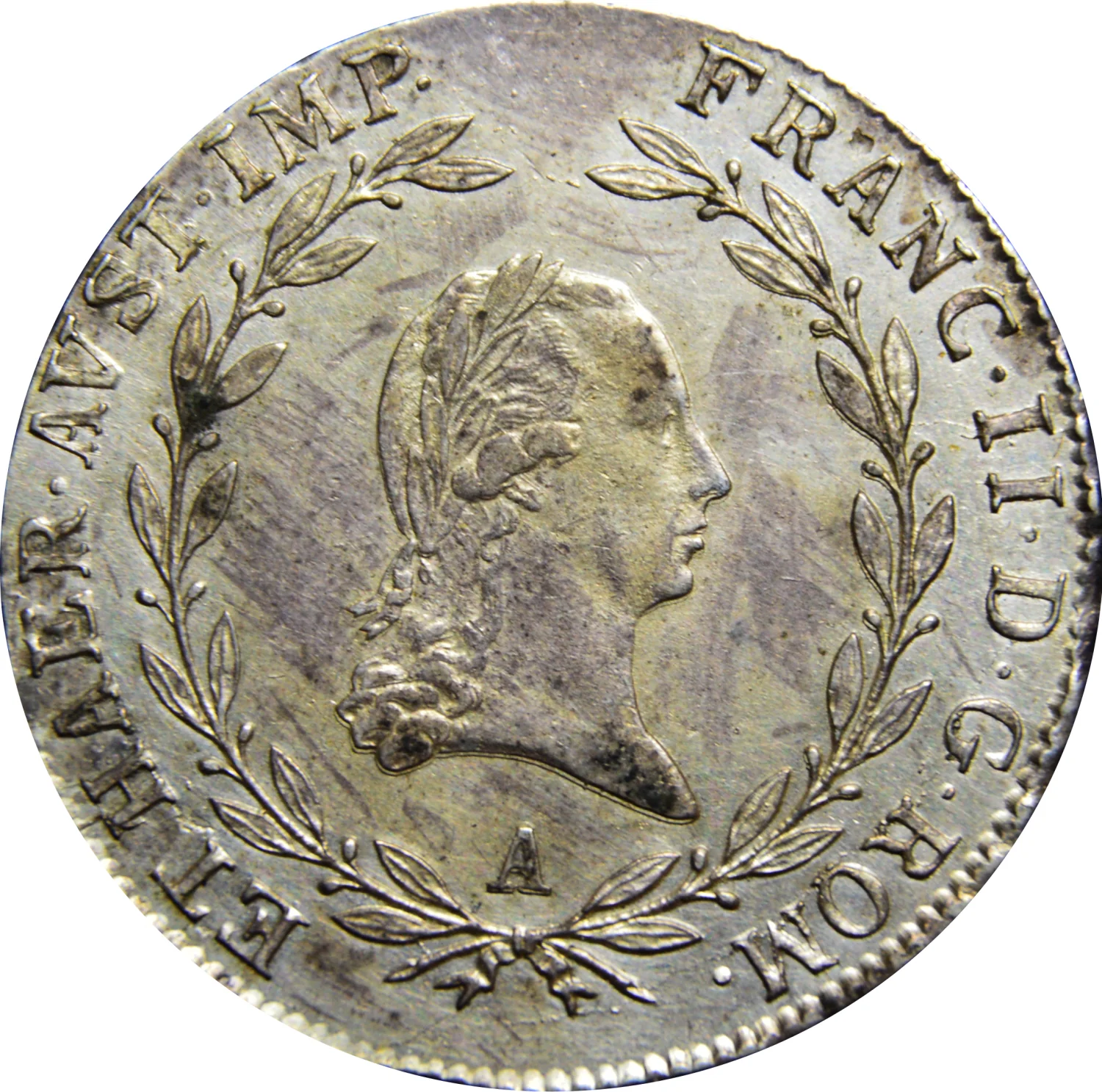
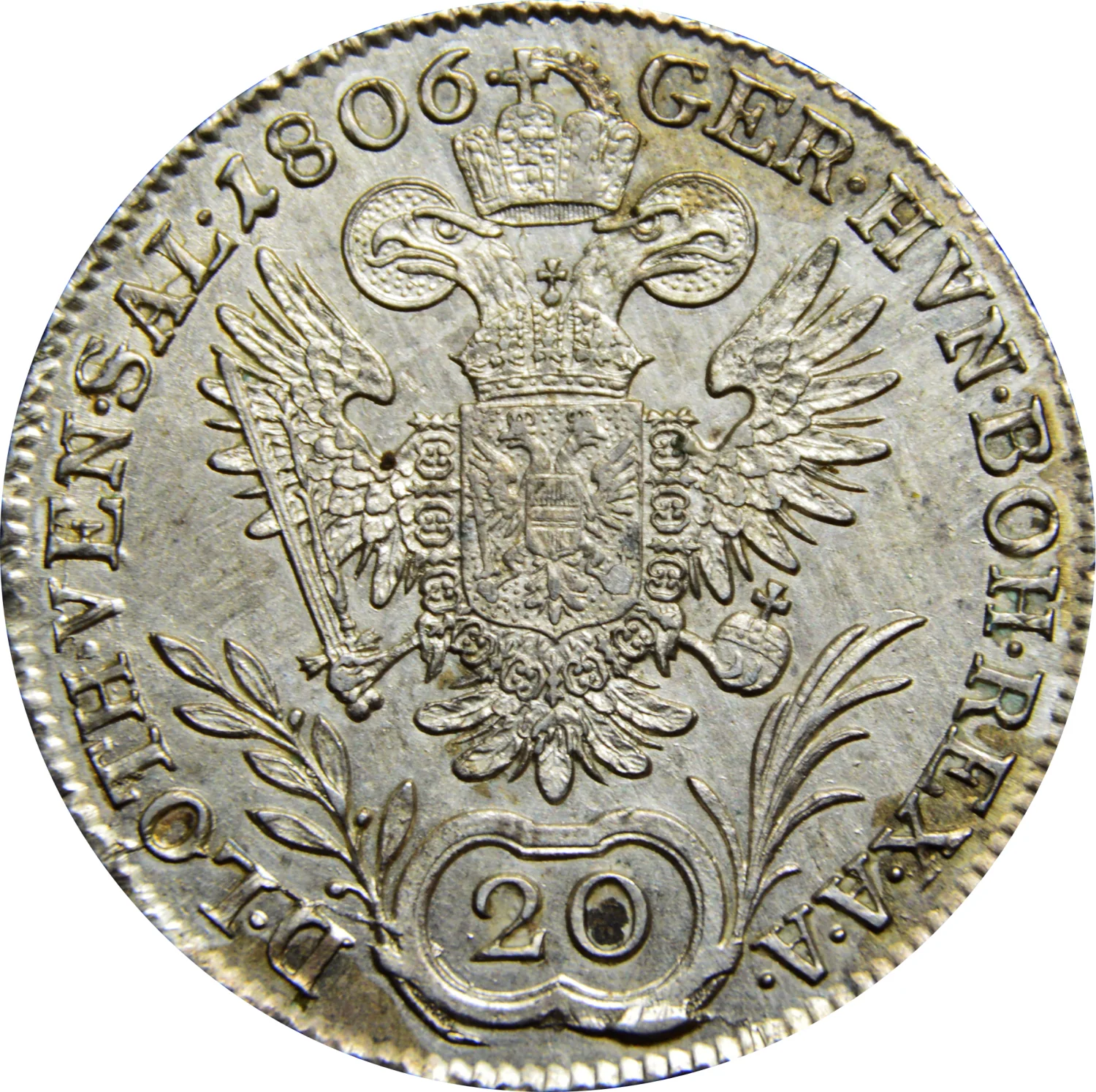
20 Kreuzers – Austrian Empire
Austria
Context
Years: 1803–1806
Country: Austria 
Issuer: Austrian Empire
Ruler: Francis II
Currency:
(1754—1857)
Demonetized: Yes
Total mintage: 32,462,000
Material
References
KM: #Click to copy to clipboard2140
Numista: #7076
Value
Bullion value: $10.99
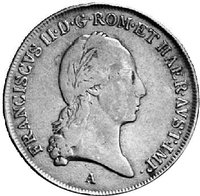
Obverse
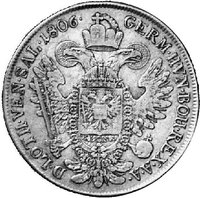
Reverse
Description:
Imperial double-headed eagle with Holy Roman Empire shield, flanked by value between palm and laurel branches. Legend surrounds, ending in date.
Inscription:
GER.HVN.BOH.REX.A.A. 20 D.LOTH.VEN.SAL.1806.
Script: Latin
Edge
Categories
| Symbol> Crown |
| Symbols> Coat of Arms |
| Symbol> Double-headed eagle |
Mints
| Name | Mark |
|---|---|
| Münze Österreich | A |
| Kremnica | B |
| Prague | C |
| Salzburg | D |
| Alba Iulia | E |
| Baia Mare | G |
Mintings
Historical background
In 1803, the currency situation in the Austrian Empire was complex and strained, a legacy of the costly wars against Revolutionary France. The state finances were heavily burdened by debt, leading to a chronic shortage of specie (gold and silver coin). The primary unit was the Conventionsthaler, a large silver coin, but everyday transactions relied on its fractional currency, the Conventionsthaler Groschen. However, the sheer volume of paper money, known as Bancozettel, issued to fund the wars had begun to undermine confidence. While not yet in a state of catastrophic collapse, these notes had started to trade at a discount against silver, signaling the early stages of the inflation that would worsen dramatically following the renewed conflicts of the Napoleonic Wars.
The monetary system was not uniform across the Habsburg lands. Alongside the official Conventionsthaler standard, older regional currencies like the Kreutzer and Gulden (Florin) remained in widespread use for accounting and local trade, creating a cumbersome environment for commerce. The Gulden, in particular, was a key unit of account, with 1 Conventionsthaler equal to 2 Gulden. This multiplicity required constant conversion and exposed the economy to inefficiencies and arbitrage.
Ultimately, the situation was one of fragile stability on the brink of deterioration. The government, under Emperor Francis II, had not yet resorted to the unrestrained printing of money that would characterize the coming years, but the structural weaknesses were apparent. The currency system was a patchwork under pressure, its stability dependent on a precarious fiscal balance that would soon be shattered by the resumption of continental warfare, leading to the severe devaluation of the Bancozettel in the period after 1805.
The monetary system was not uniform across the Habsburg lands. Alongside the official Conventionsthaler standard, older regional currencies like the Kreutzer and Gulden (Florin) remained in widespread use for accounting and local trade, creating a cumbersome environment for commerce. The Gulden, in particular, was a key unit of account, with 1 Conventionsthaler equal to 2 Gulden. This multiplicity required constant conversion and exposed the economy to inefficiencies and arbitrage.
Ultimately, the situation was one of fragile stability on the brink of deterioration. The government, under Emperor Francis II, had not yet resorted to the unrestrained printing of money that would characterize the coming years, but the structural weaknesses were apparent. The currency system was a patchwork under pressure, its stability dependent on a precarious fiscal balance that would soon be shattered by the resumption of continental warfare, leading to the severe devaluation of the Bancozettel in the period after 1805.
🌱 Fairly Common