

7 kreuzers – Austrian Empire
Add to wishlist
Austria
Context
Year: 1802
Country: Austria
Issuer: Austrian Empire
Ruler: Francis II
Currency:
(1754—1857)
Demonetized: Yes
Total mintage: 102,034,000
Material
References
KM: #
Numista: #18836
Obverse
Description:
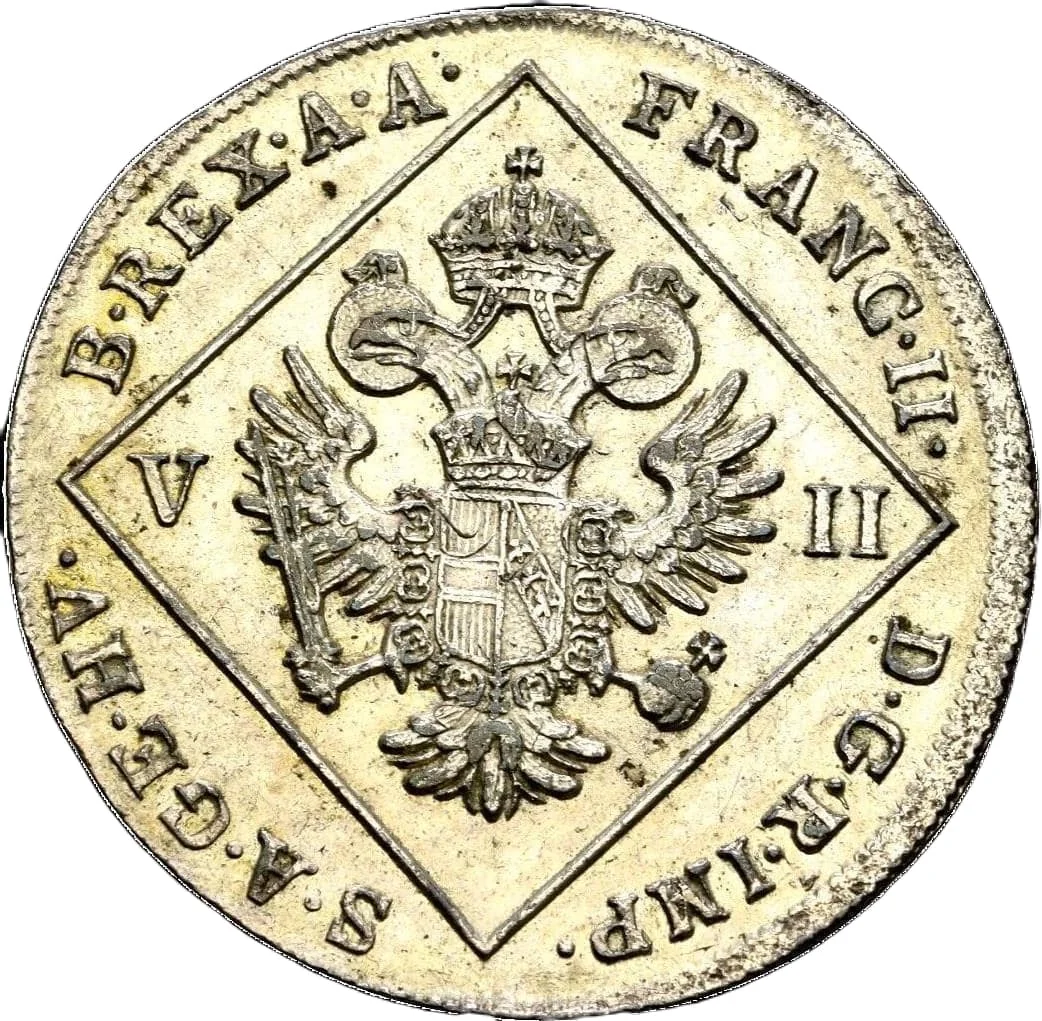
Imperial double-headed eagle with Austrian-Lorraine breast shield, within the Golden Fleece chain and a rhombus. Value in Roman numerals flank the eagle, surrounded by legend.
Inscription:
FRANC·II· D·G·R·IMP· S·A·GE·HV· B·REX·A·A·
V II
V II
Translation:
Francis II, by the Grace of God, Roman Emperor, Semper Augustus, Germany, Hungary, Bohemia, etc., King, Archduke of Austria.
7
7
Script: Latin
Language: Latin
Reverse
Description:
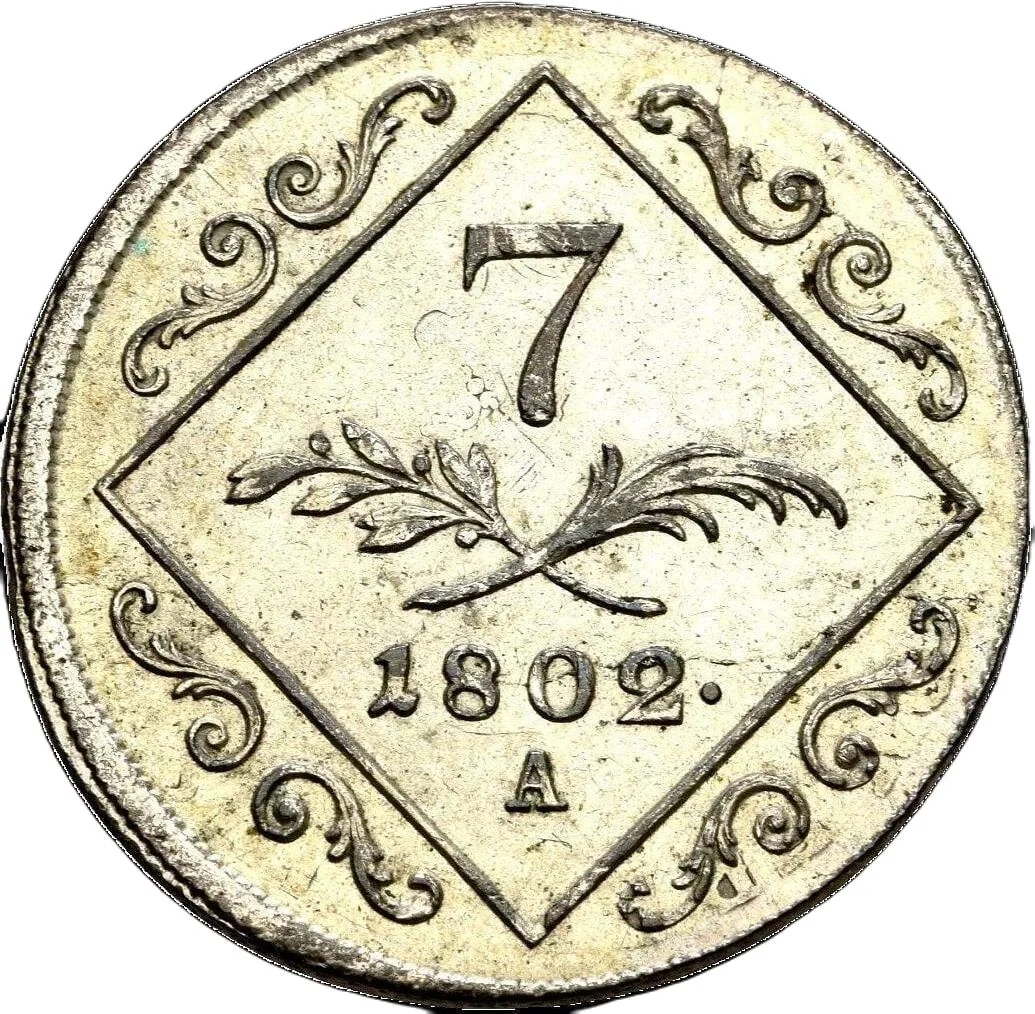
Laurel and palm branches crossed, date and mint mark in a rhombus, surrounded by ornaments.
Inscription:
7
1802·
A
1802·
A
Script: Latin
Edge
Chain ornament
Categories
| Symbol> Crown |
| Symbols> Coat of Arms |
| Symbol> Double-headed eagle |
Mints
| Name | Mark |
|---|---|
| Münze Österreich | A |
| Kremnica | B |
| Prague | C |
| Alba Iulia | E |
| Hall | F |
| Baia Mare | G |
Historical background
In 1802, the currency situation within the Habsburg Monarchy, often referred to as the Austrian Empire (formally proclaimed in 1804), was characterized by severe instability and complexity, a legacy of the costly wars against revolutionary France. The state finances were deeply strained, leading to a reliance on paper money not backed by sufficient silver reserves. The primary circulating currency was the paper Gulden (Wiener Währung), which had significantly depreciated against the silver Conventionsthaler. Since 1753, the Conventionsthaler was fixed at 2 Gulden in silver, but by 1802, the paper Gulden had fallen to roughly half its nominal value, creating a chaotic system of dual valuations for every transaction.
This environment resulted in a confusing monetary landscape where prices, debts, and contracts had to specify whether they were in Conventionsmünze (CM) – the stable silver standard – or in Bancozettel – the depreciating paper notes. The sheer volume of unbacked paper money in circulation, which had increased dramatically to fund the war effort, fueled inflation and eroded public trust. This effectively created a two-tier economy, disadvantaging those who were paid in paper and benefiting creditors who could demand repayment in silver.
The government, under Emperor Francis II and his ministers, was aware of the crisis but was politically and financially unable to enact a full stabilization. The ongoing geopolitical tensions and the looming resumption of the Napoleonic Wars (which would restart in 1803 with the War of the Third Coalition) prevented any drastic fiscal reform or recall of the paper notes. Thus, in 1802, the currency system remained in a precarious and inflationary holding pattern, a significant weakness that would continue to plague the empire's economy for decades.
This environment resulted in a confusing monetary landscape where prices, debts, and contracts had to specify whether they were in Conventionsmünze (CM) – the stable silver standard – or in Bancozettel – the depreciating paper notes. The sheer volume of unbacked paper money in circulation, which had increased dramatically to fund the war effort, fueled inflation and eroded public trust. This effectively created a two-tier economy, disadvantaging those who were paid in paper and benefiting creditors who could demand repayment in silver.
The government, under Emperor Francis II and his ministers, was aware of the crisis but was politically and financially unable to enact a full stabilization. The ongoing geopolitical tensions and the looming resumption of the Napoleonic Wars (which would restart in 1803 with the War of the Third Coalition) prevented any drastic fiscal reform or recall of the paper notes. Thus, in 1802, the currency system remained in a precarious and inflationary holding pattern, a significant weakness that would continue to plague the empire's economy for decades.
🌟 Uncommon