

½ Thaler – Austrian Empire
Austria
Context
Years: 1804–1806
Country: Austria 
Issuer: Austrian Empire
Ruler: Francis II
Currency:
(1754—1857)
Demonetized: Yes
Material
References
KM: #Click to copy to clipboard2150
Numista: #33684
Value
Bullion value: $33.38
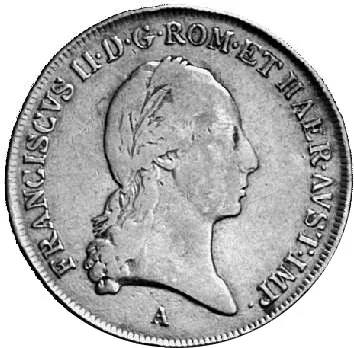
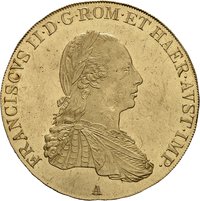
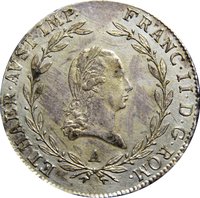
Obverse
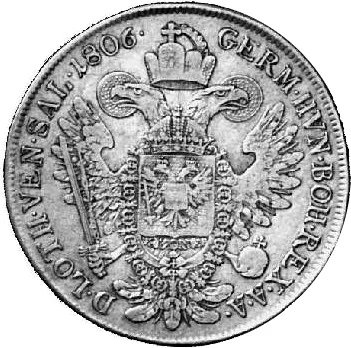
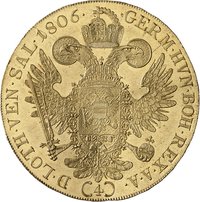
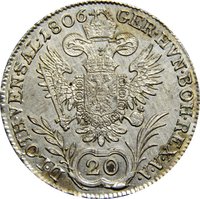
Reverse
Description:
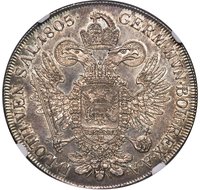
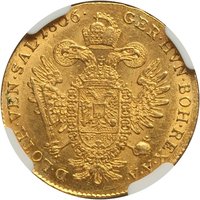
Imperial eagle, crowned and double-headed, with legend (starting at 1 o'clock).
Inscription:
GERM HVN BOH REX A A D LOTH VEN SAL 1806
Script: Latin
Edge
Inscribed text
Mints
| Name | Mark |
|---|---|
| Münze Österreich | A |
| Venice | V |
Historical background
In 1804, the Austrian Empire’s currency system was a complex and strained relic of the 18th century, fundamentally based on the Conventionsthaler. Established by the Coinage Convention of 1753 with Bavaria, this silver standard defined the gulden (florin), with 1 Conventionsthaler = 2 Gulden. However, decades of war, particularly against revolutionary France and Napoleon, had placed enormous fiscal pressure on the Habsburg monarchy. To finance these conflicts, the state had increasingly resorted to issuing paper money, known as Bankozettel, from the Vienna City Bank. While initially convertible to silver, these notes began to be issued in excess, leading to a growing distrust in their value and the beginnings of inflation.
The situation was further complicated by the existence of multiple regional monetary units across the empire's diverse lands. While the gulden was the official unit of account, regions like Hungary used the forint (identical to the gulden) and the krajcár, while other areas calculated in kreuzers (60 kreuzers = 1 gulden). This lack of uniformity hindered trade and administration. Crucially, by 1804, the pressure of the ongoing Napoleonic Wars was pushing the system toward a breaking point. The state's need for war financing was leading to a significant increase in the volume of Bankozettel in circulation, setting the stage for a severe devaluation.
Thus, in 1804, the currency system was nominally on a silver standard but was in a fragile and transitional state. The paper gulden was beginning to diverge in value from the silver gulden, a prelude to the full-scale financial crisis that would erupt just a few years later. In 1811, this pressure would force the state to declare a bankruptcy, implementing a drastic devaluation called the Finanzpatent, which slashed the value of Bankozettel to one-fifth of their face value. Therefore, the year 1804 represents the final phase of an increasingly unstable pre-war monetary order, teetering on the edge of collapse under the weight of geopolitical conflict.
The situation was further complicated by the existence of multiple regional monetary units across the empire's diverse lands. While the gulden was the official unit of account, regions like Hungary used the forint (identical to the gulden) and the krajcár, while other areas calculated in kreuzers (60 kreuzers = 1 gulden). This lack of uniformity hindered trade and administration. Crucially, by 1804, the pressure of the ongoing Napoleonic Wars was pushing the system toward a breaking point. The state's need for war financing was leading to a significant increase in the volume of Bankozettel in circulation, setting the stage for a severe devaluation.
Thus, in 1804, the currency system was nominally on a silver standard but was in a fragile and transitional state. The paper gulden was beginning to diverge in value from the silver gulden, a prelude to the full-scale financial crisis that would erupt just a few years later. In 1811, this pressure would force the state to declare a bankruptcy, implementing a drastic devaluation called the Finanzpatent, which slashed the value of Bankozettel to one-fifth of their face value. Therefore, the year 1804 represents the final phase of an increasingly unstable pre-war monetary order, teetering on the edge of collapse under the weight of geopolitical conflict.

✨ Legendary