

5 centimes – France
Add to wishlist
France
Context
Years: 1920–1938
Issuer: France
Period:
(1870—1940)
Currency:
(1795—1959)
Demonetization: 24 November 1940
Total mintage: 517,001,353
Material
Diameter: 17 mm
Weight: 2 g
Thickness: 1.16 mm
Shape: Round with a round hole
Composition: Copper-nickel
Technique: Milled
Alignment: Coin alignment
flip
References
KM: #
Numista: #701
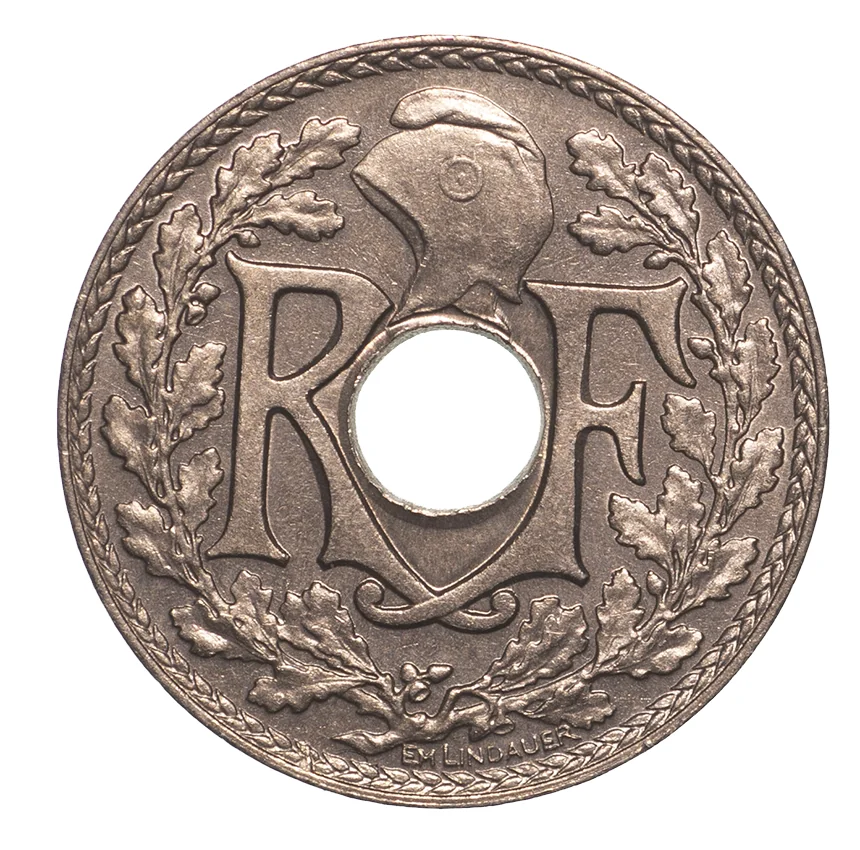
Obverse
Description:
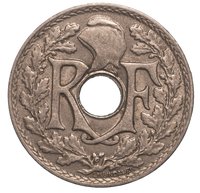
Monogram flanking liberty cap, encircled by wreath.
Inscription:
R F
EM LINDAUER
EM LINDAUER
Translation:
R(es) F(ublica) Lindauer
Script: Latin
Language: Latin
Engraver: Edmond-Émile Lindauer
Reverse
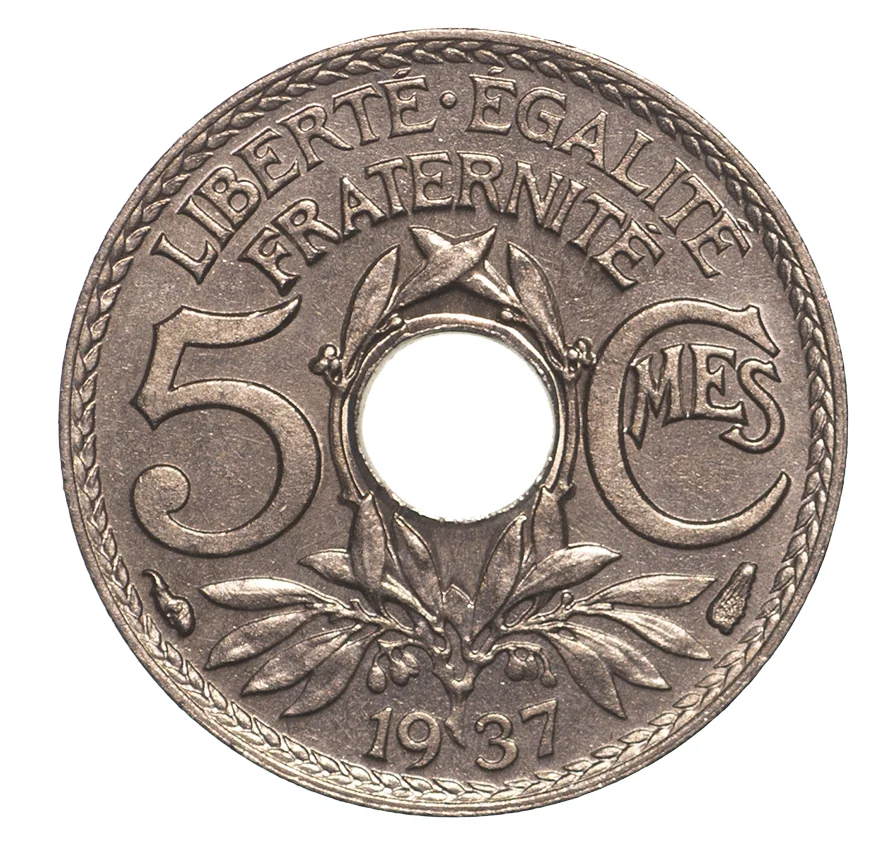
Description:
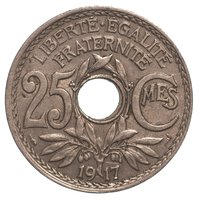
Denomination, plant, and center hole. Date below.
Inscription:
LIBERTE·EGALITE
FRATERNITE
5 CMES
19 25
FRATERNITE
5 CMES
19 25
Translation:
LIBERTY EQUALITY
FRATERNITY
5 CENTIMES
19 25
FRATERNITY
5 CENTIMES
19 25
Script: Latin
Language: French
Engraver: Edmond-Émile Lindauer
Edge
Plain
Categories
| Symbols> Monogram |
| Symbol> Phrygian cap |
Mints
| Name | Mark |
|---|---|
| Monnaie de Paris | — |
| Société Française de Monnayage | — |
Mintings
| Year | Mint Mark | Mintage | Quality | Collection |
|---|---|---|---|---|
| 1920 | — | — | ||
| 1921 | — | 32,907,986 | ||
| 1922 | — | 17,716,885 | ||
| 1923 | — | 45,097,296 | ||
| 1924 | — | 21,210,078 | ||
| 1925 | — | 66,838,410 | ||
| 1926 | — | 19,819,520 | ||
| 1927 | — | 6,066,146 | ||
| 1930 | — | 31,902,116 | ||
| 1931 | — | 34,711,236 | ||
| 1932 | — | 31,111,633 | ||
| 1933 | — | 12,970,114 | ||
| 1934 | — | 27,143,993 | ||
| 1935 | — | 57,221,458 | ||
| 1936 | — | 64,340,897 | ||
| 1937 | — | 26,329,202 | ||
| 1938 | — | 21,614,383 |
Historical background
Following the devastation of the First World War, France entered the 1920s with a severe and complex currency crisis rooted in the financial methods used to fund the conflict. The government had relied heavily on borrowing from the Bank of France and issuing short-term bonds (bons de la Défense nationale) rather than raising taxes, leading to a massive expansion of the money supply. This, combined with the immense costs of reconstruction in the devastated northern regions and a large public debt, created intense inflationary pressures. While the franc had been officially pegged to gold in 1914, this convertibility was suspended, leaving the currency vulnerable to depreciation both domestically and on foreign exchange markets.
The situation was exacerbated by a lack of political consensus on how to achieve stabilization. A "weak franc" policy was initially tolerated and even encouraged by some industrialists and exporters, as it made French goods cheaper abroad and helped reduce the real value of the domestic debt. However, this led to a loss of confidence, capital flight, and a sharp decline in the franc's international value, which fell from about 19 to the US dollar in 1919 to nearly 50 by early 1924. This depreciation severely eroded the purchasing power of the French middle class and savers, creating social tension and political instability, as successive governments struggled to balance budgets without provoking public unrest.
The currency turmoil defined the decade, culminating in the failed attempt at a de facto return to the gold standard under Premier Raymond Poincaré in 1926. His government ultimately achieved stabilization not by a full return to the pre-war gold parity, but through a de jure devaluation in 1928. The franc was pegged to gold at a new, much lower value—approximately 20% of its 1914 worth. This "Poincaré franc" finally ended the period of acute instability, but it came at a significant social cost, effectively wiping out a large portion of the savings of the French bourgeoisie and leaving a lasting legacy of public distrust in paper money and a preference for tangible assets like gold.
The situation was exacerbated by a lack of political consensus on how to achieve stabilization. A "weak franc" policy was initially tolerated and even encouraged by some industrialists and exporters, as it made French goods cheaper abroad and helped reduce the real value of the domestic debt. However, this led to a loss of confidence, capital flight, and a sharp decline in the franc's international value, which fell from about 19 to the US dollar in 1919 to nearly 50 by early 1924. This depreciation severely eroded the purchasing power of the French middle class and savers, creating social tension and political instability, as successive governments struggled to balance budgets without provoking public unrest.
The currency turmoil defined the decade, culminating in the failed attempt at a de facto return to the gold standard under Premier Raymond Poincaré in 1926. His government ultimately achieved stabilization not by a full return to the pre-war gold parity, but through a de jure devaluation in 1928. The franc was pegged to gold at a new, much lower value—approximately 20% of its 1914 worth. This "Poincaré franc" finally ended the period of acute instability, but it came at a significant social cost, effectively wiping out a large portion of the savings of the French bourgeoisie and leaving a lasting legacy of public distrust in paper money and a preference for tangible assets like gold.
Series: 1920 France circulation coins
🌱 Very Common