

Obverse
Description:
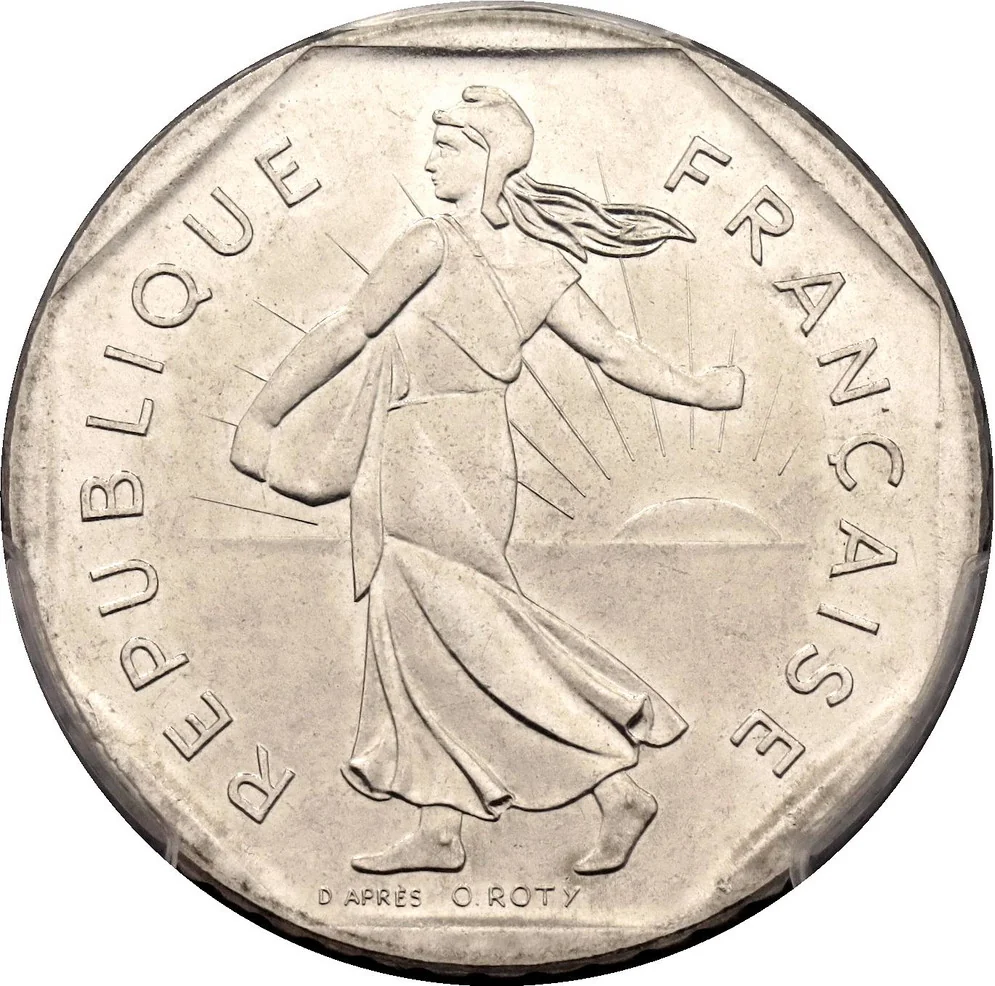
The Sower, by Oscar Roty (1900): a French national emblem.
Inscription:
REPUBLIQUE FRANÇAISE
D'APRÈS O.ROTY
D'APRÈS O.ROTY
Translation:
FRENCH REPUBLIC
AFTER O.ROTY
AFTER O.ROTY
Script: Latin
Language: French
Designer: Louis-Oscar Roty
Reverse
Description:
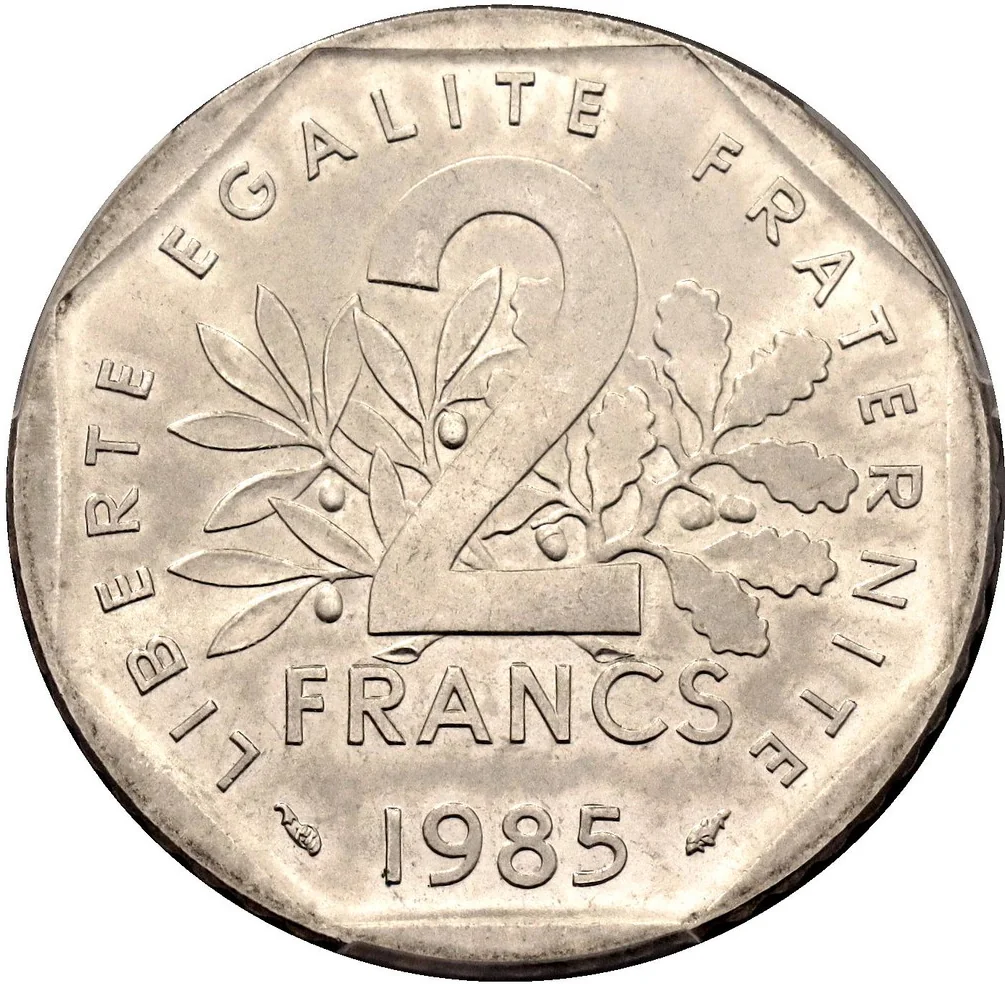
An olive and oak branch frame the French motto: "LIBERTÉ, ÉGALITÉ, FRATERNITÉ."
Inscription:
LIBERTE EGALITE FRATERNITE
2
FRANCS
1989
2
FRANCS
1989
Script: Latin
Edge
Milled (widely spaced)
Categories
| Symbol> Allegory |
| Symbol> Phrygian cap |
Mints
| Name | Mark |
|---|---|
| Monnaie de Paris | — |
Mintings
| Year | Mint Mark | Mintage | Quality | Collection |
|---|---|---|---|---|
| 1977 | — | 253 | ||
| 1979 | — | 130,040,511 | ||
| 1980 | — | 100,010,011 | ||
| 1981 | — | 120,000,011 | ||
| 1982 | — | 90,002,511 | ||
| 1983 | — | 90,002,572 | ||
| 1984 | — | 50,347 | ||
| 1985 | — | 20,011 | ||
| 1986 | — | 15,000 | ||
| 1987 | — | 92,967 | BU | |
| 1988 | — | 95,576 | BU | |
| 1989 | — | 94,449 | BU | |
| 1990 | — | 15,011 | ||
| 1991 | — | 2,511 | ||
| 1992 | — | 65,011 | ||
| 1993 | — | 20,011 | ||
| 1994 | — | 10,000 | BU | |
| 1994 | — | 9,970,111 | ||
| 1995 | — | 19,011 | ||
| 1996 | — | 11,980,013 | ||
| 1997 | — | 15,000 | BU | |
| 1997 | — | 9,990,013 | ||
| 1998 | — | 25,000 | BU | |
| 1999 | — | 25,500 | BU | |
| 2000 | — | 100,000 | BU | |
| 2001 | — | 125,000 | BU |
Historical background
By 1977, France found itself in a precarious monetary position, grappling with the lingering effects of the 1973 oil crisis and a domestic economic strategy that had left it vulnerable. President Valéry Giscard d'Estaing and Prime Minister Raymond Barre were committed to a strong franc policy, known as the franc fort, believing it was essential for controlling inflation and maintaining France's prestige. However, this policy created a significant strain as it made French exports more expensive and less competitive internationally, particularly against West Germany's powerful Deutsche Mark, leading to persistent trade deficits and sluggish growth.
This situation was exacerbated by France's participation in the European "snake in the tunnel" exchange rate mechanism, a precursor to the European Monetary System. The franc was repeatedly forced to devalue within this arrangement—notably in 1976—and faced sustained speculative pressure. Investors lacked confidence in France's ability to reconcile its strong currency goal with its need for economic stimulus and rising unemployment. Consequently, the Banque de France was compelled to spend heavily from its foreign exchange reserves to defend the franc's parity, a costly and ultimately unsustainable effort.
The year 1977 thus became a pivotal moment of tension and difficult choices. The Barre government pursued a policy of austerity, prioritizing anti-inflation measures over growth, which included wage controls and cuts to public spending. This "Barre Plan" was politically unpopular as unemployment continued to rise, yet it was deemed necessary to restore confidence and stabilize the currency. The period highlighted the fundamental dilemma of the franc fort: the conflict between the desire for monetary stability aligned with Germany and the domestic need for economic expansion, a tension that would define French economic policy for years to come.
This situation was exacerbated by France's participation in the European "snake in the tunnel" exchange rate mechanism, a precursor to the European Monetary System. The franc was repeatedly forced to devalue within this arrangement—notably in 1976—and faced sustained speculative pressure. Investors lacked confidence in France's ability to reconcile its strong currency goal with its need for economic stimulus and rising unemployment. Consequently, the Banque de France was compelled to spend heavily from its foreign exchange reserves to defend the franc's parity, a costly and ultimately unsustainable effort.
The year 1977 thus became a pivotal moment of tension and difficult choices. The Barre government pursued a policy of austerity, prioritizing anti-inflation measures over growth, which included wage controls and cuts to public spending. This "Barre Plan" was politically unpopular as unemployment continued to rise, yet it was deemed necessary to restore confidence and stabilize the currency. The period highlighted the fundamental dilemma of the franc fort: the conflict between the desire for monetary stability aligned with Germany and the domestic need for economic expansion, a tension that would define French economic policy for years to come.
🌱 Very Common