

100 Francs – France
France
Context
Years: 1982–2001
Issuer: France 
Period:
(since 1958)
Currency:
(1960—2001)
Demonetization: 17 February 2002
Total mintage: 11,918,768
Material
References
KM: #Click to copy to clipboard951.1
Numista: #11
Value
Exchange value: 100 FRF
Bullion value: $37.83
Inflation-adjusted value: 296.26 FRF
Obverse
Description:
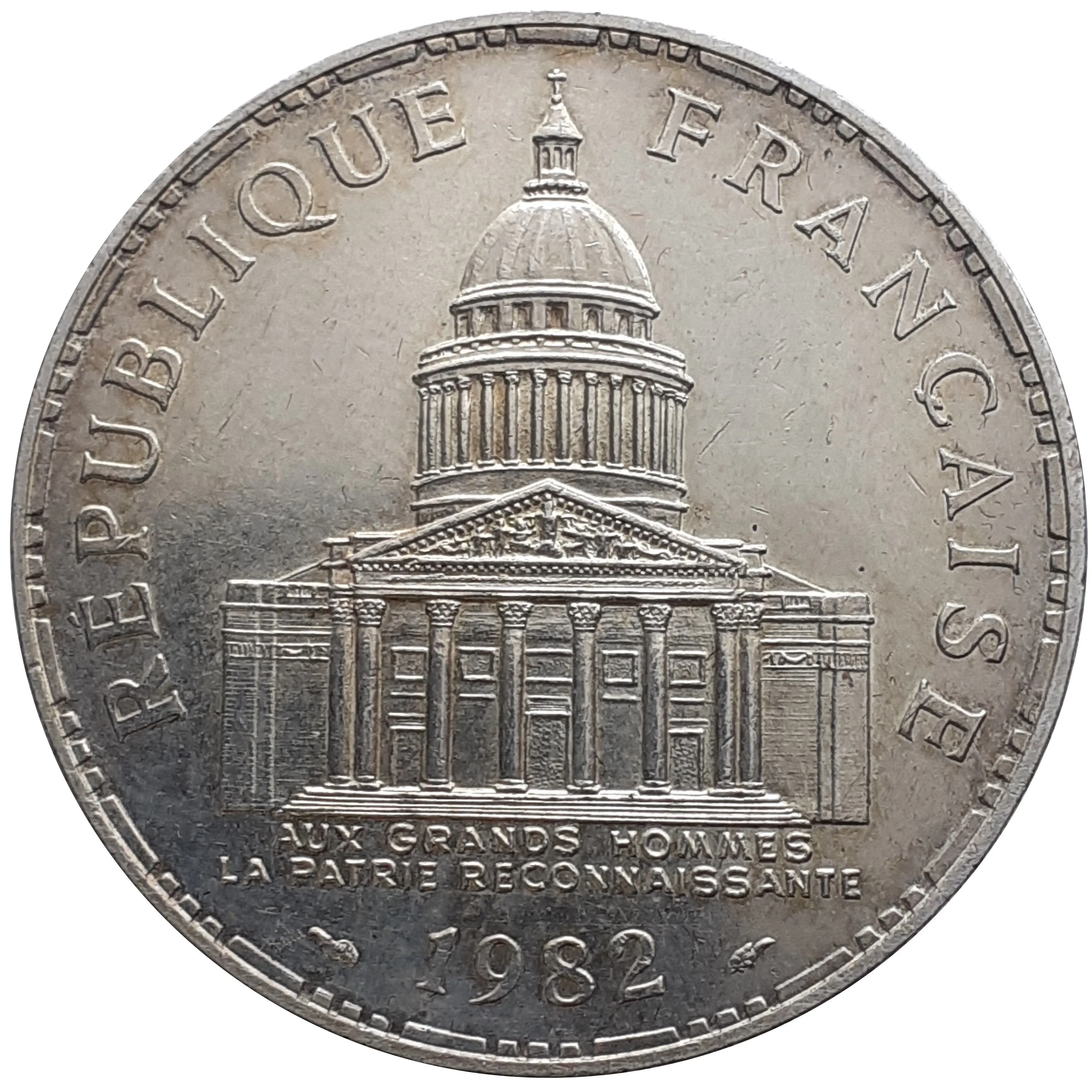
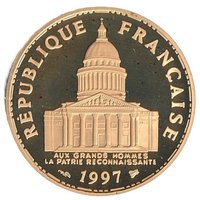
The Panthéon in Paris bears the inscription "AUX GRANDS HOMMES LA PATRIE RECONNAISSANTE" and is encircled by "REPUBLIQUE FRANÇAISE."
Inscription:
RÉPUBLIQUE FRANÇAISE
AUX GRANDS HOMMES
LA PATRIE RECONNAISSANTE
1983
AUX GRANDS HOMMES
LA PATRIE RECONNAISSANTE
1983
Translation:
TO GREAT MEN
THE GRATEFUL HOMELAND
1983
THE GRATEFUL HOMELAND
1983
Script: Latin
Language: French
Engravers: Jean-Claude Dieudonné, Atelier de Gravure (A.G.M.M.)
Reverse
Description:
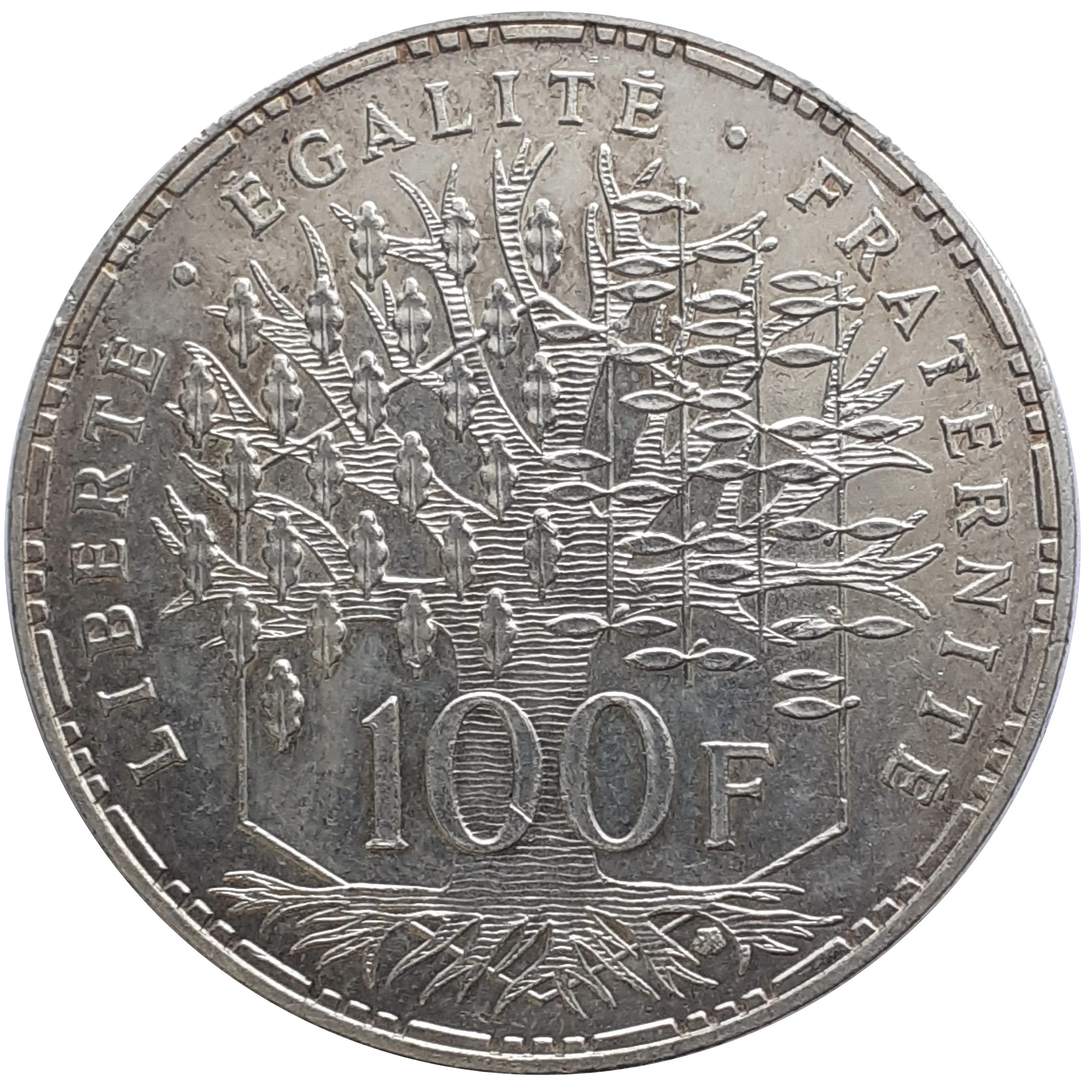
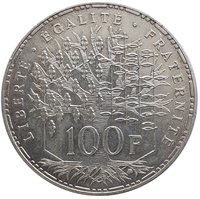
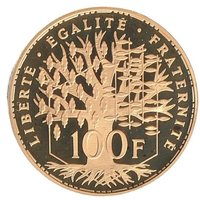
A large tree bearing the face value and a French hexagon, encircled by the motto "LIBERTE • EGALITE • FRATERNITE".
Inscription:
LIBERTÉ · ÉGALITÉ · FRATERNITÉ
100 F
100 F
Translation:
LIBERTY · EQUALITY · FRATERNITY
100 FRANCS
100 FRANCS
Script: Latin
Language: French
Engravers: Daniel Gédalge, Atelier de Gravure (A.G.M.M.)
Edge
Plain
Mints
| Name | Mark |
|---|---|
| Monnaie de Paris | — |
Mintings
| Year | Mint Mark | Mintage | Quality | Collection |
|---|---|---|---|---|
| 1982 | — | — | ||
| 1983 | — | 5,000,961 | ||
| 1984 | — | 5,000,647 | ||
| 1985 | — | 999,711 | ||
| 1986 | — | 501,411 | BU | |
| 1987 | — | 92,967 | BU | |
| 1988 | — | 95,576 | BU | |
| 1989 | — | 96,449 | BU | |
| 1990 | — | 15,011 | ||
| 1991 | — | 5,011 | ||
| 1991 | — | 6,232 | Proof | |
| 1992 | — | 4,938 | Proof | |
| 1993 | — | 5,309 | Proof | |
| 1994 | — | 4,566 | Proof | |
| 1995 | — | 4,011 | ||
| 1995 | — | 4,796 | Proof | |
| 1996 | — | 2,013 | ||
| 1996 | — | 5,319 | Proof | |
| 1997 | — | 6,436 | Proof | |
| 1998 | — | 7,404 | Proof | |
| 1999 | — | 10,000 | Proof | |
| 2000 | — | 15,000 | Proof | |
| 2001 | — | 35,000 | Proof |
Historical background
In 1982, France found itself grappling with a severe currency crisis within the broader context of the European Monetary System (EMS). The newly elected Socialist government of President François Mitterrand, which had come to power in 1981, had embarked on an ambitious program of economic reflation—increasing public spending, nationalizing industries, and raising wages and social benefits. This "Keynesianism in one country" approach, however, clashed with the restrictive monetary policies of major trading partners like the United States and West Germany, leading to soaring trade deficits and capital flight as investors lost confidence.
The franc came under intense speculative pressure, forcing three devaluations within the EMS in just over a year: in October 1981, June 1982, and March 1983. Each devaluation was a negotiated realignment meant to restore French competitiveness, but they were politically humiliating and economically painful, failing to resolve the underlying issues. By the 1982 devaluation, the government had already begun a sharp policy pivot known as the "tournant de la rigueur" (turn to austerity), freezing prices and wages and beginning to curb public spending in an attempt to defend the currency and remain within the European exchange rate mechanism.
This currency turmoil of 1982 thus represented a critical juncture. It exposed the impossibility of pursuing a unilateral expansionist policy while tied to a fixed exchange rate system with Germany's dominant, stability-oriented Bundesbank. The crisis set the stage for the decisive choice in March 1983 to fully commit to the EMS and European integration, prioritizing monetary stability and competitiveness over domestic stimulus—a foundational moment that would shape French economic policy for decades and ultimately lead to the euro.
The franc came under intense speculative pressure, forcing three devaluations within the EMS in just over a year: in October 1981, June 1982, and March 1983. Each devaluation was a negotiated realignment meant to restore French competitiveness, but they were politically humiliating and economically painful, failing to resolve the underlying issues. By the 1982 devaluation, the government had already begun a sharp policy pivot known as the "tournant de la rigueur" (turn to austerity), freezing prices and wages and beginning to curb public spending in an attempt to defend the currency and remain within the European exchange rate mechanism.
This currency turmoil of 1982 thus represented a critical juncture. It exposed the impossibility of pursuing a unilateral expansionist policy while tied to a fixed exchange rate system with Germany's dominant, stability-oriented Bundesbank. The crisis set the stage for the decisive choice in March 1983 to fully commit to the EMS and European integration, prioritizing monetary stability and competitiveness over domestic stimulus—a foundational moment that would shape French economic policy for decades and ultimately lead to the euro.
🌱 Very Common