

50 francs – France
Add to wishlist
France
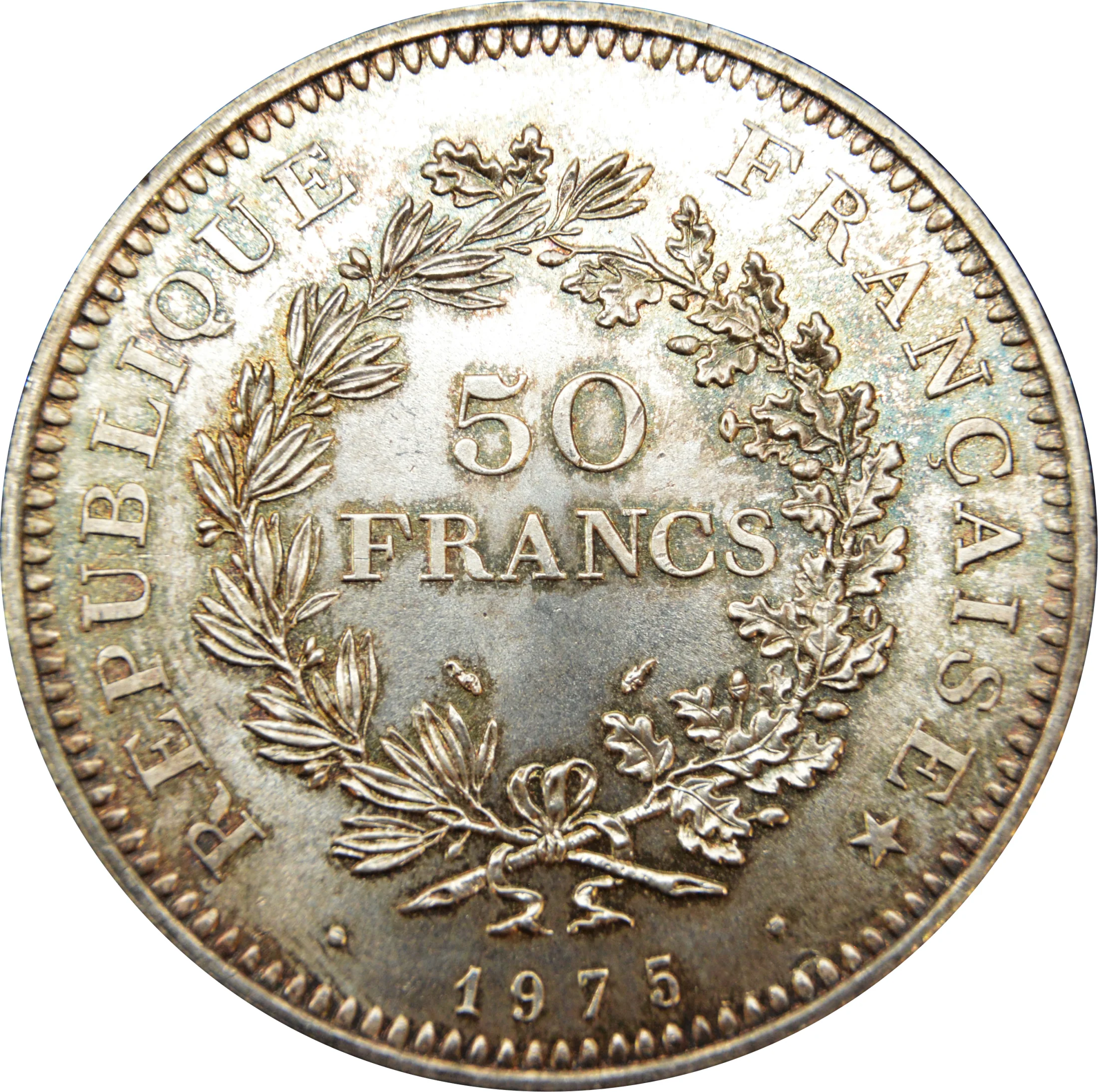
Obverse
Description:
Denomination in wreath, date below.
Inscription:
REPUBLIQUE FRANÇAISE
50
FRANCS
⦁ 1975 ⦁
50
FRANCS
⦁ 1975 ⦁
Translation:
FRENCH REPUBLIC
50
FRANCS
⦁ 1975 ⦁
50
FRANCS
⦁ 1975 ⦁
Script: Latin
Language: French
Engraver: Atelier de Gravure (A.G.M.M.)
Designer: Augustin Dupré
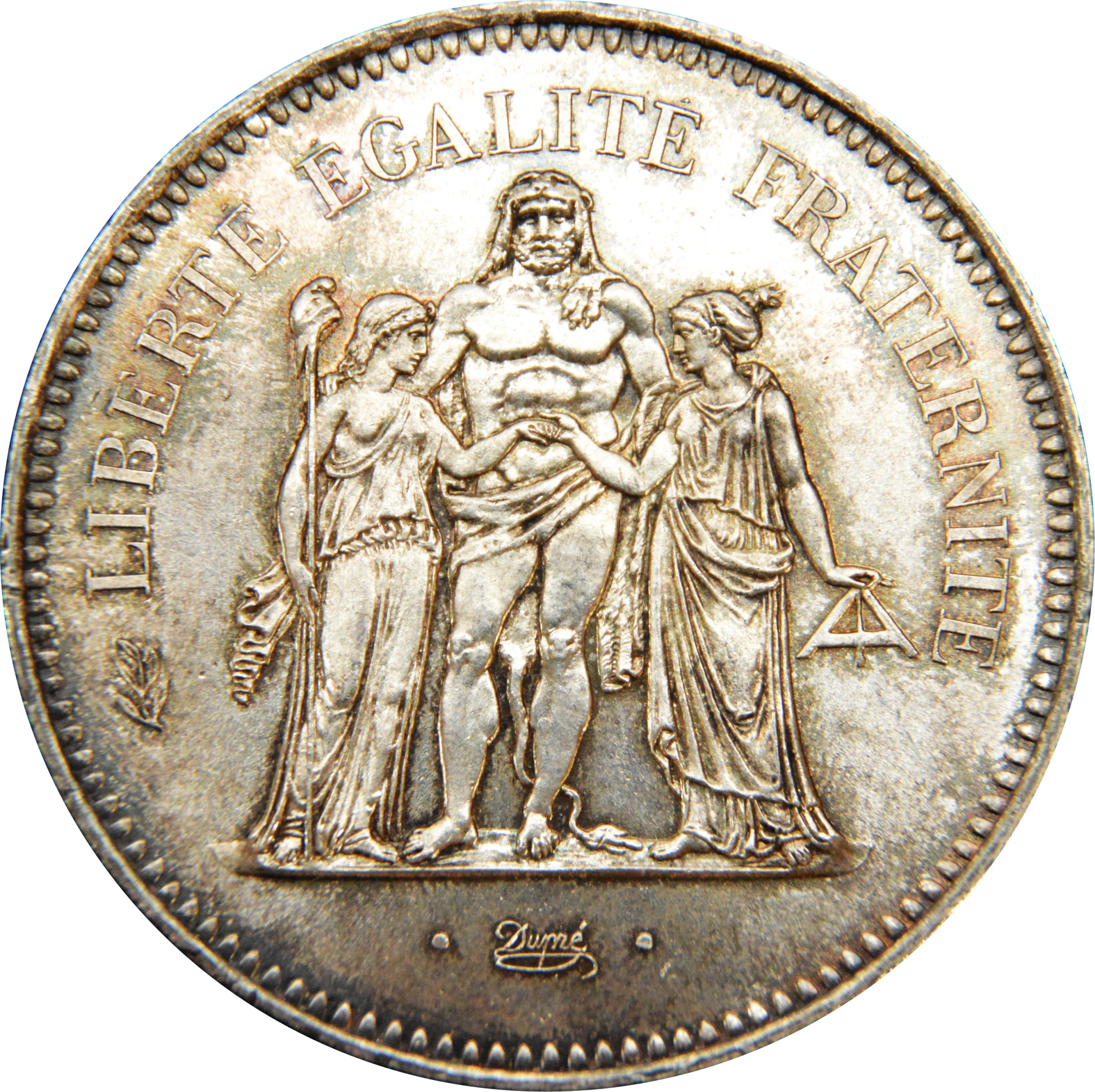
Reverse
Description:
Liberty and Equality, reconciled with Fraternity by Hercules.
Inscription:
LIBERTÉ ÉGALITÉ FRATERNITÉ
⦁ Dupré ⦁
⦁ Dupré ⦁
Translation:
Liberty, Equality, Fraternity
• Dupré •
• Dupré •
Script: Latin
Language: French
Engraver: Atelier de Gravure (A.G.M.M.)
Designer: Augustin Dupré
Edge
Designs in relief
Mints
| Name | Mark |
|---|---|
| Monnaie de Paris | — |
Mintings
| Year | Mint Mark | Mintage | Quality | Collection |
|---|---|---|---|---|
| 1974 | — | — | ||
| 1975 | — | 4,552,011 | ||
| 1976 | — | 5,544,711 | ||
| 1977 | — | 7,884,011 | ||
| 1978 | — | 12,030,211 | ||
| 1979 | — | 12,040,511 | ||
| 1980 | — | 60,000 | In sets |
Historical background
In 1974, France's currency situation was defined by its participation in the European "currency snake," a mechanism designed to limit exchange rate fluctuations between European Community members. This system, established in 1972, required France to keep the franc within a narrow 2.25% band against other participating currencies, notably the powerful German Deutsche Mark. However, this commitment proved challenging amidst the global economic turmoil triggered by the 1973 oil crisis, which fueled inflation and widened trade deficits across Europe, putting severe pressure on the franc.
Domestically, the new presidency of Valéry Giscard d'Estaing, who took office in May 1974, inherited an economy struggling with rising inflation and a weakening external position. The government's priority was to maintain monetary stability and defend the franc's parity within the snake, a policy seen as crucial for anchoring France to German economic discipline and controlling inflation. This often required supportive interventions from the Banque de France, utilizing foreign currency reserves to buy francs and prop up its value, alongside domestic tightening measures.
Despite these efforts, the fundamental pressures proved overwhelming. In January 1974, France had already been forced to temporarily exit the snake, only to re-enter it two months later. The strain continued, and by 1975, the situation would become untenable. Thus, the currency background of 1974 was one of a fragile and costly defense of a fixed exchange rate, setting the stage for France's eventual second and final exit from the snake in 1976, which marked a pivotal moment in the long and difficult European journey toward monetary union.
Domestically, the new presidency of Valéry Giscard d'Estaing, who took office in May 1974, inherited an economy struggling with rising inflation and a weakening external position. The government's priority was to maintain monetary stability and defend the franc's parity within the snake, a policy seen as crucial for anchoring France to German economic discipline and controlling inflation. This often required supportive interventions from the Banque de France, utilizing foreign currency reserves to buy francs and prop up its value, alongside domestic tightening measures.
Despite these efforts, the fundamental pressures proved overwhelming. In January 1974, France had already been forced to temporarily exit the snake, only to re-enter it two months later. The strain continued, and by 1975, the situation would become untenable. Thus, the currency background of 1974 was one of a fragile and costly defense of a fixed exchange rate, setting the stage for France's eventual second and final exit from the snake in 1976, which marked a pivotal moment in the long and difficult European journey toward monetary union.
🌱 Very Common