

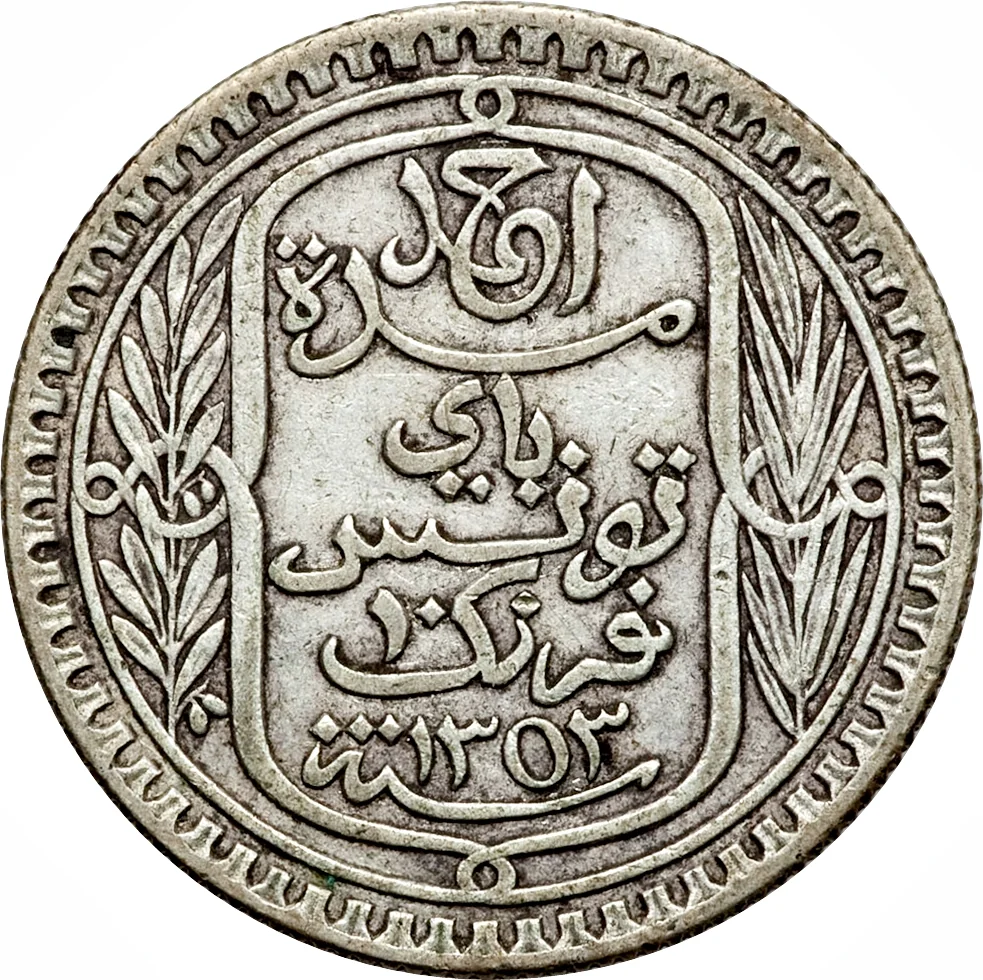
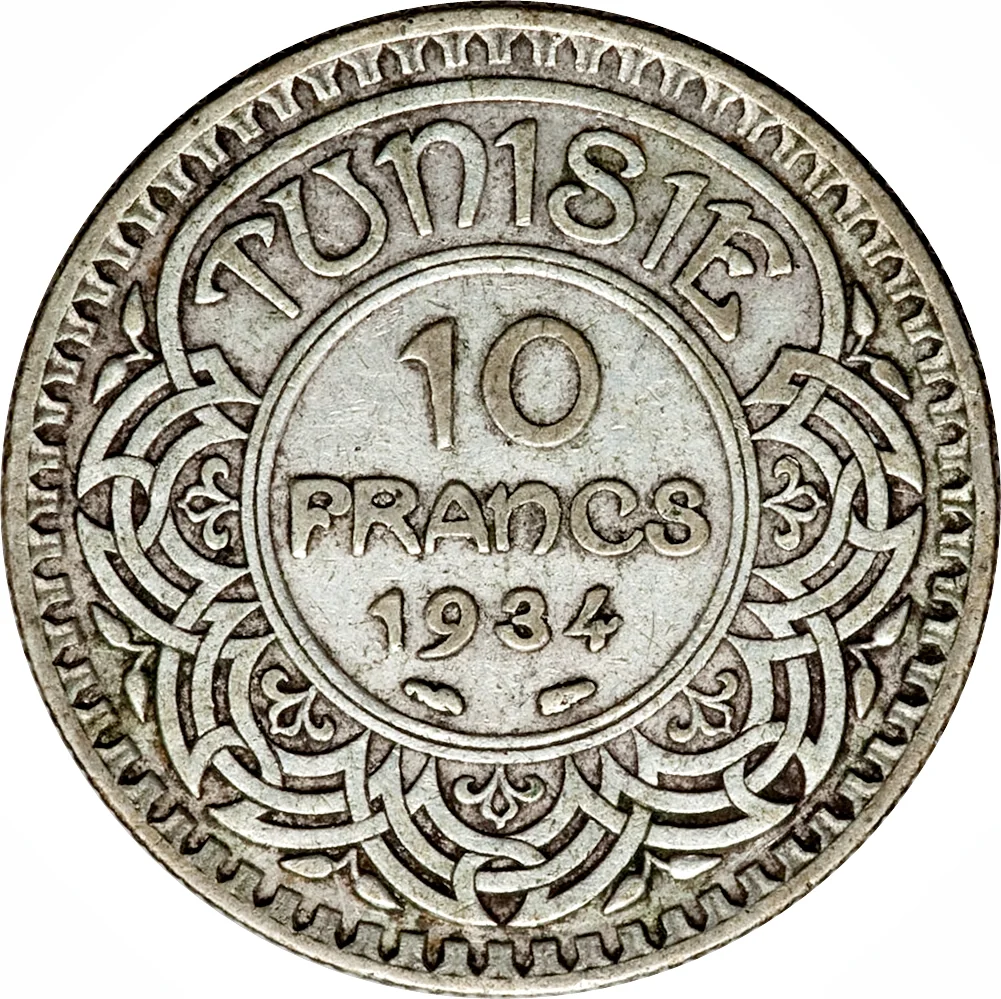
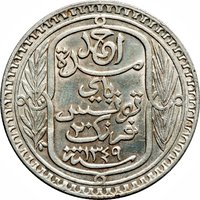
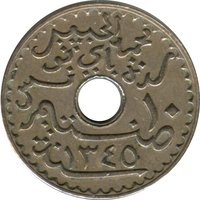
Obverse
Edge
Reeded
Mints
| Name | Mark |
|---|---|
| Monnaie de Paris | — |
Mintings
| Year | Mint Mark | Mintage | Quality | Collection |
|---|---|---|---|---|
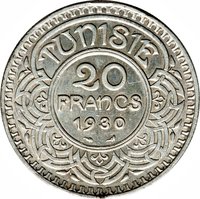
| 1930 | — | 60,000 | ||
| 1931 | — | 1,103 | ||
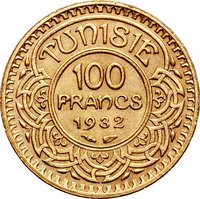
| 1932 | — | 60,000 | ||
| 1933 | — | 1,103 | ||
| 1934 | — | 30,000 |
Historical background
In 1930, Tunisia operated under a dual currency system, a direct legacy of its status as a French protectorate established in 1881. The official currency was the Tunisian franc, which was pegged at par with the French franc and issued by the Banque de l'Algérie et de la Tunisie, a private French institution granted the privilege of note-issuing. This arrangement firmly integrated Tunisia into the Franc Zone, ensuring monetary stability and facilitating trade and colonial administration by tying the local economy directly to that of metropolitan France.
Alongside the franc, the Spanish piastre (or "riyal") remained in widespread circulation, particularly in the southern and rural regions. This historical currency, also known as the "piece of eight," was a holdover from pre-protectorate Ottoman and Mediterranean trade networks. Its persistent use highlighted the incomplete penetration of the French monetary system and reflected the continued importance of regional trade links across the Maghreb and with Malta, as well as a degree of local distrust towards the colonial banking structure.
Economically, this period was characterized by relative stability under the franc's peg, which benefited French settlers and commercial exporters tied to the French market. However, the system primarily served French imperial interests, channeling capital and facilitating the export of Tunisian minerals and agricultural products. For much of the local population, the coexisting currencies symbolized the duality of the protectorate itself: a modernizing colonial economy superimposed upon traditional social and commercial structures, with monetary policy decisively controlled from Paris for colonial advantage.
Alongside the franc, the Spanish piastre (or "riyal") remained in widespread circulation, particularly in the southern and rural regions. This historical currency, also known as the "piece of eight," was a holdover from pre-protectorate Ottoman and Mediterranean trade networks. Its persistent use highlighted the incomplete penetration of the French monetary system and reflected the continued importance of regional trade links across the Maghreb and with Malta, as well as a degree of local distrust towards the colonial banking structure.
Economically, this period was characterized by relative stability under the franc's peg, which benefited French settlers and commercial exporters tied to the French market. However, the system primarily served French imperial interests, channeling capital and facilitating the export of Tunisian minerals and agricultural products. For much of the local population, the coexisting currencies symbolized the duality of the protectorate itself: a modernizing colonial economy superimposed upon traditional social and commercial structures, with monetary policy decisively controlled from Paris for colonial advantage.
⭐ Rare