

10 centimes – Tunisia
Add to wishlist
Tunisia
Context
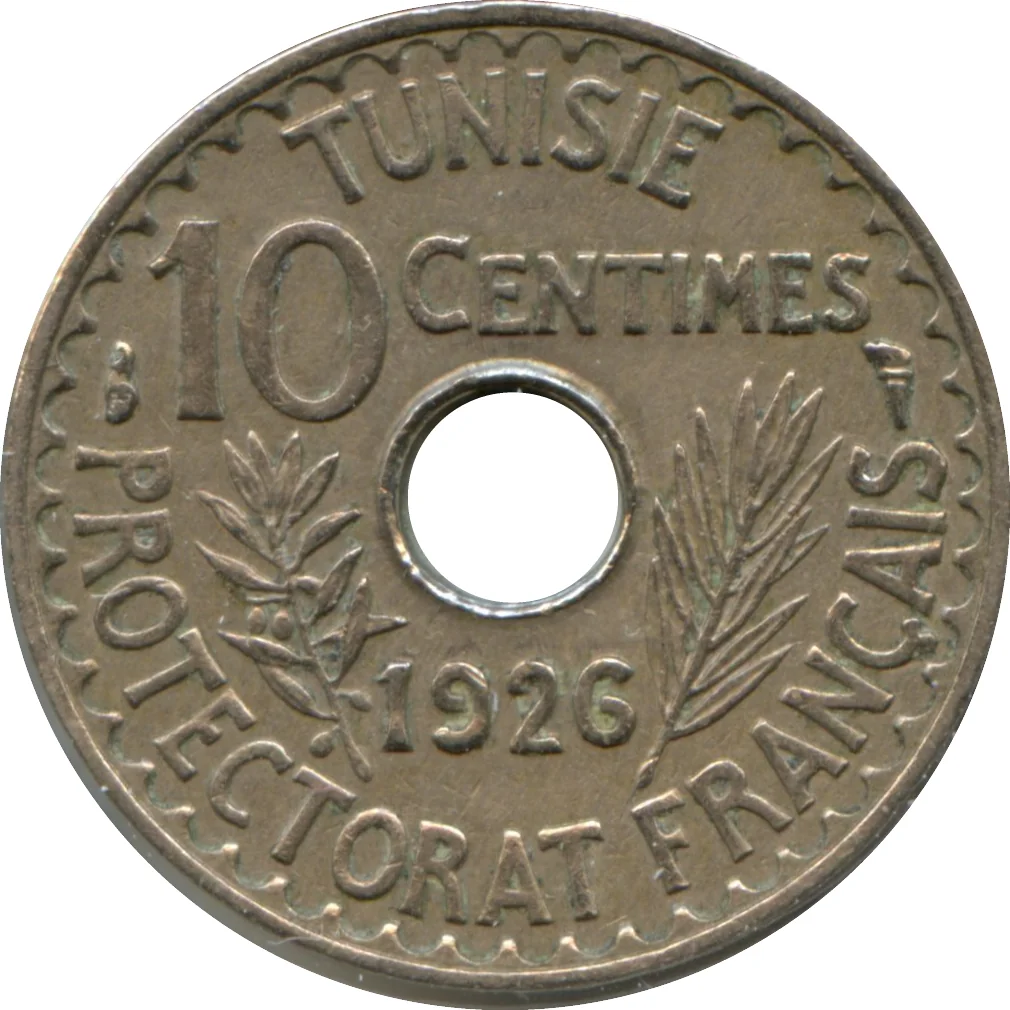
Year: 1926
Islamic (Hijri) Year:: 1345
Issuer: Tunisia
Currency:
(1891—1957)
Demonetized: Yes
Total mintage: 1,000,000
Material
Diameter: 21 mm
Weight: 4 g
Shape: Round with a round hole
Composition: Nickel brass
Magnetic: No
Technique: Milled
Alignment: Coin alignment
flip
References
KM: #
Numista: #11226
Value
Exchange value: 0.10 TNF
Obverse
Description:
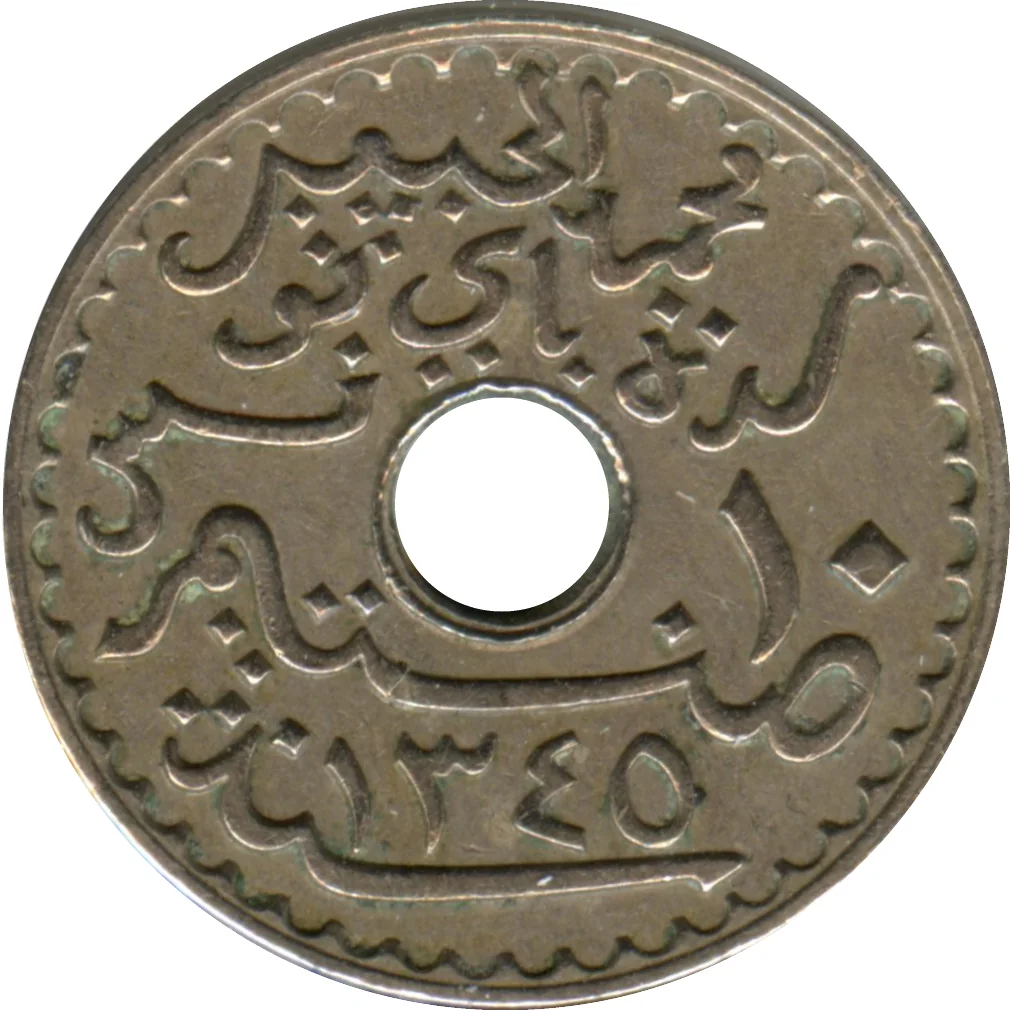
Inscription hole: "Muḥammad al-Ḥabīb Bāy, King of Tunisia, 10 centimes, Year 1345."
Inscription:
محمد الحبيب باي
ملك تونس
١٠ صنتيم
١٣٤٥ سنة
ملك تونس
١٠ صنتيم
١٣٤٥ سنة
Translation:
Muhammad al-Habib Bey
King of Tunisia
10 Centimes
Year 1345
King of Tunisia
10 Centimes
Year 1345
Script: Arabic
Language: Arabic
Engraver: Henri-Auguste Patey
Reverse
Edge
Plain
Mints
| Name | Mark |
|---|---|
| Monnaie de Paris | — |
Mintings
| Year | Mint Mark | Mintage | Quality | Collection |
|---|---|---|---|---|
| 1926 | — | 1,000,000 |
Historical background
In 1926, Tunisia's currency situation was defined by its status as a French protectorate, established in 1881. The monetary system was formally integrated into the Franc Zone, with the French franc serving as the legal tender. However, the practical reality was more complex, as the country operated under a unique dual-currency system. Alongside the franc, the Tunisian rial, a legacy of the pre-protectorate Ottoman and local monetary traditions, remained in widespread use for everyday transactions, particularly in rural areas and traditional markets. This created a persistent exchange calculation between the two units.
The core economic pressure in 1926 stemmed from a significant divergence in value between the metallic rial and the paper franc. The rial, historically pegged to silver, had retained much of its intrinsic value, while the French franc had been severely weakened by inflation following World War I. This led to a problematic disparity where the official fixed exchange rate (1 rial = 10 francs since 1891) no longer reflected market reality. The stronger silver-backed rial was effectively undervalued, causing economic distortions, hoarding of silver coins, and difficulties in fiscal administration for the French authorities.
Consequently, 1926 was a pivotal year of transition. On July 1, the protectorate administration enacted a major monetary reform to resolve this instability. The Tunisian franc was introduced as a new distinct currency, replacing both the French franc and the rial as the sole legal tender. It was pegged at par to the French franc but was intended to be more stable and uniquely Tunisian. This reform successfully unified the monetary system, ended the cumbersome dual circulation, and further tightened Tunisia's economic integration with France, solidifying colonial financial control for decades to come.
The core economic pressure in 1926 stemmed from a significant divergence in value between the metallic rial and the paper franc. The rial, historically pegged to silver, had retained much of its intrinsic value, while the French franc had been severely weakened by inflation following World War I. This led to a problematic disparity where the official fixed exchange rate (1 rial = 10 francs since 1891) no longer reflected market reality. The stronger silver-backed rial was effectively undervalued, causing economic distortions, hoarding of silver coins, and difficulties in fiscal administration for the French authorities.
Consequently, 1926 was a pivotal year of transition. On July 1, the protectorate administration enacted a major monetary reform to resolve this instability. The Tunisian franc was introduced as a new distinct currency, replacing both the French franc and the rial as the sole legal tender. It was pegged at par to the French franc but was intended to be more stable and uniquely Tunisian. This reform successfully unified the monetary system, ended the cumbersome dual circulation, and further tightened Tunisia's economic integration with France, solidifying colonial financial control for decades to come.
🌱 Fairly Common