

25 pounds (Corrective Movement) – Syria
Add to wishlist
Circulating commemorative coins
Commemoration: 25th Anniversary of the Corrective Movement
Syria
Context
Year: 1995
Islamic (Hijri) Year:: 1416
Issuer: Syria
Period:
(since 1961)
Currency:
(since 1919)
Total mintage: 15,000,000
Material
References
KM: #
Numista: #6972
Value
Exchange value: 25 SYP
Obverse
Description:
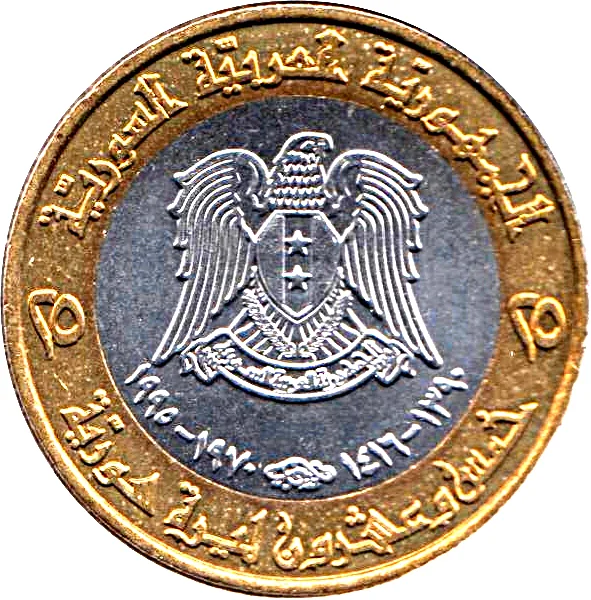
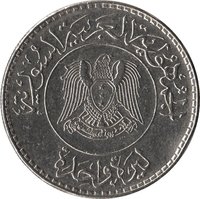
Syrian coat of arms: A Quraish hawk holding a shield with two stars and a scroll inscribed "Syrian Arab Republic." Arabic dates below, with the value ٢٥ on both sides.
Inscription:
الجمهورية العربية السورية
٢٥ ٢٥
١٣٩٥ - ١٤١٦ ١٩٧٠ - ١٩٩٥
خمس وعشرون ليرة سورية
٢٥ ٢٥
١٣٩٥ - ١٤١٦ ١٩٧٠ - ١٩٩٥
خمس وعشرون ليرة سورية
Translation:
Syrian Arab Republic
25 25
1395 - 1416 1970 - 1995
Twenty-five Syrian pounds
25 25
1395 - 1416 1970 - 1995
Twenty-five Syrian pounds
Script: Arabic
Language: Arabic
Reverse
Description:
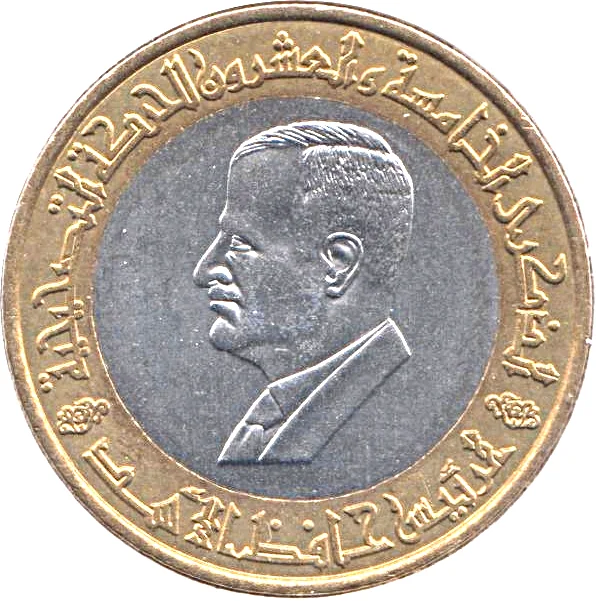
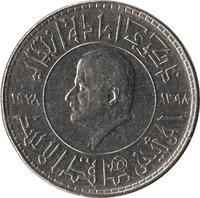
Portrait of Hafez Al-Assad facing left.
Inscription:
الذكرى الخامسة والعشرون للحركة التصحيحية
الرئيس حافظ الأسد
الرئيس حافظ الأسد
Translation:
The Twenty-Fifth Anniversary of the Corrective Movement
President Hafez al-Assad
President Hafez al-Assad
Script: Arabic
Language: Arabic
Engraver: Bernard Turlan
Edge
Reeded
Categories
| Animal> Bird |
| Person> Politician |
| Symbols> Coat of Arms |
Mints
| Name | Mark |
|---|---|
| Monnaie de Paris | — |
Mintings
| Year | Mint Mark | Mintage | Quality | Collection |
|---|---|---|---|---|
| 1995 | — | 15,000,000 |
Historical background
In 1995, Syria's currency situation was characterized by strict state control and a significant divergence between the official and black-market exchange rates. The Syrian Pound (SYP) was pegged to the U.S. Dollar at an official rate of 11.2 pounds to the dollar, a rate maintained by the government of President Hafez al-Assad for over a decade. This fixed rate was a cornerstone of the state's centralized economic policy, intended to project stability and control within the country's socialist-oriented economy, which was heavily dependent on oil exports, agriculture, and remittances from abroad.
However, this official peg was largely artificial and unsustainable due to underlying economic weaknesses, including declining oil revenues, inefficient state-owned enterprises, and a growing budget deficit. Consequently, a vibrant black market for foreign currency flourished, where the pound traded at a steep discount. By 1995, the parallel market rate was approximately 50 SYP to the dollar, more than four times weaker than the official rate. This wide gap reflected a lack of confidence in the currency, pressures from international sanctions, and the demands of a large informal sector that relied on hard currency for trade.
The dual-rate system created major distortions in the economy. It privileged a small group with access to cheap dollars at the official rate—often state entities and loyalists—while the general population and private businesses faced much higher costs for imports and foreign transactions on the black market. This environment encouraged corruption, smuggling, and capital flight, as individuals and businesses sought to circumvent stringent currency controls. Thus, while superficially stable in official terms, the 1995 Syrian pound was under severe pressure, exposing the growing contradictions within the country's managed economy.
However, this official peg was largely artificial and unsustainable due to underlying economic weaknesses, including declining oil revenues, inefficient state-owned enterprises, and a growing budget deficit. Consequently, a vibrant black market for foreign currency flourished, where the pound traded at a steep discount. By 1995, the parallel market rate was approximately 50 SYP to the dollar, more than four times weaker than the official rate. This wide gap reflected a lack of confidence in the currency, pressures from international sanctions, and the demands of a large informal sector that relied on hard currency for trade.
The dual-rate system created major distortions in the economy. It privileged a small group with access to cheap dollars at the official rate—often state entities and loyalists—while the general population and private businesses faced much higher costs for imports and foreign transactions on the black market. This environment encouraged corruption, smuggling, and capital flight, as individuals and businesses sought to circumvent stringent currency controls. Thus, while superficially stable in official terms, the 1995 Syrian pound was under severe pressure, exposing the growing contradictions within the country's managed economy.
🌱 Common