

10 pounds (Ba'ath Party) – Syria
Add to wishlist
Circulating commemorative coins
Commemoration: 50th Anniversary of Ba'ath Party
Syria
Context
Year: 1997
Islamic (Hijri) Year:: 1417
Issuer: Syria
Period:
(since 1961)
Currency:
(since 1919)
Total mintage: 100,000
Material
Diameter: 26.5 mm
Weight: 7 g
Thickness: 1.65 mm
Shape: Round
Composition: Copper-nickel
Technique: Milled
Alignment: Medal alignment
flip
References
KM: #
Numista: #6509
Value
Exchange value: 10 SYP
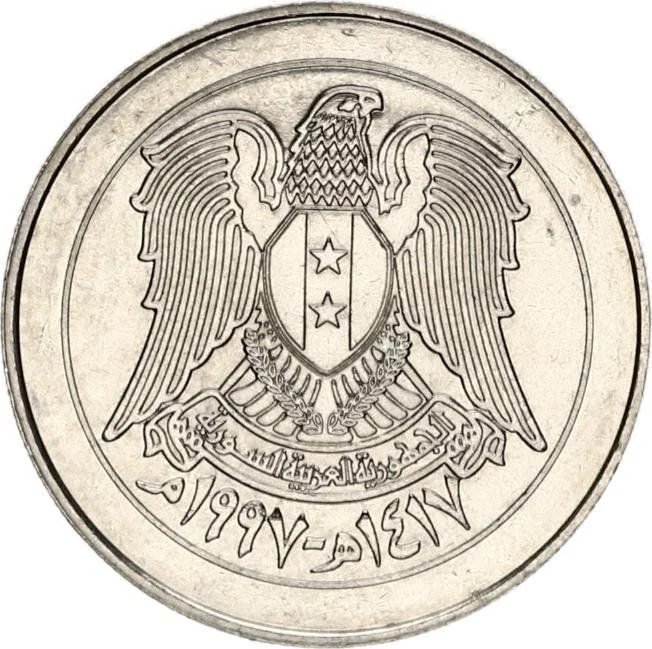
Obverse
Description:
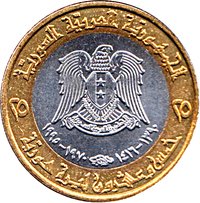
Syria's coat of arms: the Quraish hawk holding a shield with two stars and a scroll bearing the country's Arabic name. Arabic numeral dates (AD and AH) below.
Inscription:
الجمهورية العربية السورية
١٤١٧هـ - ١٩٩٧مـ
١٤١٧هـ - ١٩٩٧مـ
Translation:
The Syrian Arab Republic
1417H - 1997AD
1417H - 1997AD
Script: Arabic
Language: Arabic
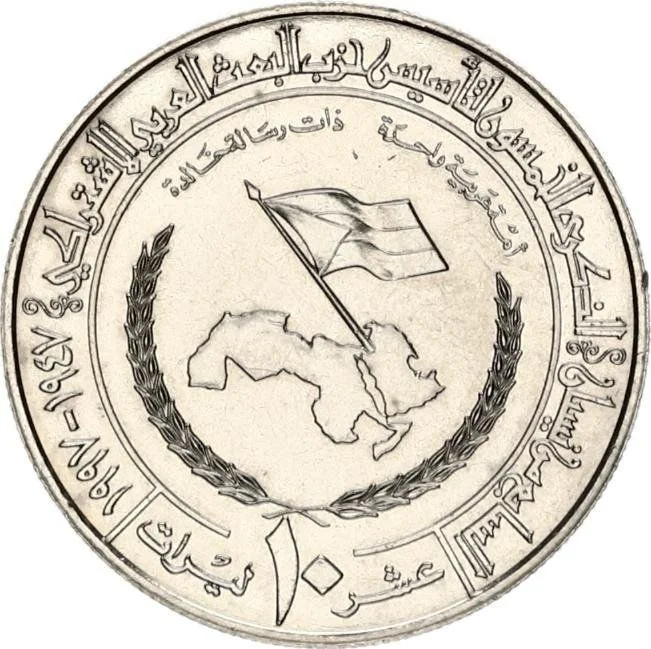
Reverse
Description:
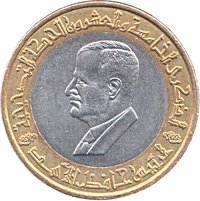
Ba'ath Party emblem: the Arab League map with the party flag planted upon it.
Inscription:
السابع من نيسان - الذكرى الخمسون لتاسيس حزب البعث العربي الإشتراكي
١٩٤٧-١٩٩٧
عشر ١٠ ليرات
١٩٤٧-١٩٩٧
عشر ١٠ ليرات
Translation:
The Seventh of April - The Fiftieth Anniversary of the Founding of the Arab Socialist Ba'ath Party
1947-1997
Ten 10 Liras
1947-1997
Ten 10 Liras
Script: Arabic
Language: Arabic
Edge
Reeded
Mintings
| Year | Mint Mark | Mintage | Quality | Collection |
|---|---|---|---|---|
| 1997 | — | 100,000 |
Historical background
In 1997, Syria's currency situation was characterized by a rigid, state-controlled system centered on the Syrian Pound (SYP). The government of President Hafez al-Assad maintained an official fixed exchange rate, which was pegged at an artificially high value, approximately 11.2 SYP to 1 US Dollar. This official rate was reserved for strategic imports, government transactions, and select public sector industries, creating a heavily subsidized economic channel. However, this policy did not reflect the currency's true market value, leading to a significant disparity with the parallel (black) market rate.
The reality for most commercial and personal transactions existed in this vibrant parallel market, where the Syrian Pound traded at a steep discount. By 1997, the black-market rate was roughly 50-55 SYP per US Dollar, nearly five times weaker than the official peg. This dual-system created major economic distortions, encouraging corruption and rent-seeking as individuals with access to cheap official dollars could profit immensely. It also hampered legitimate private sector growth, as most businesses had to source foreign currency at the costly parallel rate to pay for imports, fueling inflation and reducing competitiveness.
This entrenched dual-exchange regime was a symptom of Syria's broader, struggling state-led economy. Heavily dependent on declining oil revenues and facing structural inefficiencies, the government used currency controls to manage scarce foreign reserves and shield priority sectors. The growing gap between the official and black-market rates in 1997 signaled underlying economic pressures that would intensify in the following decades, setting the stage for future monetary crises long before the devastating conflict that began in 2011.
The reality for most commercial and personal transactions existed in this vibrant parallel market, where the Syrian Pound traded at a steep discount. By 1997, the black-market rate was roughly 50-55 SYP per US Dollar, nearly five times weaker than the official peg. This dual-system created major economic distortions, encouraging corruption and rent-seeking as individuals with access to cheap official dollars could profit immensely. It also hampered legitimate private sector growth, as most businesses had to source foreign currency at the costly parallel rate to pay for imports, fueling inflation and reducing competitiveness.
This entrenched dual-exchange regime was a symptom of Syria's broader, struggling state-led economy. Heavily dependent on declining oil revenues and facing structural inefficiencies, the government used currency controls to manage scarce foreign reserves and shield priority sectors. The growing gap between the official and black-market rates in 1997 signaled underlying economic pressures that would intensify in the following decades, setting the stage for future monetary crises long before the devastating conflict that began in 2011.
🌱 Common