

1 pound – Syria
Add to wishlist
Circulating commemorative coins
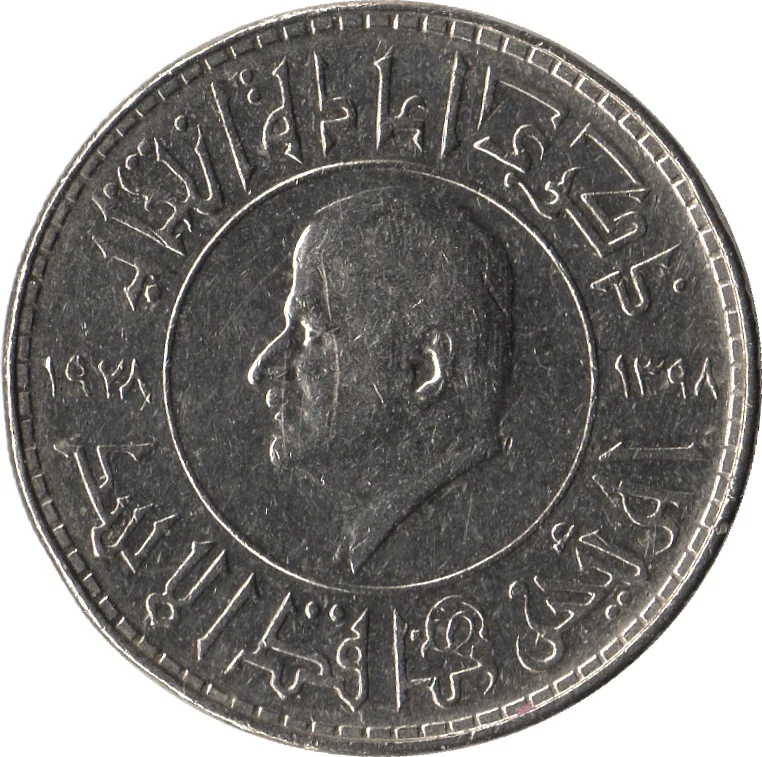
Commemoration: Re-election of President Assad
Syria
Context
Year: 1978
Islamic (Hijri) Year:: 1398
Issuer: Syria
Period:
(since 1961)
Currency:
(since 1919)
Demonetized: Yes
Material
References
KM: #
Numista: #2681
Value
Exchange value: 1 SYP
Obverse
Description:
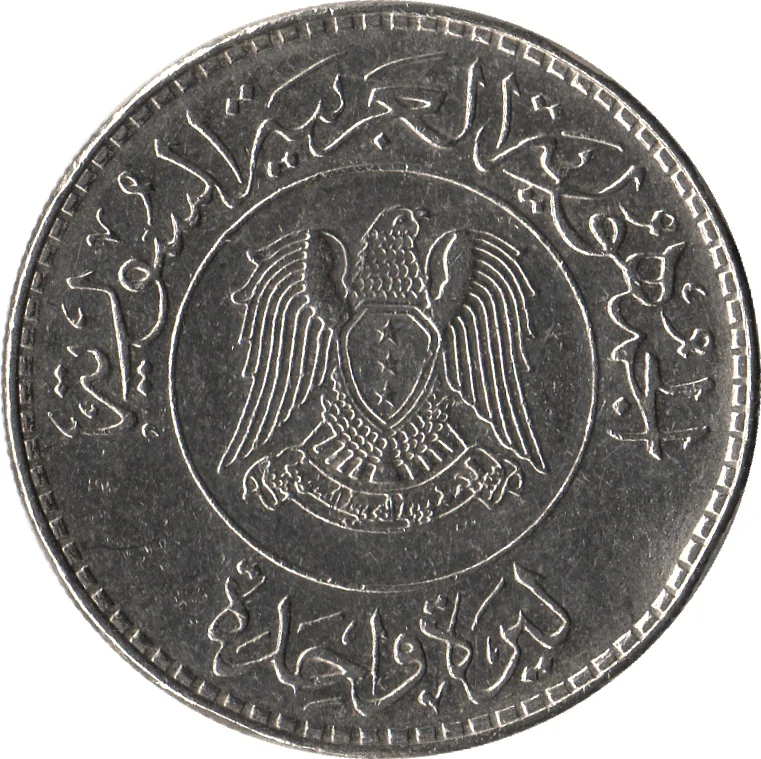
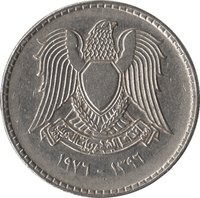
Syria's coat of arms: the Quraish hawk holding a shield with three stars and a scroll reading "Syrian Arab Republic" in Arabic.
Inscription:
الجمهورية العربية السورية
الجمهورية العربية السورية
ليرة واحدة
الجمهورية العربية السورية
ليرة واحدة
Translation:
Syrian Arab Republic
Syrian Arab Republic
One Lira
Syrian Arab Republic
One Lira
Script: Arabic
Language: Arabic
Reverse
Edge
Reeded
Categories
| Animal> Bird |
| Person> Politician |
| Symbols> Coat of Arms |
Mintings
| Year | Mint Mark | Mintage | Quality | Collection |
|---|---|---|---|---|
| 1978 | — | — |
Historical background
In 1978, Syria's currency situation was characterized by relative stability and strong state control, a marked contrast to the severe crises that would emerge in later decades. The Syrian Pound (S£) was a fixed, overvalued currency, officially pegged to the U.S. Dollar at a rate of approximately S£3.90 to $1. This peg was maintained through strict exchange controls administered by the Central Bank of Syria, which monopolized all foreign currency transactions. The government's socialist-oriented economic policies, including heavy subsidies on basic goods and significant public sector employment, were funded by robust revenues from oil exports, which had begun flowing in commercial quantities in the mid-1970s.
This stability, however, masked underlying economic pressures and a growing disconnect from market realities. The fixed exchange rate, combined with high levels of public spending, contributed to inflationary pressures that were not fully reflected in the official figures. Furthermore, the overvalued pound discouraged non-oil exports and encouraged smuggling and the emergence of a small black market for foreign currency, where the dollar traded at a modest premium. The economy was becoming increasingly dependent on oil income and remittances from Syrian workers in the Gulf, making it vulnerable to external shocks.
Overall, the currency regime in 1978 functioned as a key tool for the Hafez al-Assad government to project an image of economic strength and social stability. It allowed for the financing of a large military and security apparatus while subsidizing the cost of living for the urban population, a crucial part of the regime's social contract. However, the system's rigidity and the suppression of market signals sowed the seeds for future difficulties, which would become acute as oil revenues fluctuated and population growth strained the state-led economic model in the coming decades.
This stability, however, masked underlying economic pressures and a growing disconnect from market realities. The fixed exchange rate, combined with high levels of public spending, contributed to inflationary pressures that were not fully reflected in the official figures. Furthermore, the overvalued pound discouraged non-oil exports and encouraged smuggling and the emergence of a small black market for foreign currency, where the dollar traded at a modest premium. The economy was becoming increasingly dependent on oil income and remittances from Syrian workers in the Gulf, making it vulnerable to external shocks.
Overall, the currency regime in 1978 functioned as a key tool for the Hafez al-Assad government to project an image of economic strength and social stability. It allowed for the financing of a large military and security apparatus while subsidizing the cost of living for the urban population, a crucial part of the regime's social contract. However, the system's rigidity and the suppression of market signals sowed the seeds for future difficulties, which would become acute as oil revenues fluctuated and population growth strained the state-led economic model in the coming decades.
🌱 Common