

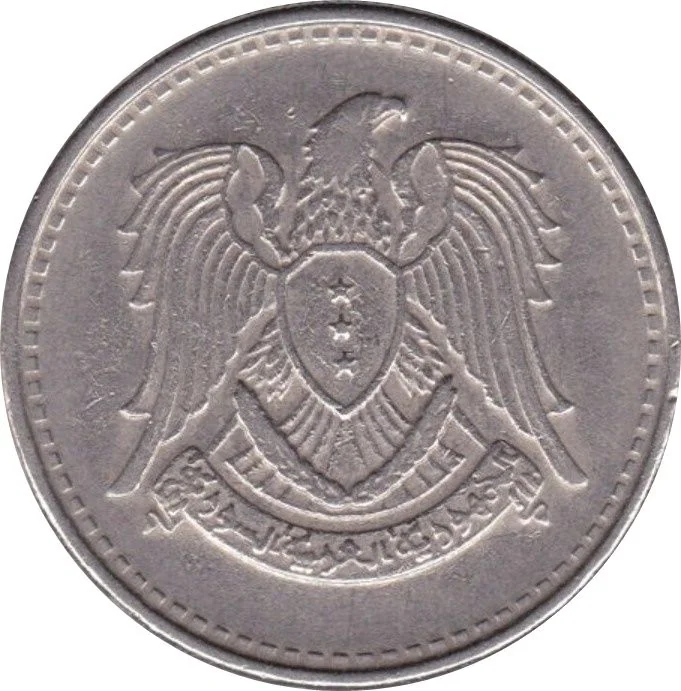
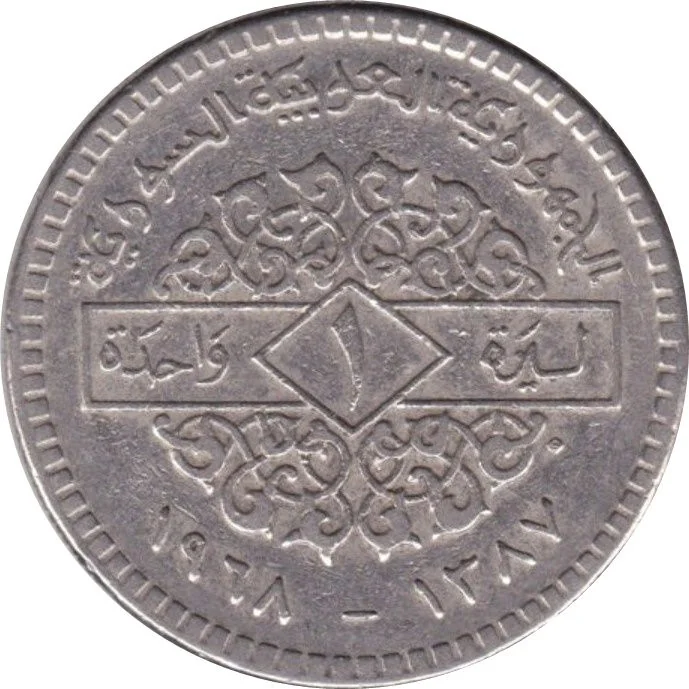
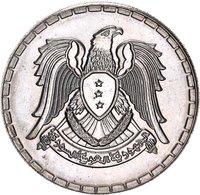
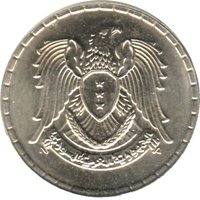
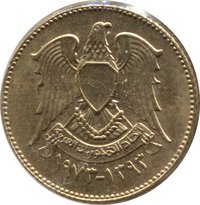
Obverse
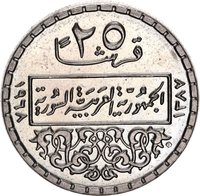
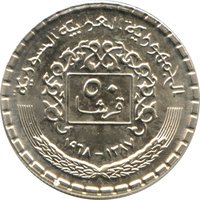
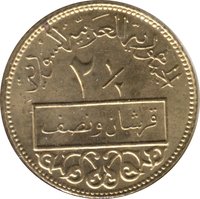
Reverse
Edge
Reeded
Categories
| Animal> Bird |
| Symbols> Coat of Arms |
Mintings
| Year | Mint Mark | Mintage | Quality | Collection |
|---|---|---|---|---|
| 1968 | — | — | ||
| 1971 | — | 10,000,000 |
Historical background
In 1968, Syria's currency situation was characterized by relative stability under the centralized economic planning of the Ba'athist government, which had consolidated power in 1963. The Syrian pound (also known as the lira) was a non-convertible currency, its value and circulation tightly controlled by the state through the Central Bank of Syria. This period followed the 1961 breakup of the United Arab Republic with Egypt, after which Syria re-established its own independent monetary authority and currency, moving away from the shared currency union.
Economically, the country was pursuing a socialist model, emphasizing nationalization, agrarian reform, and state-led industrial development. This insulated the currency from international market fluctuations but also limited foreign exchange reserves and trade flexibility. The pound's official exchange rate was fixed by the government, primarily for planning purposes, while a modest black market for foreign currencies existed to facilitate trade not sanctioned by the state. Inflation was not a major crisis at this time, as price controls and subsidies on essential goods were key features of the state economy.
Regionally, the currency's context was dominated by the aftermath of the Six-Day War in June 1967, a profound political and economic shock. The loss of the strategic Golan Heights to Israel damaged agricultural output and morale, while increased military expenditure strained the state budget. However, by 1968, the immediate financial turmoil had subsided into a managed austerity, with the currency stability reflecting the regime's tight grip on the economy rather than underlying economic strength. This controlled environment set the stage for the economic challenges that would emerge in subsequent decades.
Economically, the country was pursuing a socialist model, emphasizing nationalization, agrarian reform, and state-led industrial development. This insulated the currency from international market fluctuations but also limited foreign exchange reserves and trade flexibility. The pound's official exchange rate was fixed by the government, primarily for planning purposes, while a modest black market for foreign currencies existed to facilitate trade not sanctioned by the state. Inflation was not a major crisis at this time, as price controls and subsidies on essential goods were key features of the state economy.
Regionally, the currency's context was dominated by the aftermath of the Six-Day War in June 1967, a profound political and economic shock. The loss of the strategic Golan Heights to Israel damaged agricultural output and morale, while increased military expenditure strained the state budget. However, by 1968, the immediate financial turmoil had subsided into a managed austerity, with the currency stability reflecting the regime's tight grip on the economy rather than underlying economic strength. This controlled environment set the stage for the economic challenges that would emerge in subsequent decades.
🌱 Very Common