

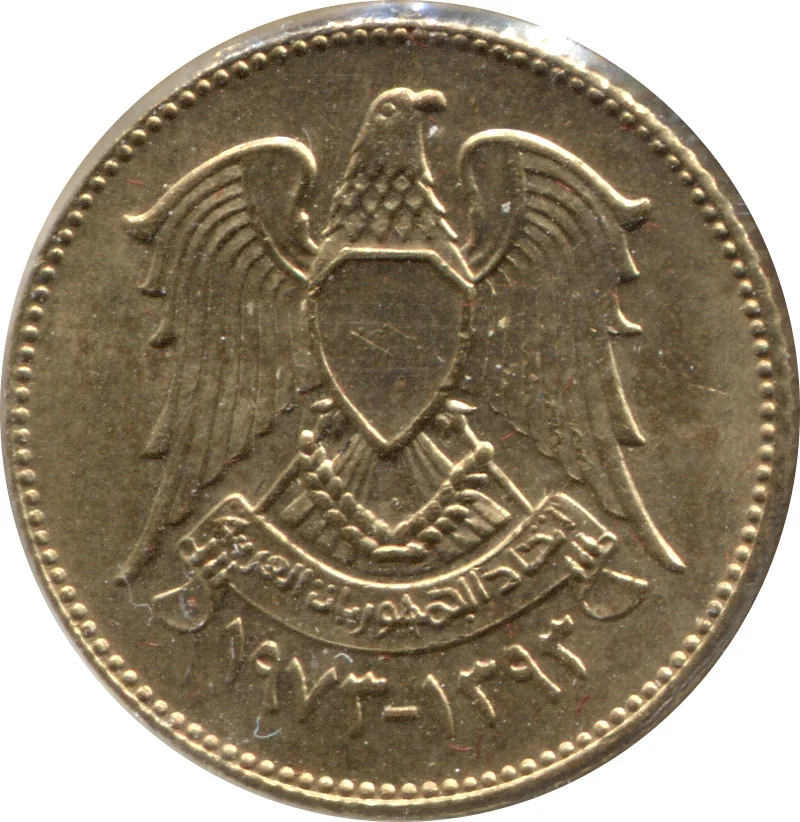
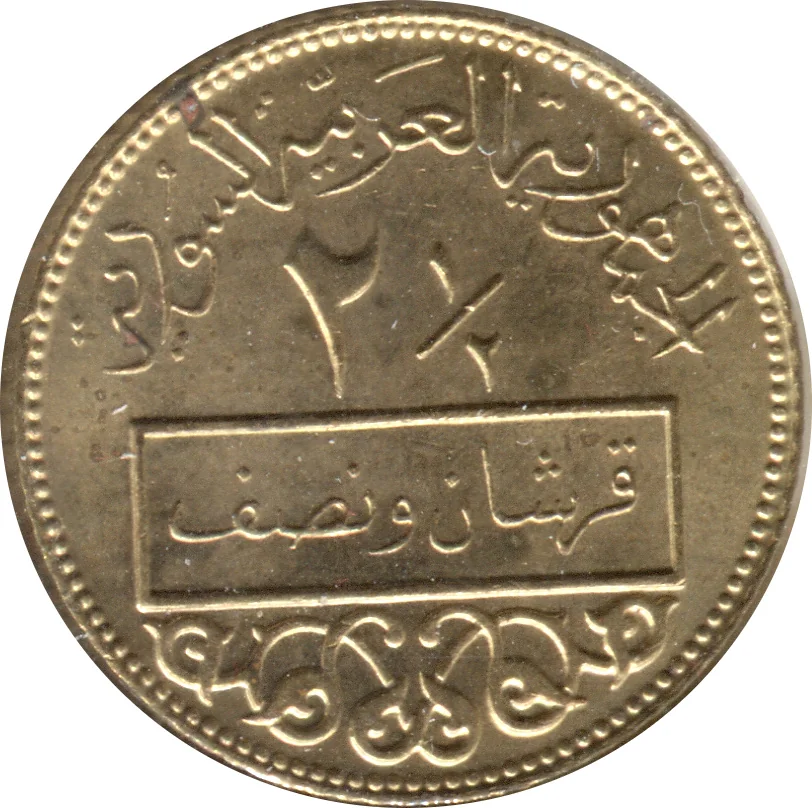
2½ piastres – Syria
Add to wishlist
Syria
Context
Year: 1973
Islamic (Hijri) Year:: 1393
Issuer: Syria
Period:
(since 1961)
Currency:
(since 1919)
Demonetized: Yes
Total mintage: 10,000,000
Material
References
KM: #
Numista: #11425
Value
Exchange value: 0.025 SYP
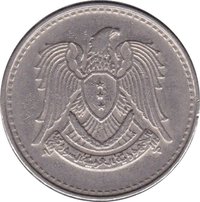
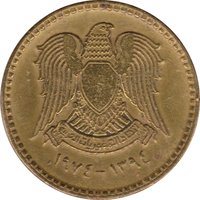
Obverse
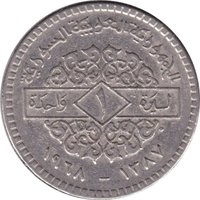
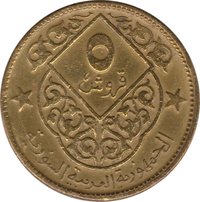
Reverse
Edge
Milled
Categories
| Animal> Bird |
| Symbols> Coat of Arms |
Mints
| Name | Mark |
|---|---|
| Royal Mint | — |
Mintings
| Year | Mint Mark | Mintage | Quality | Collection |
|---|---|---|---|---|
| 1973 | — | 10,000,000 |
Historical background
In 1973, Syria's currency situation was characterized by relative stability and alignment with its socialist economic policies and close ties to the Soviet Union. The official currency, the Syrian pound (SYP), was issued by the Central Bank of Syria and operated under a fixed exchange rate regime. This stability was largely artificial, maintained through strict state control, capital restrictions, and a heavily centralized economy that insulated it from immediate market pressures. The government of President Hafez al-Assad, which had taken power in 1970, prioritized economic planning and nationalization, which extended to firm control over the monetary system.
This controlled environment existed despite significant underlying pressures. Syria's economy was burdened by immense military expenditure, driven by its ongoing conflict with Israel and the goal of achieving "strategic parity." The country was in a perpetual state of military mobilization, with defense spending consuming a substantial portion of the national budget and GDP. Furthermore, while the fixed exchange rate provided nominal stability, it often led to the emergence of a black market for foreign currencies, particularly the US dollar, where the pound traded at a less favorable rate. This disparity hinted at an overvaluation maintained by administrative fiat rather than economic fundamentals.
The major test for the currency came with the outbreak of the October 1973 (Yom Kippur) War. The immense cost of the conflict placed immediate and severe strain on state finances. While direct hyperinflation was not an immediate consequence in 1973, the war's financial aftermath—including massive debt, reconstruction costs, and continued high defense spending—set the stage for future economic difficulties. The fixed exchange rate and controlled system remained in place, but the war exacerbated the fundamental imbalances between state expenditure and productive economic capacity, planting the seeds for the gradual erosion of the pound's value in the decades to follow.
This controlled environment existed despite significant underlying pressures. Syria's economy was burdened by immense military expenditure, driven by its ongoing conflict with Israel and the goal of achieving "strategic parity." The country was in a perpetual state of military mobilization, with defense spending consuming a substantial portion of the national budget and GDP. Furthermore, while the fixed exchange rate provided nominal stability, it often led to the emergence of a black market for foreign currencies, particularly the US dollar, where the pound traded at a less favorable rate. This disparity hinted at an overvaluation maintained by administrative fiat rather than economic fundamentals.
The major test for the currency came with the outbreak of the October 1973 (Yom Kippur) War. The immense cost of the conflict placed immediate and severe strain on state finances. While direct hyperinflation was not an immediate consequence in 1973, the war's financial aftermath—including massive debt, reconstruction costs, and continued high defense spending—set the stage for future economic difficulties. The fixed exchange rate and controlled system remained in place, but the war exacerbated the fundamental imbalances between state expenditure and productive economic capacity, planting the seeds for the gradual erosion of the pound's value in the decades to follow.
🌱 Fairly Common