

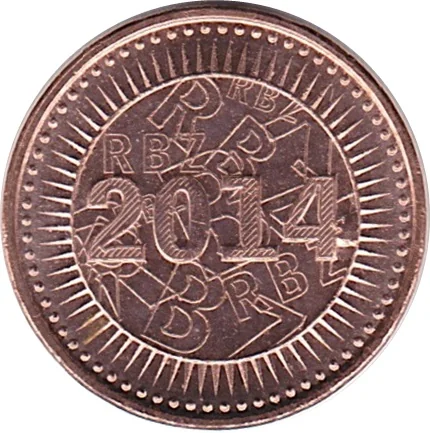
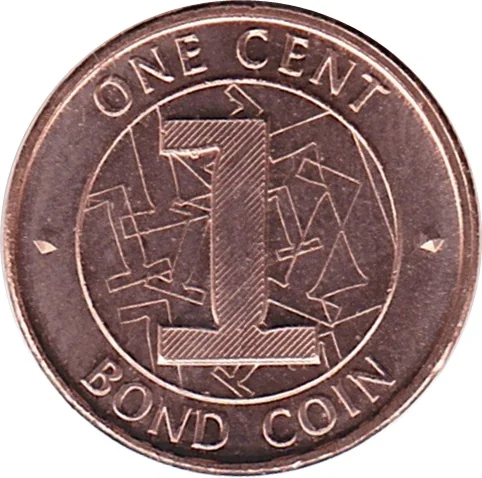
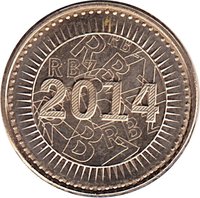
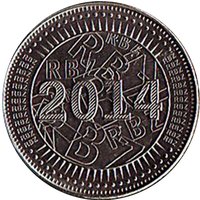
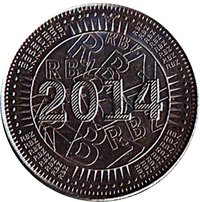
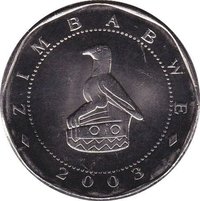
Obverse
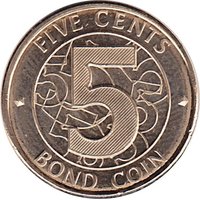
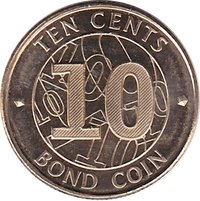
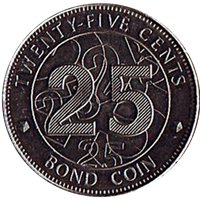
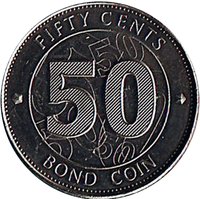
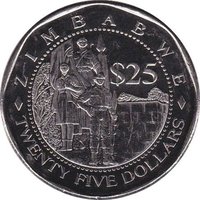
Reverse
Edge
Plain.
Mints
| Name | Mark |
|---|---|
| South African Mint | — |
Mintings
| Year | Mint Mark | Mintage | Quality | Collection |
|---|---|---|---|---|
| 2014 | — | — |
Historical background
By 2014, Zimbabwe was operating under a complex multi-currency system, having formally abandoned its own hyperinflated Zimbabwean dollar in 2009. The US dollar was the dominant currency for everyday transactions, alongside the South African rand and the Botswana pula. This "dollarization" had brought a crucial period of stability, halting the world-record hyperinflation and allowing supermarkets to restock and the economy to experience a brief recovery. However, this stability came at a significant cost: the country had ceded control of its monetary policy and was entirely reliant on physical inflows of foreign cash, leading to chronic liquidity shortages.
The core problem in 2014 was a severe and growing shortage of US dollars in the formal banking system. Declining exports, particularly in mining and tobacco, coupled with massive public debt and limited foreign investment, meant the country was earning far less foreign currency than it was spending. This resulted in long bank queues, strict withdrawal limits, and the emergence of a thriving black market where US dollars traded at a significant premium to their official value. The government struggled to pay its civil servants and fund imports, creating widespread frustration.
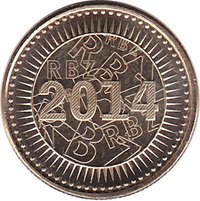
In response to the cash crisis, the Reserve Bank of Zimbabwe introduced a new domestic currency in early 2014: the "Bond Coin," pegged at par to the US dollar. Initially met with deep public skepticism due to traumatic memories of the Zimbabwean dollar, these coins were intended to alleviate the shortage of small change. While they gradually gained acceptance for minor transactions, they did not solve the underlying structural deficit of US dollars. The year 2014 thus represented a precarious and fragile stage of dollarization, where the veneer of stability was cracking, setting the stage for the more radical and controversial monetary experiments that would follow later in the decade.
The core problem in 2014 was a severe and growing shortage of US dollars in the formal banking system. Declining exports, particularly in mining and tobacco, coupled with massive public debt and limited foreign investment, meant the country was earning far less foreign currency than it was spending. This resulted in long bank queues, strict withdrawal limits, and the emergence of a thriving black market where US dollars traded at a significant premium to their official value. The government struggled to pay its civil servants and fund imports, creating widespread frustration.
In response to the cash crisis, the Reserve Bank of Zimbabwe introduced a new domestic currency in early 2014: the "Bond Coin," pegged at par to the US dollar. Initially met with deep public skepticism due to traumatic memories of the Zimbabwean dollar, these coins were intended to alleviate the shortage of small change. While they gradually gained acceptance for minor transactions, they did not solve the underlying structural deficit of US dollars. The year 2014 thus represented a precarious and fragile stage of dollarization, where the veneer of stability was cracking, setting the stage for the more radical and controversial monetary experiments that would follow later in the decade.
Series: 2014 Zimbabwe circulation coins
🌱 Common