

20 Korun / Korún – Czechoslovakia
Context
Years: 1933–1934
Issuer: Czechoslovakia 
Period:
(1918—1938)
Currency:
(1919—1939)
Demonetized: Yes
Total mintage: 5,560,000
Material
References
KM: #Click to copy to clipboard17
Numista: #12629
Value
Bullion value: $24.27
Obverse
Description:
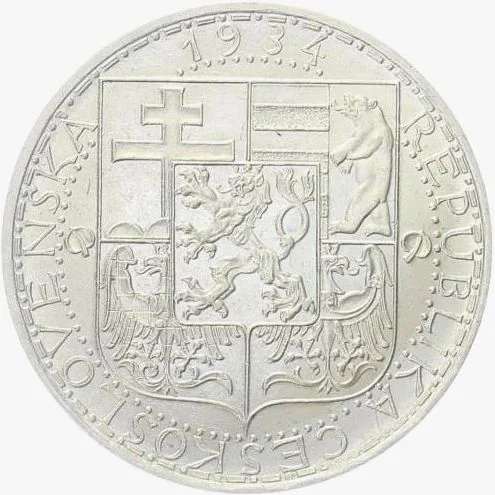
State emblem with date above.
Inscription:
REPUBLIKA ČESKOSLOVENSKÁ 20 Kč
1934
1934
Translation:
Republic of Czechoslovakia 20 Crowns
1934
1934
Script: Latin
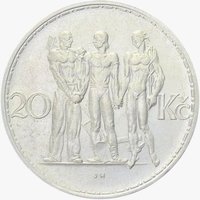
Engraver: Jaroslav Horejc
Reverse
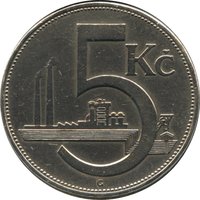
Description:
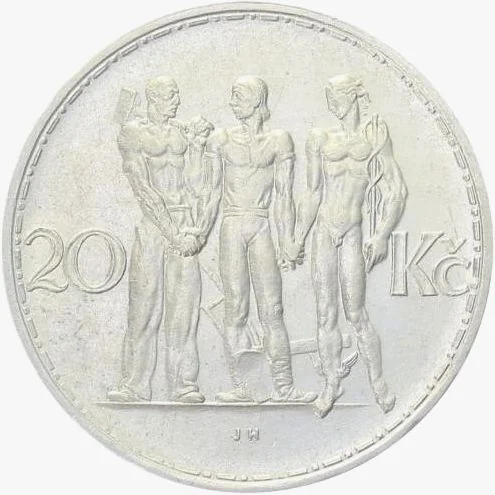
Industry, agriculture, business.
Inscription:
20 Kč
Translation:
20 Crowns
Script: Latin
Language: Czech
Engraver: Jaroslav Horejc
Edge
Plain with crosses and waves
Mints
| Name | Mark |
|---|---|
| Kremnica | — |
Mintings
| Year | Mint Mark | Mintage | Quality | Collection |
|---|---|---|---|---|
| 1933 | — | 2,280,000 | ||
| 1934 | — | 3,280,000 |
Historical background
In 1933, Czechoslovakia stood out as a rare island of economic and political stability in Central Europe, largely insulated from the hyperinflation and banking crises that had ravaged its neighbours in the preceding years. This stability was anchored by the Czechoslovak koruna (Kč), introduced in 1919 following the empire's dissolution. Through disciplined fiscal policy and high industrial output, the country had established a strong, convertible currency backed by substantial gold reserves. The National Bank of Czechoslovakia, operating with notable independence, successfully maintained the koruna's peg to the gold standard, fostering domestic confidence and attracting foreign investment.
However, the global Great Depression, triggered by the 1929 Wall Street Crash, began to exert severe pressure on this stability by 1933. As a major exporter of manufactured goods like machinery, armaments, and footwear, Czechoslovakia faced a collapse in international demand and a wave of protectionist tariffs. This led to a sharp decline in industrial production, rising unemployment, and a growing trade deficit. While the currency itself remained technically stable and convertible, the real economy was contracting, creating deflationary pressures and social strain, particularly in the heavily industrialised German-speaking border regions.
Consequently, the government of Prime Minister Jan Malypetr pursued a defensive strategy focused on preserving the koruna's parity at all costs. This involved austere deflationary policies, including cuts to public spending and wages, rather than devaluation. The primary goal was to maintain international credibility and the hard-won financial prestige of the state. While this prevented a currency crisis, it arguably deepened and prolonged the domestic economic downturn, setting the stage for the political tensions and external pressures that would escalate later in the decade.
However, the global Great Depression, triggered by the 1929 Wall Street Crash, began to exert severe pressure on this stability by 1933. As a major exporter of manufactured goods like machinery, armaments, and footwear, Czechoslovakia faced a collapse in international demand and a wave of protectionist tariffs. This led to a sharp decline in industrial production, rising unemployment, and a growing trade deficit. While the currency itself remained technically stable and convertible, the real economy was contracting, creating deflationary pressures and social strain, particularly in the heavily industrialised German-speaking border regions.
Consequently, the government of Prime Minister Jan Malypetr pursued a defensive strategy focused on preserving the koruna's parity at all costs. This involved austere deflationary policies, including cuts to public spending and wages, rather than devaluation. The primary goal was to maintain international credibility and the hard-won financial prestige of the state. While this prevented a currency crisis, it arguably deepened and prolonged the domestic economic downturn, setting the stage for the political tensions and external pressures that would escalate later in the decade.
🌱 Common