

25 kuna (Introduction of the Kuna as the Monetary Unit of Croatia) – Croatia
Add to wishlist
Circulating commemorative coins
Commemoration: 25th Anniversary of the Introduction of the Kuna as the Monetary Unit of the Republic of Croatia
Croatia
Context
Material
Diameter: 32 mm
Weight: 12.75 g
Thickness: 2.2 mm
Shape: Dodecagonal
Technique: Milled
Alignment: Medal alignment
flip
References
KM: #
Numista: #168763
Value
Exchange value: 25 HRK
Obverse
Description:
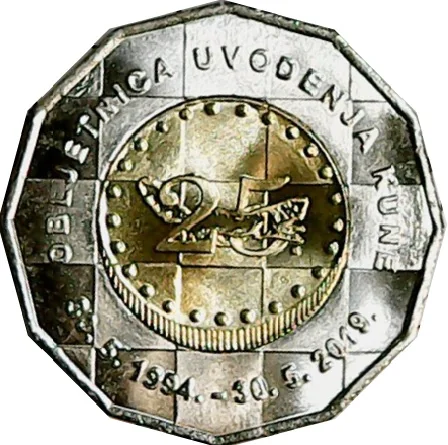
The coin's core features a marten within the number "25," marking the anniversary year, surrounded by 25 small circles symbolizing the years since the kuna's introduction. The top ring bears the inscription "OBLJETNICA UVOĐENJA KUNE," while the bottom ring shows the dates "30. 5. 1994. – 30. 5. 2019." The field is textured with 25 squares, evoking the Croatian coat of arms and the anniversary.
Inscription:
25
OBLJETNICA UVOĐENJA KUNE
30. 5. 1994. – 30. 5. 2019.
OBLJETNICA UVOĐENJA KUNE
30. 5. 1994. – 30. 5. 2019.
Translation:
ANNIVERSARY OF THE INTRODUCTION OF THE KUNA
30. 5. 1994. – 30. 5. 2019.
30. 5. 1994. – 30. 5. 2019.
Script: Latin
Language: Croatian
Engraver: Damir Mataušić
Reverse
Description:
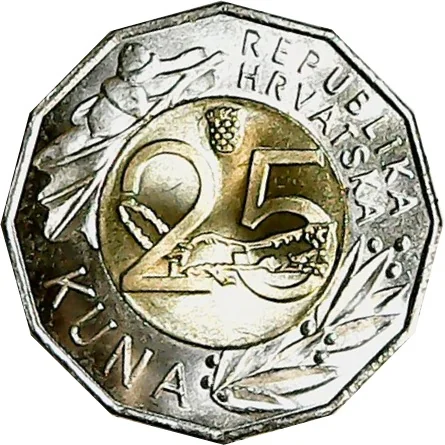
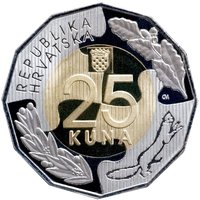
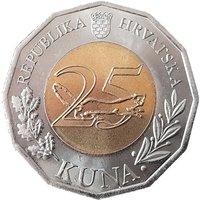
The coin's core features the numeral "25", its outlines forming a right-facing marten. Above this is Croatia's coat of arms. On the surrounding ring, a common oak branch with acorns is at left above the numeral, with "REPUBLIKA HRVATSKA" inscribed at the top right. "KUNA" is at left below the numeral, and a blooming laurel branch is at the right.
Inscription:
REPUBLIKA HRVATSKA
25
KUNA
25
KUNA
Translation:
REPUBLIC OF CROATIA
25
KUNA
25
KUNA
Script: Latin
Language: Croatian
Engraver: Damir Mataušić
Edge
Plain
Mints
| Name | Mark |
|---|---|
| Croatian Mint | — |
Mintings
| Year | Mint Mark | Mintage | Quality | Collection |
|---|---|---|---|---|
| 2019 | — | 30,000 |
Historical background
In 2019, Croatia was in the final stages of its long-standing path toward adopting the euro, operating under a managed floating exchange rate regime with the kuna (HRK) as its national currency. The kuna's exchange rate was not pegged to a single currency but was closely influenced by the euro, with the Croatian National Bank (HNB) actively intervening in the foreign exchange market to maintain stability and prevent excessive volatility. This policy, in place for decades, had successfully ensured low inflation and exchange rate predictability, which were seen as crucial for an economy where euro-denominated savings and loans were widespread, and tourism, a key sector, generated significant euro inflows.
The year was dominated by strategic preparations for Eurozone accession, a core strategic goal for the government. Croatia had already entered the European Exchange Rate Mechanism II (ERM II) in July 2020, but the technical and legislative groundwork was intensely underway throughout 2019. The HNB and government focused on meeting the convergence criteria, including price stability and sustainable public finances, while also launching public information campaigns to educate citizens and businesses about the practical changeover. The stable kuna-euro exchange rate, which had hovered around 7.4 HRK for EUR 1 for years, was a critical factor, as it minimized the conversion risk for the future switch.
Economists and institutions broadly agreed that euro adoption would eliminate exchange rate costs and risks for trade and investment, given that over half of Croatia's trade and a majority of its foreign debt were already euro-denominated. However, some public concern persisted regarding potential negative effects, such as a perceived risk of one-off price increases during the changeover and the loss of independent monetary policy. Nevertheless, by the end of 2019, the political and institutional momentum was firmly set, positioning Croatia to formally receive the green light for euro adoption in mid-2022, with the currency changeover successfully taking place on January 1, 2023.
The year was dominated by strategic preparations for Eurozone accession, a core strategic goal for the government. Croatia had already entered the European Exchange Rate Mechanism II (ERM II) in July 2020, but the technical and legislative groundwork was intensely underway throughout 2019. The HNB and government focused on meeting the convergence criteria, including price stability and sustainable public finances, while also launching public information campaigns to educate citizens and businesses about the practical changeover. The stable kuna-euro exchange rate, which had hovered around 7.4 HRK for EUR 1 for years, was a critical factor, as it minimized the conversion risk for the future switch.
Economists and institutions broadly agreed that euro adoption would eliminate exchange rate costs and risks for trade and investment, given that over half of Croatia's trade and a majority of its foreign debt were already euro-denominated. However, some public concern persisted regarding potential negative effects, such as a perceived risk of one-off price increases during the changeover and the loss of independent monetary policy. Nevertheless, by the end of 2019, the political and institutional momentum was firmly set, positioning Croatia to formally receive the green light for euro adoption in mid-2022, with the currency changeover successfully taking place on January 1, 2023.
🌱 Fairly Common