

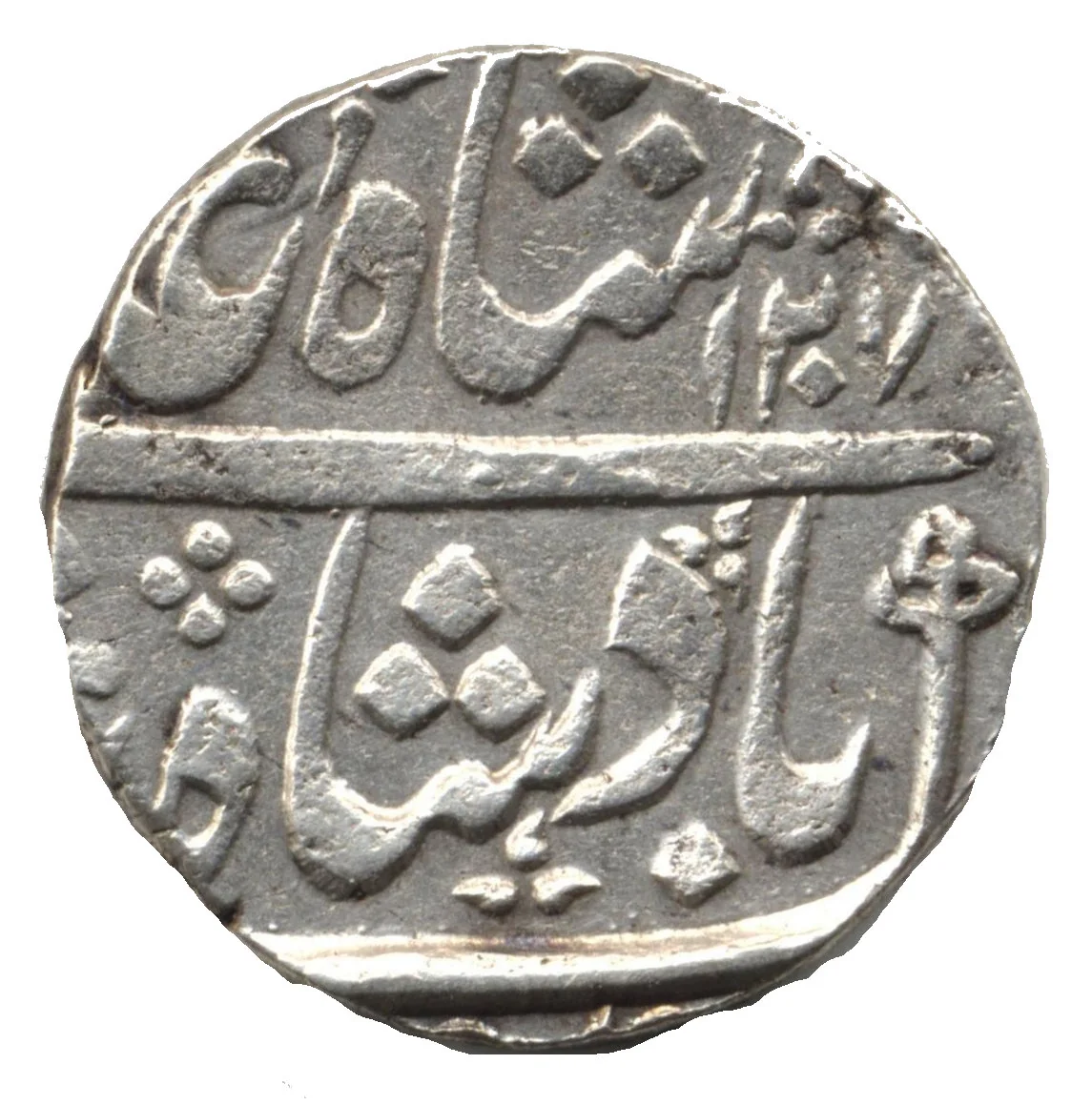
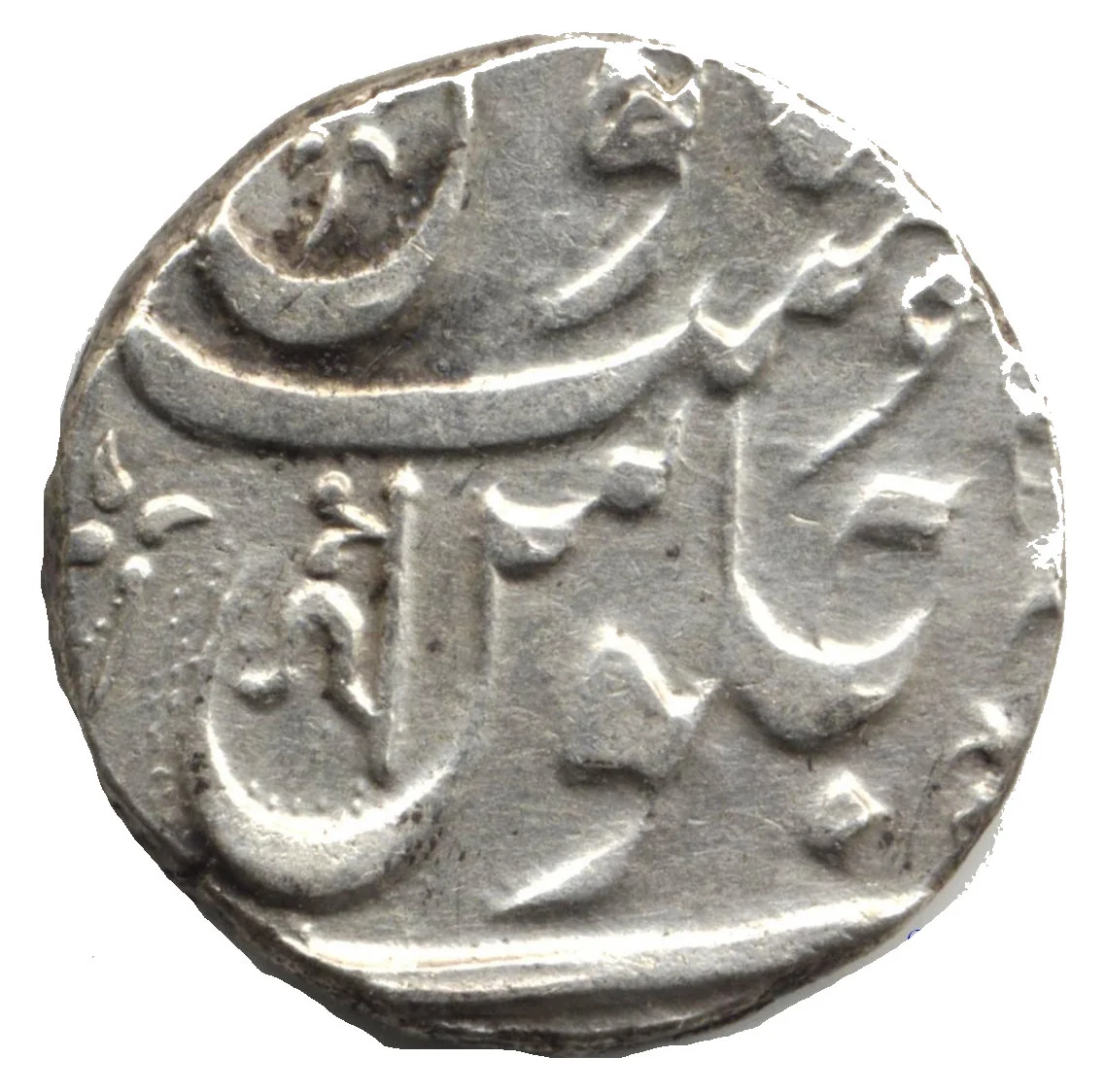
1 rupee – Mughal Empire
Add to wishlist
India
Context
Year: 1828
Iranian - Persian Year:: 1207
Country: India
Issuer: Mughal Empire
Ruler: Shah Alam II
Currency:
(1540—1842)
Demonetized: Yes
Material
References
Numista: #67066
Value
Bullion value: $28.40
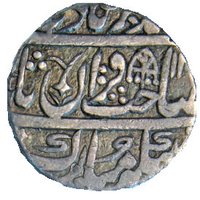
Obverse
Description:
KM# 251
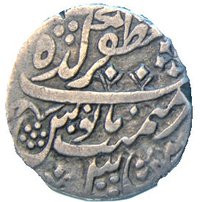
Reverse
Edge
Rough
Mintings
| Year | Mint Mark | Mintage | Quality | Collection |
|---|---|---|---|---|
| 1828 | — | — |
Historical background
By 1828, the Mughal Empire's currency system was a shadow of its former self, reflecting the empire's profound political and economic decline. While the Emperor in Delhi still nominally issued coins—the silver rupee and its copper fractions (dam, paisā)—his minting authority was largely symbolic and geographically confined to the capital and its immediate surroundings. The real monetary power had fragmented among the rising British East India Company, which controlled Bengal, Bihar, and much of northern India, and various autonomous regional rulers like the Nawab of Awadh and the Nizam of Hyderabad, who issued their own distinct coinage.
This period was characterized by a chaotic multiplicity of currencies. The Company's newly standardized silver rupee (the "Company Rupee"), minted in Calcutta and other controlled mints, was gaining dominance in trade and revenue collection. Meanwhile, hundreds of local and obsolete Mughal-style coins remained in circulation, varying widely in weight and purity. This created a complex and inefficient economy where money-changers (sarrafs) were essential for daily commerce, charging fees to assess and exchange coins. The value of money was unstable, not governed by a central policy but by the fluctuating fortunes of competing political powers.
The year 1828 fell within a critical transitional phase just before the British formalized their monetary hegemony. The Mughal system, once renowned for its uniformity and high silver content established under emperors like Sher Shah Suri and Akbar, had devolved into a patchwork of competing issues. The empire's currency, much like its political authority, was being systematically supplanted. Within a decade, the British would undertake major coinage reforms, leading to the uniform "Company Rupee" and, after 1835, the issuance of coins bearing the name of the British monarch, formally ending the Mughal era of Indian coinage.
This period was characterized by a chaotic multiplicity of currencies. The Company's newly standardized silver rupee (the "Company Rupee"), minted in Calcutta and other controlled mints, was gaining dominance in trade and revenue collection. Meanwhile, hundreds of local and obsolete Mughal-style coins remained in circulation, varying widely in weight and purity. This created a complex and inefficient economy where money-changers (sarrafs) were essential for daily commerce, charging fees to assess and exchange coins. The value of money was unstable, not governed by a central policy but by the fluctuating fortunes of competing political powers.
The year 1828 fell within a critical transitional phase just before the British formalized their monetary hegemony. The Mughal system, once renowned for its uniformity and high silver content established under emperors like Sher Shah Suri and Akbar, had devolved into a patchwork of competing issues. The empire's currency, much like its political authority, was being systematically supplanted. Within a decade, the British would undertake major coinage reforms, leading to the uniform "Company Rupee" and, after 1835, the issuance of coins bearing the name of the British monarch, formally ending the Mughal era of Indian coinage.
✨ Legendary