

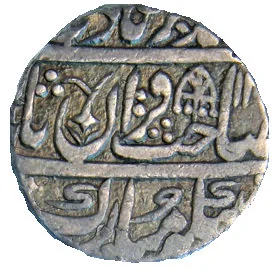
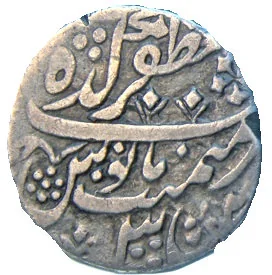
1 rupee – Mughal Empire
Add to wishlist
India
Context
Years: 1806–1809
Country: India
Issuer: Mughal Empire
Ruler: Akbar Shah II
Currency:
(1540—1842)
Demonetized: Yes
Material
References
KM: #
Numista: #84009
Value
Bullion value: $27.30
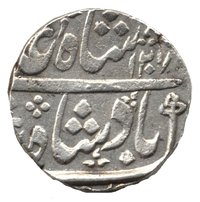
Obverse
Description:
Sunshade of the Emperor, AH Date
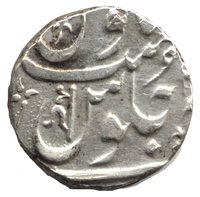
Reverse
Description:
RY Date
Edge
Plain
Mintings
| Year | Mint Mark | Mintage | Quality | Collection |
|---|---|---|---|---|
| 1806 | — | — | ||
| — | — | — | ||
| 1807 | — | — | ||
| 1808 | — | — |
Historical background
By 1806, the Mughal Empire's currency system was a complex and fragmented reflection of its diminished political power. While the Emperor in Delhi still nominally issued gold mohurs and silver rupees bearing his name, his authority over the minting and circulation of coinage had drastically eroded. The primary silver rupee in circulation was the "Sicca" rupee, minted in Calcutta under the authority of the British East India Company, which had become the dominant economic and military power in the subcontinent. This effectively meant that the financial heartbeat of the empire was no longer controlled by the Mughal court.
The monetary landscape was further complicated by a multitude of regional currencies. Powerful successor states like Awadh, Hyderabad, and the Maratha Confederacy all minted their own distinct rupees, which circulated alongside the Company's Sicca rupees and various older Mughal issues. This proliferation led to chronic problems of varying weight, purity, and exchange rates, creating significant hurdles for trade and administration. Furthermore, the Company itself was in a transitional phase, moving from recognizing Mughal suzerainty towards establishing its own sovereign currency system, adding a layer of political uncertainty to the economic confusion.
Consequently, 1806 represents a pivotal moment of overlap and transition. The Mughal monetary system, once a unified and prestigious symbol of imperial authority, had devolved into a patchwork of competing currencies. The British East India Company was steadily consolidating its control, not just territorially but also financially, setting the stage for the eventual introduction of a uniform British-Indian rupee that would fully replace the Mughal legacy within a few decades. The currency situation, therefore, was a precise indicator of the empire's reality: the Mughal name persisted on coins, but the power to govern their value and use had decisively shifted.
The monetary landscape was further complicated by a multitude of regional currencies. Powerful successor states like Awadh, Hyderabad, and the Maratha Confederacy all minted their own distinct rupees, which circulated alongside the Company's Sicca rupees and various older Mughal issues. This proliferation led to chronic problems of varying weight, purity, and exchange rates, creating significant hurdles for trade and administration. Furthermore, the Company itself was in a transitional phase, moving from recognizing Mughal suzerainty towards establishing its own sovereign currency system, adding a layer of political uncertainty to the economic confusion.
Consequently, 1806 represents a pivotal moment of overlap and transition. The Mughal monetary system, once a unified and prestigious symbol of imperial authority, had devolved into a patchwork of competing currencies. The British East India Company was steadily consolidating its control, not just territorially but also financially, setting the stage for the eventual introduction of a uniform British-Indian rupee that would fully replace the Mughal legacy within a few decades. The currency situation, therefore, was a precise indicator of the empire's reality: the Mughal name persisted on coins, but the power to govern their value and use had decisively shifted.
✨ Legendary