

5 cents – French Indochina
Add to wishlist
Context
Years: 1923–1938
Issuer: French Indochina
Period:
(1870—1940)
Currency:
(1880—1952)
Demonetized: Yes
Total mintage: 26,480,000
Material
Diameter: 24 mm
Weight: 5 g
Thickness: 1.6 mm
Shape: Round with a round hole
Composition: Copper-nickel
Technique: Milled
Alignment: Coin alignment
flip
References
KM: #
Numista: #6665
Value
Exchange value: 0.05 ICFP
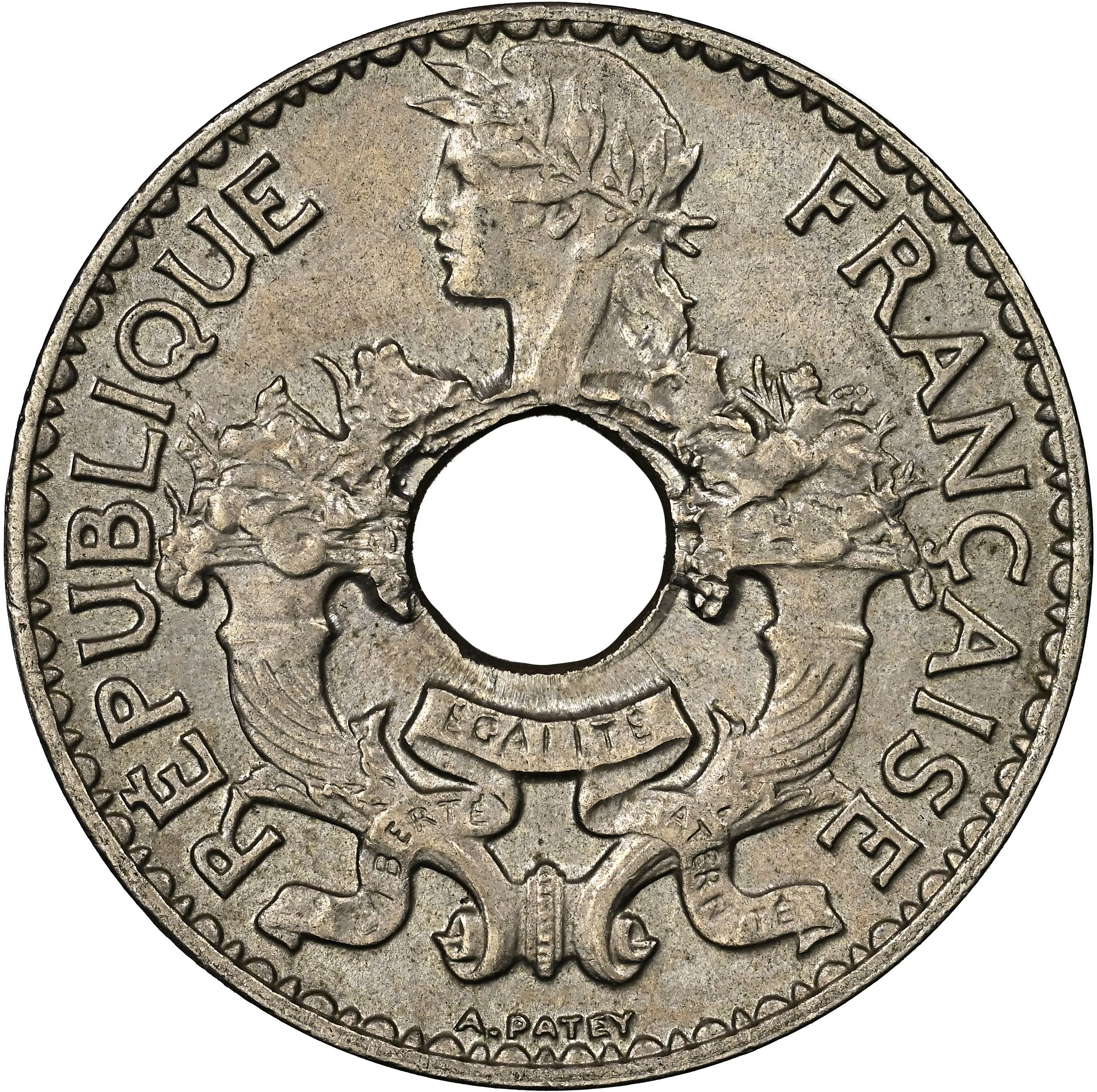
Obverse
Description:
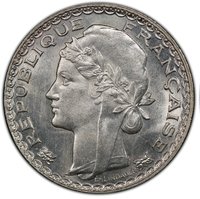
Cornucopias flank central hole, laureate head left.
Inscription:
REPUBLIQUE FRANÇAISE
LIBERTÉ ÉGALITÉ FRATERNITÉ
A.PATEY
LIBERTÉ ÉGALITÉ FRATERNITÉ
A.PATEY
Translation:
FRENCH REPUBLIC
LIBERTY EQUALITY FRATERNITY
A.PATEY
LIBERTY EQUALITY FRATERNITY
A.PATEY
Script: Latin
Language: French
Engraver: Henri-Auguste Patey
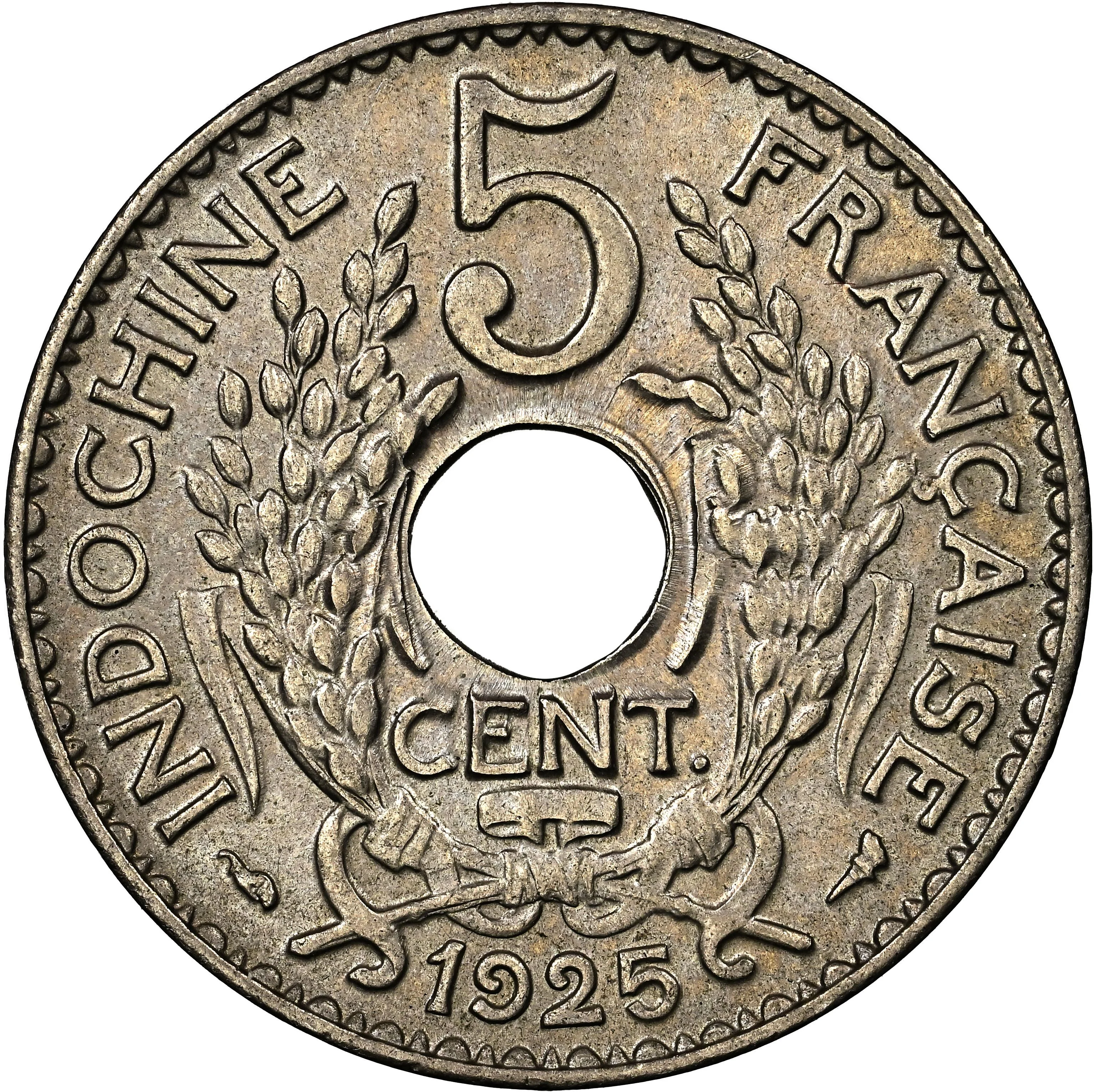
Reverse
Description:
Centre hole splits value, wreath encircles, date beneath.
Inscription:
INDOCHINE FRANÇAISE
5 CENT.
1925
5 CENT.
1925
Translation:
French Indochina
5 Centimes
1925
5 Centimes
1925
Script: Latin
Language: French
Engraver: Henri-Auguste Patey
Edge
Plain
Mints
| Name | Mark |
|---|---|
| Monnaie de Paris | — |
Mintings
| Year | Mint Mark | Mintage | Quality | Collection |
|---|---|---|---|---|
| 1923 | — | 1,610,926 | ||
| 1924 | — | 3,389,074 | ||
| 1925 | — | 6,000,000 | ||
| 1930 | — | 4,000,000 | ||
| 1937 | — | 10,000,000 | ||
| 1938 | — | — | Proof | |
| 1938 | — | 1,480,000 |
Historical background
In 1923, the currency system of French Indochina was firmly anchored to the French franc through the Indochinese piastre (ICP), a unique colonial currency established by the Bank of Indochina (Banque de l'Indochine). This system was designed to facilitate colonial trade and financial control, with the piastre's value fixed at a rate of 1 piastre = 10 francs. However, this fixed parity created significant economic tension. Following World War I, the franc had depreciated substantially on international markets, yet the piastre—backed by a conservative gold standard and the colony's healthy trade surplus—remained strong. This led to a situation where the piastre was officially overvalued against the franc, making exports to France artificially cheap but burdening the colonial administration with a high local cost structure.
The strong, gold-backed piastre became a magnet for regional capital, particularly from a China experiencing instability. This influx of capital, while financing development, also fueled speculative attacks and concerns about inflation. For local Vietnamese, Khmer, and Lao populations, the system was often experienced as extractive and complex. They continued to use subsidiary coins like the sapeque for daily small transactions, but the overarching monetary policy was set in Paris and Saigon to serve French commercial interests and the profitability of the Bank of Indochina, rather than local economic needs.
Consequently, 1923 fell within a period of growing critique of the currency regime. French exporters and colonists in Indochina complained that the overvalued piastre made their costs too high, while metropolitan French interests argued the fixed parity was unsustainable. This debate would intensify throughout the 1920s, leading to a major political scandal known as the "Piastre Affair" and ultimately forcing a devaluation in 1930, when the peg was adjusted to 1 piastre = 10 new francs. Thus, 1923 represents a point of simmering disequilibrium within a rigid colonial monetary framework.
The strong, gold-backed piastre became a magnet for regional capital, particularly from a China experiencing instability. This influx of capital, while financing development, also fueled speculative attacks and concerns about inflation. For local Vietnamese, Khmer, and Lao populations, the system was often experienced as extractive and complex. They continued to use subsidiary coins like the sapeque for daily small transactions, but the overarching monetary policy was set in Paris and Saigon to serve French commercial interests and the profitability of the Bank of Indochina, rather than local economic needs.
Consequently, 1923 fell within a period of growing critique of the currency regime. French exporters and colonists in Indochina complained that the overvalued piastre made their costs too high, while metropolitan French interests argued the fixed parity was unsustainable. This debate would intensify throughout the 1920s, leading to a major political scandal known as the "Piastre Affair" and ultimately forcing a devaluation in 1930, when the peg was adjusted to 1 piastre = 10 new francs. Thus, 1923 represents a point of simmering disequilibrium within a rigid colonial monetary framework.
🌱 Common