

½ Cent – French Indochina
Context
Years: 1935–1940
Issuer: French Indochina
Period:
(1870—1940)
Currency:
(1880—1952)
Demonetized: Yes
Total mintage: 105,431,998
Material
Diameter: 21 mm
Weight: 4 g
Thickness: 1.6 mm
Shape: Round with a round hole
Composition: Bronze
Magnetic: No
Technique: Milled
Alignment: Coin alignment
flip
References
KM: #Click to copy to clipboard20
Numista: #6663
Value
Exchange value: 0.005 ICFP
Obverse
Description:
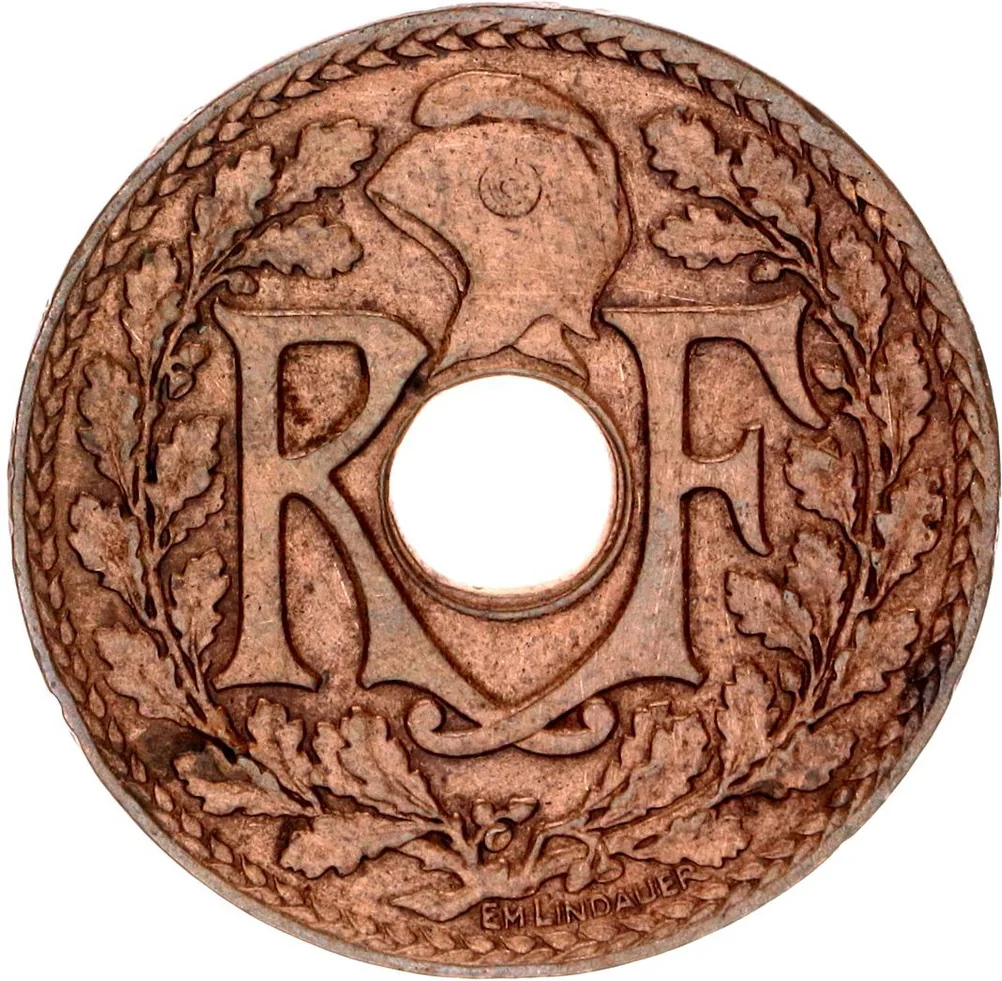
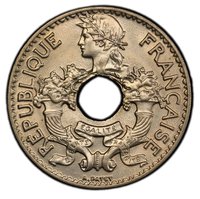
RF divided by center hole, liberty cap above, encircled by wreath.
Inscription:
R F
Translation:
Rex Francorum
Script: Latin
Language: Latin
Engraver: Edmond-Émile Lindauer
Reverse
Description:
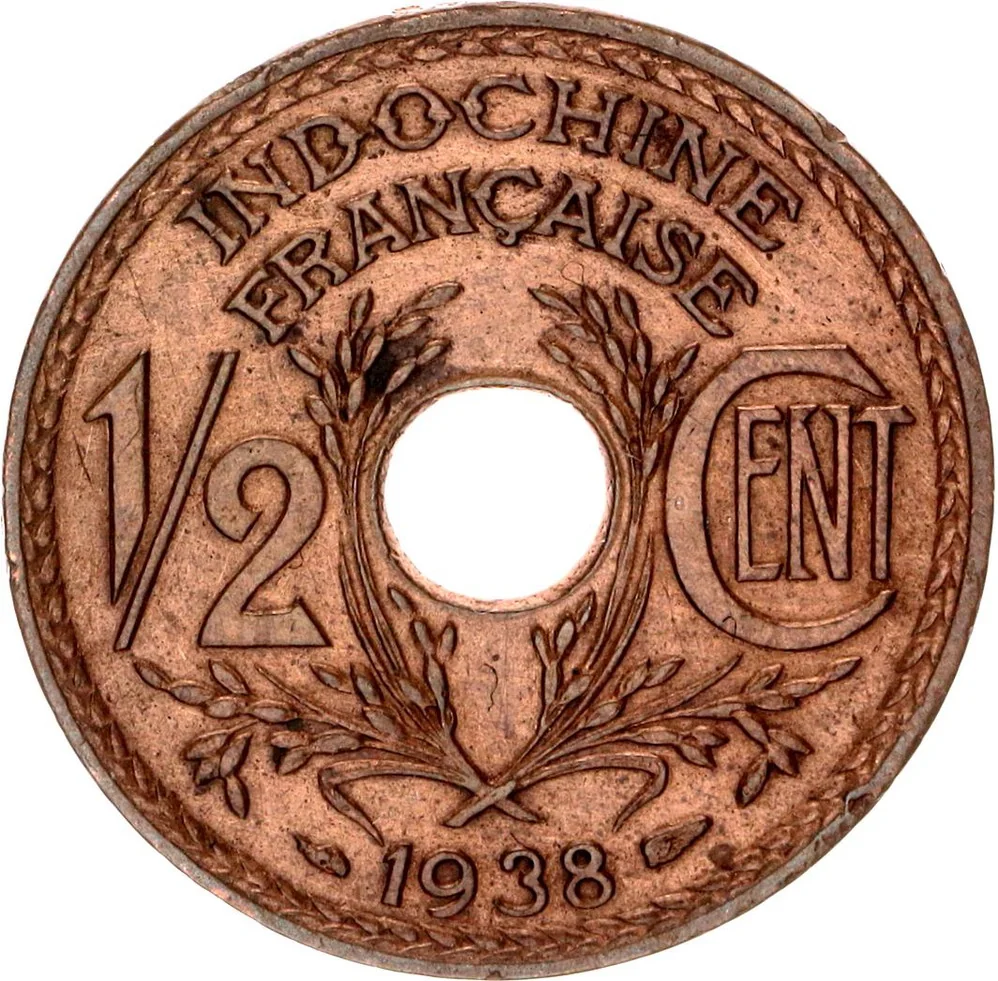
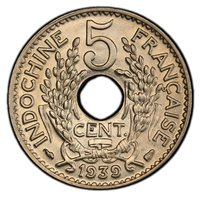
Denomination flanked by grain, date below.
Inscription:
INDOCHINE
FRANÇAISE
1/2 CENT
1937
FRANÇAISE
1/2 CENT
1937
Translation:
French Indochina
Half Cent
1937
Half Cent
1937
Script: Latin
Language: French
Engraver: Edmond-Émile Lindauer
Edge
Plain
Categories
| Symbol> Wreath |
| Symbol> Phrygian cap |
Mints
| Name | Mark |
|---|---|
| Monnaie de Paris | — |
Mintings
| Year | Mint Mark | Mintage | Quality | Collection |
|---|---|---|---|---|
| 1935 | — | 26,365,135 | ||
| 1936 | — | 23,634,865 | ||
| 1937 | — | 10,243,526 | ||
| 1938 | — | 16,665,472 | ||
| 1939 | — | 17,305,000 | ||
| 1940 | — | 11,218,000 |
Historical background
In 1935, the currency situation in French Indochina was defined by its integration into the Franc Bloc, operating under the authority of the Banque de l'Indochine. This private institution, granted the exclusive right of note issue for the colony, anchored the local currency, the Indochinese Piastre (ICP), to the French Franc at a fixed rate. However, this was not a simple colonial franc; the Piastre was deliberately overvalued and pegged to a substantial silver content, making it a strong, trade-oriented currency within Asia. This strength facilitated imports from France and stabilized government finances but came at the cost of making Indochina's exports, like rice and rubber, more expensive on the global market.
This monetary policy created significant internal tensions. The strong Piastre benefited French businesses and civil servants by ensuring their remittances to France held greater value, and it cheapened the cost of importing French manufactured goods. Conversely, it penalized local Vietnamese, Cambodian, and Lao producers, as well as Chinese merchant communities, by hindering the competitiveness of their agricultural exports during the global economic depression. This led to repeated accusations that the system was designed to exploit the colony for metropolitan benefit, suppressing indigenous economic development to serve French commercial and administrative interests.
Furthermore, the Piastre's peg to silver (and thus indirectly to gold) meant it weathered the early 1930s differently than the French Franc itself. When France abandoned the gold standard in 1936, the Piastre maintained its metallic link for a time, creating a complex duality. Thus, in 1935, the currency system was a point of political and economic contention, symbolizing colonial control and economic distortion. It was a stable but deeply unpopular system, setting the stage for the monetary crises and reforms that would follow later in the decade as global pressures and local dissent intensified.
This monetary policy created significant internal tensions. The strong Piastre benefited French businesses and civil servants by ensuring their remittances to France held greater value, and it cheapened the cost of importing French manufactured goods. Conversely, it penalized local Vietnamese, Cambodian, and Lao producers, as well as Chinese merchant communities, by hindering the competitiveness of their agricultural exports during the global economic depression. This led to repeated accusations that the system was designed to exploit the colony for metropolitan benefit, suppressing indigenous economic development to serve French commercial and administrative interests.
Furthermore, the Piastre's peg to silver (and thus indirectly to gold) meant it weathered the early 1930s differently than the French Franc itself. When France abandoned the gold standard in 1936, the Piastre maintained its metallic link for a time, creating a complex duality. Thus, in 1935, the currency system was a point of political and economic contention, symbolizing colonial control and economic distortion. It was a stable but deeply unpopular system, setting the stage for the monetary crises and reforms that would follow later in the decade as global pressures and local dissent intensified.
🌱 Very Common