

5 Cents – French Indochina
Context
Years: 1938–1939
Issuer: French Indochina
Period:
(1870—1940)
Currency:
(1880—1952)
Demonetized: Yes
Total mintage: 89,070,000
Material
Diameter: 24 mm
Weight: 4 g
Thickness: 1.3 mm
Shape: Round with a round hole
Composition: Nickel silver
Technique: Milled
Alignment: Coin alignment
flip
References
KM: #Click to copy to clipboard18.1a
Numista: #22677
Value
Exchange value: 0.05 ICFP
Obverse
Description:
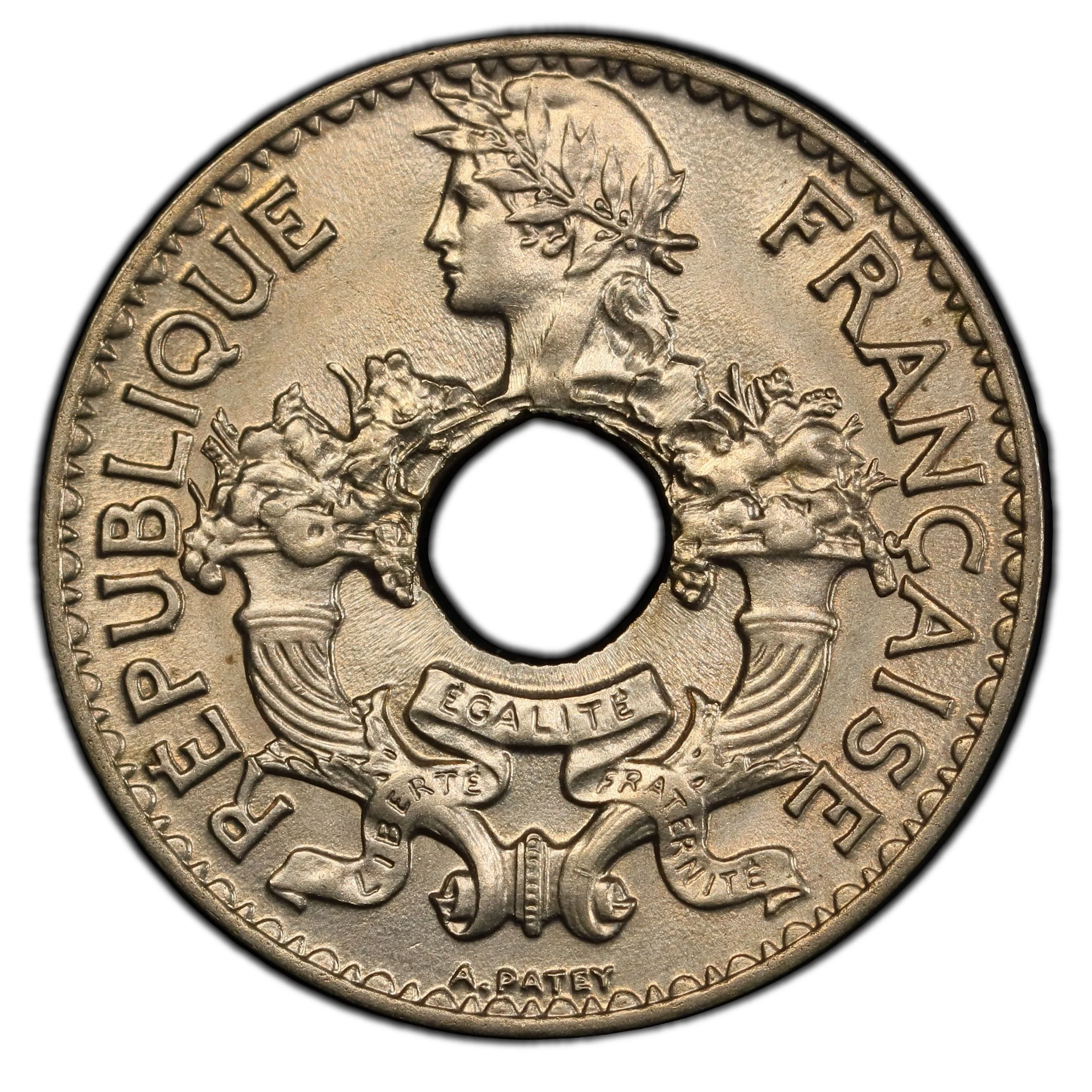
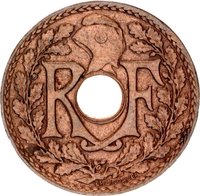
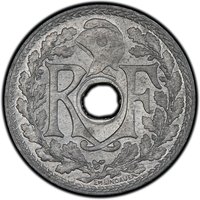
Cornucopias flank central hole, laureate head left.
Inscription:
RÉPUBLIQUE FRANÇAISE
LIBERTÉ ÉGALITÉ FRATERNITÉ
A.PATEY
LIBERTÉ ÉGALITÉ FRATERNITÉ
A.PATEY
Translation:
FRENCH REPUBLIC
LIBERTY EQUALITY FRATERNITY
A.PATEY
LIBERTY EQUALITY FRATERNITY
A.PATEY
Script: Latin
Language: French
Engraver: Henri-Auguste Patey
Reverse
Description:
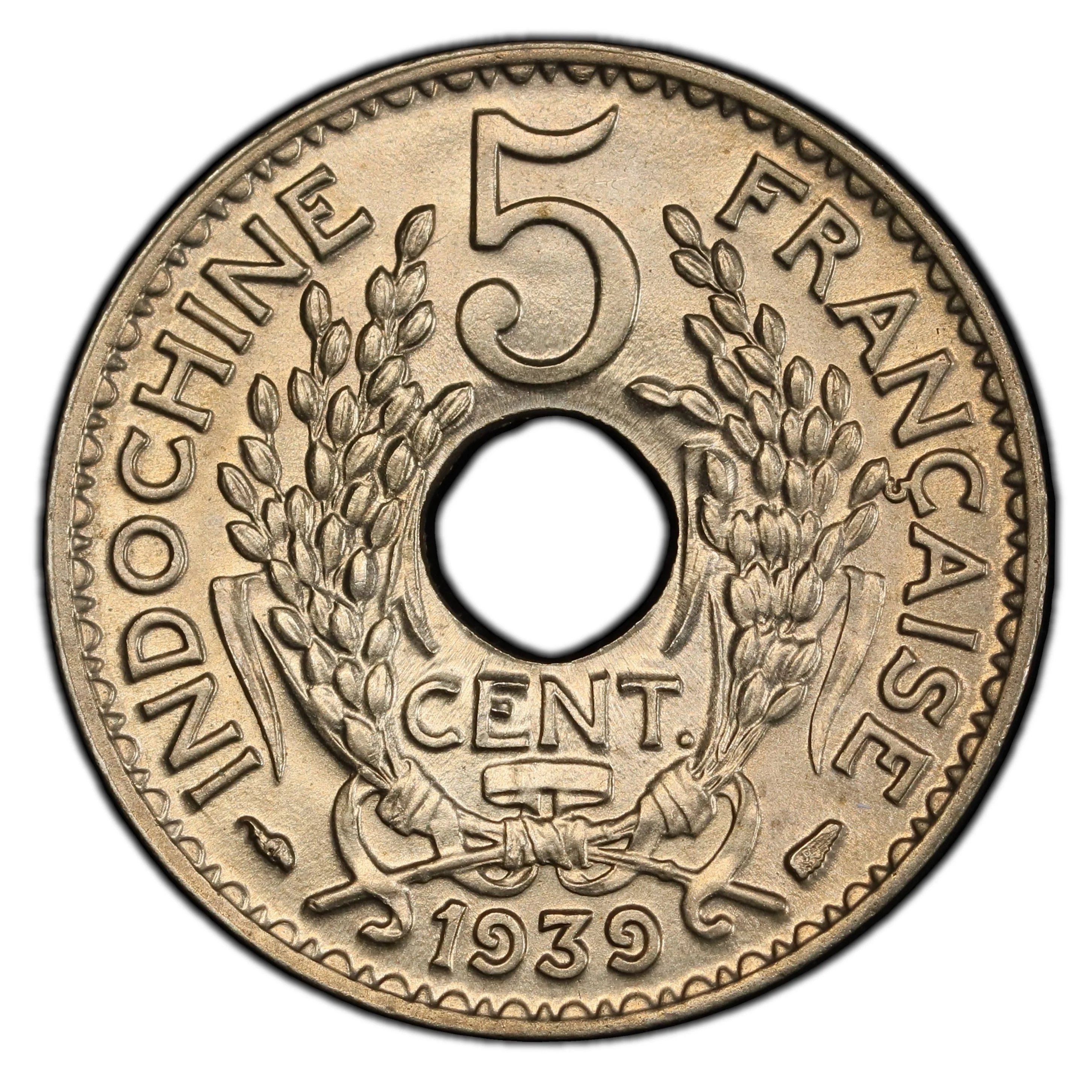
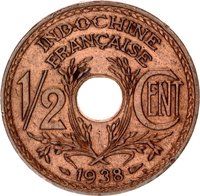
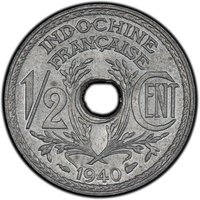
Centre hole splits value, wreath encircles, date beneath.
Inscription:
INDOCHINE FRANÇAISE
5 CENT.
1939
5 CENT.
1939
Translation:
French Indochina
5 Centimes.
1939
5 Centimes.
1939
Script: Latin
Language: French
Engraver: Henri-Auguste Patey
Edge
Plain
Mints
| Name | Mark |
|---|---|
| Monnaie de Paris | — |
Mintings
| Year | Mint Mark | Mintage | Quality | Collection |
|---|---|---|---|---|
| 1938 | — | 50,569,000 | ||
| 1939 | — | 38,501,000 |
Historical background
In 1938, the currency situation in French Indochina was defined by the Piastre de Commerce, a silver-based currency administered by the Bank of Indochina (Banque de l'Indochine). Established in the late 19th century, this currency was unique as it served not just the Indochinese Union (Vietnam, Cambodia, Laos) but also the French concessions in Guangzhou and Guangzhouwan. The piastre was notably strong, deliberately overvalued by colonial authorities to benefit metropolitan French interests. This high exchange rate facilitated cheap imports of French manufactured goods but severely hampered the export competitiveness of local rice, rubber, and coal, structuring the colonial economy to be extractive and trade-deficit prone for the indigenous population.
The period was one of monetary tension and transition. The global abandonment of the gold standard and fluctuating silver prices in the 1930s had pressured the piastre's stability. In response, 1930 saw the piastre officially pegged to the French franc at a fixed rate of 1 piastre = 10 francs, a rate far above its market value. This peg was fiercely defended by the "Piastre Lobby"—a coalition of colonial officials, the Bank of Indochina, and major exporters—who benefited from its purchasing power. However, it was increasingly misaligned with the weakened franc and local economic realities, creating distortions and widespread criticism from smaller merchants and nationalists.
By 1938, the system was under strain but still firmly in place. The fixed, overvalued peg drained the colony of currency, encouraged smuggling, and exacerbated the effects of the Great Depression for local producers. While there were calls for devaluation to stimulate the Indochinese economy, the powerful Bank of Indochina and colonial administration resisted any change to preserve the financial advantages for France and its elite allies. This rigid monetary policy, favoring metropolitan capital over colonial development, would persist until the upheavals of World War II and the Japanese occupation fundamentally shattered the system in the early 1940s.
The period was one of monetary tension and transition. The global abandonment of the gold standard and fluctuating silver prices in the 1930s had pressured the piastre's stability. In response, 1930 saw the piastre officially pegged to the French franc at a fixed rate of 1 piastre = 10 francs, a rate far above its market value. This peg was fiercely defended by the "Piastre Lobby"—a coalition of colonial officials, the Bank of Indochina, and major exporters—who benefited from its purchasing power. However, it was increasingly misaligned with the weakened franc and local economic realities, creating distortions and widespread criticism from smaller merchants and nationalists.
By 1938, the system was under strain but still firmly in place. The fixed, overvalued peg drained the colony of currency, encouraged smuggling, and exacerbated the effects of the Great Depression for local producers. While there were calls for devaluation to stimulate the Indochinese economy, the powerful Bank of Indochina and colonial administration resisted any change to preserve the financial advantages for France and its elite allies. This rigid monetary policy, favoring metropolitan capital over colonial development, would persist until the upheavals of World War II and the Japanese occupation fundamentally shattered the system in the early 1940s.
🌱 Very Common