

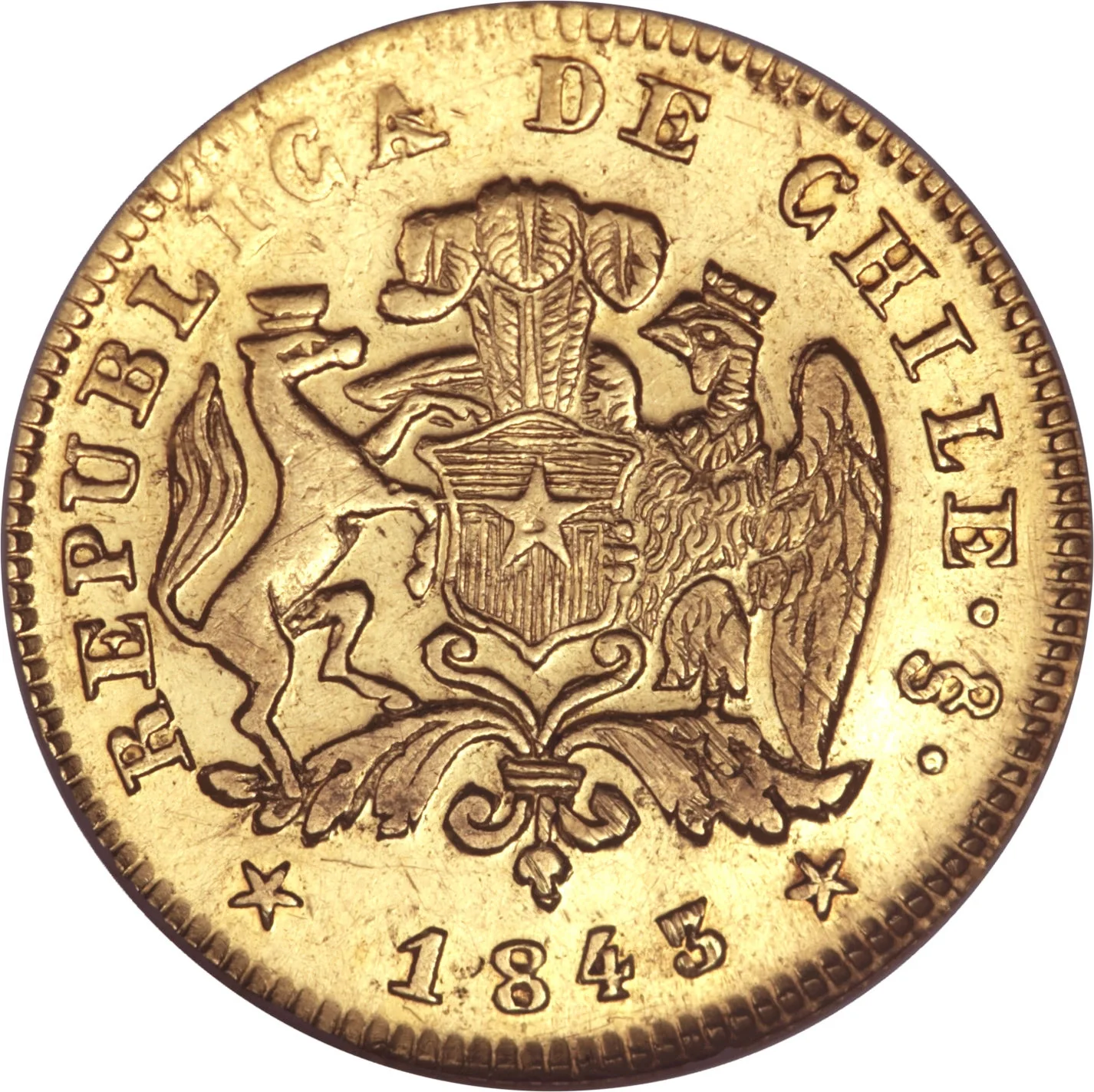
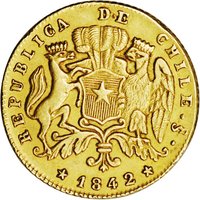
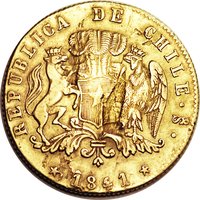
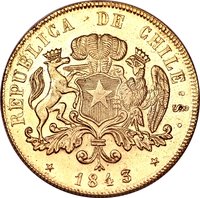
Obverse
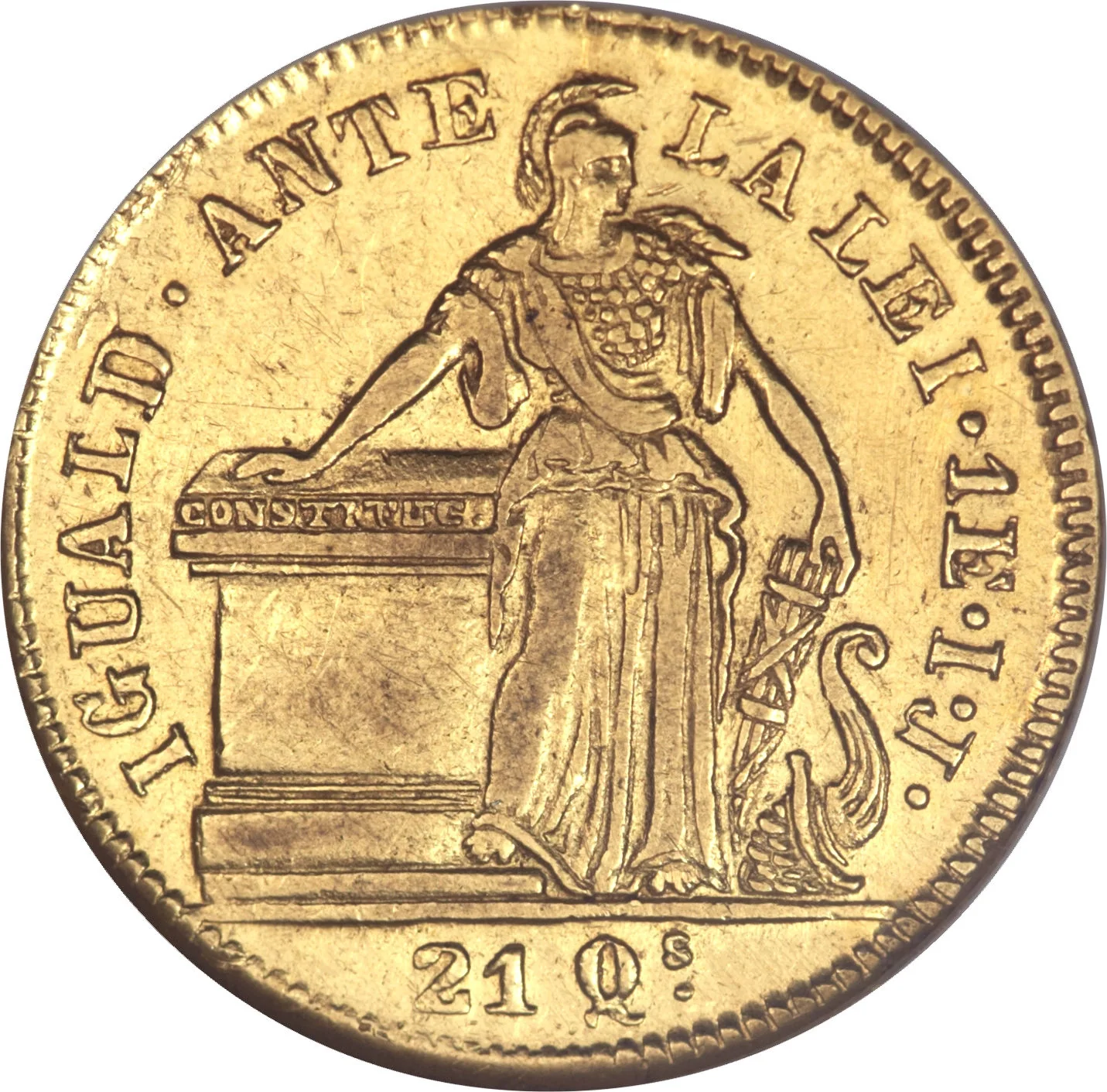
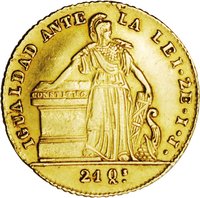
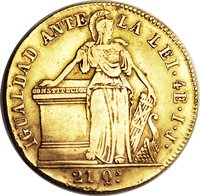
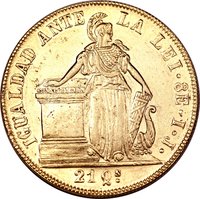
Reverse
Description:
Liberty stands beside a column, holding a fasces and cornucopia.
Inscription:
IGUALD. ANTE LA LEI. 1 E I.J.
21 Qs.
21 Qs.
Script: Latin
Edge
Mints
| Name | Mark |
|---|---|
| Casa de Moneda de Chile | (So) |
Mintings
| Year | Mint Mark | Mintage | Quality | Collection |
|---|---|---|---|---|
| 1839 | So | 4,946 | ||
| 1840 | So | 4,312 | ||
| 1841 | So | 3,992 | ||
| 1842 | So | 5,076 | ||
| 1843 | So | 4,632 | ||
| 1844 | So | — | ||
| 1845 | So | — | ||
| 1846 | So | — | ||
| 1847 | So | — | ||
| 1848 | So | — | ||
| 1849 | So | — | ||
| 1850 | So | — | ||
| 1851 | So | — |
Historical background
In 1839, Chile's currency situation was characterized by a chaotic and fragmented system inherited from the colonial era and the turbulent early years of independence. The primary circulating coins were foreign, especially the Peruvian silver peso, alongside a dwindling supply of old Spanish colonial coins. The state itself had not yet established a unified national mint, leading to a reliance on these external and inconsistent sources of hard currency. This environment created significant challenges for commerce and state finance, as the value and purity of coins varied widely, fostering uncertainty and complicating transactions.
The government of the conservative regime, led by Minister Manuel Rengifo, had taken initial steps toward stabilization earlier in the decade. A key milestone was the 1835 law that officially adopted the silver peso of eight reales as the national monetary unit, defining it as containing 8 escudos of fine silver. However, the practical implementation lagged behind the law. The state lacked the institutional capacity to produce enough coinage to unify the system, meaning that the old mixed circulation persisted. Furthermore, the government's fiscal health was still recovering, and it often resorted to issuing billetes fiscales (treasury notes) to cover expenses, though these were not yet a true paper currency and enjoyed limited public trust.
Therefore, the currency situation in 1839 represented a transitional phase. While a legal framework for a national currency existed, the tangible reality was one of disarray. The pressing need for a stable, uniform, and nationally controlled coinage was clear, setting the stage for the critical reforms that would follow in the 1840s. These would culminate in the establishment of the Casa de Moneda de Santiago in 1844 and the subsequent issuance of Chile's first standardized national coins, finally bringing order to the monetary system.
The government of the conservative regime, led by Minister Manuel Rengifo, had taken initial steps toward stabilization earlier in the decade. A key milestone was the 1835 law that officially adopted the silver peso of eight reales as the national monetary unit, defining it as containing 8 escudos of fine silver. However, the practical implementation lagged behind the law. The state lacked the institutional capacity to produce enough coinage to unify the system, meaning that the old mixed circulation persisted. Furthermore, the government's fiscal health was still recovering, and it often resorted to issuing billetes fiscales (treasury notes) to cover expenses, though these were not yet a true paper currency and enjoyed limited public trust.
Therefore, the currency situation in 1839 represented a transitional phase. While a legal framework for a national currency existed, the tangible reality was one of disarray. The pressing need for a stable, uniform, and nationally controlled coinage was clear, setting the stage for the critical reforms that would follow in the 1840s. These would culminate in the establishment of the Casa de Moneda de Santiago in 1844 and the subsequent issuance of Chile's first standardized national coins, finally bringing order to the monetary system.
Series: 1839 Chile circulation coins
💎 Extremely Rare