

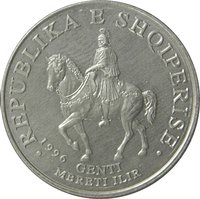
Obverse
Description:
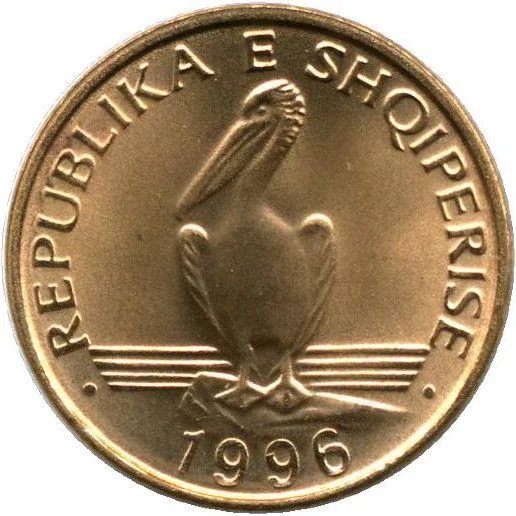
Dalmatian Pelican departing.
Inscription:
· REPUBLIKA E SHQIPERISE ·
1996
1996
Translation:
· REPUBLIC OF ALBANIA ·
1996
1996
Script: Latin
Language: Albanian
Engraver: Kujtim Qami
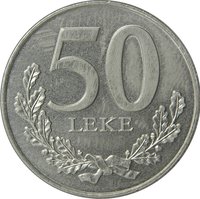
Reverse
Edge
Plain
Mintings
| Year | Mint Mark | Mintage | Quality | Collection |
|---|---|---|---|---|
| 1996 | — | — |
Historical background
In 1996, Albania was in the final, volatile phase of a decade-long transition from a rigid communist command economy to a market-oriented system. The national currency, the lek, had been stabilized after the hyperinflation of the early 1990s through a tight IMF-monitored program. However, underlying economic conditions remained fragile, with high unemployment, a large trade deficit, and a nascent, poorly regulated banking sector. The state-run financial system was weak and unable to meet the credit demands of a population eager to participate in the new economy, creating a vacuum that would soon be catastrophically filled.
This vacuum was exploited by a proliferation of "pyramid schemes" or "fund-raising companies," which offered extraordinarily high monthly interest rates, sometimes exceeding 50%. By 1996, these schemes, operating in a legal grey area and often masquerading as legitimate investment firms or charities, had attracted deposits from a staggering proportion of the population—estimates suggest up to two-thirds of Albanians invested. The phenomenon created an artificial sense of prosperity and a surge in consumer imports, but it also represented a massive, unbacked shadow financial system that was completely detached from the real economy and the official monetary policy of the Bank of Albania.
Consequently, the official currency situation existed in a dangerous parallel with this fraudulent boom. While the lek remained formally stable, the pyramid schemes were effectively conducting a giant, unregulated experiment in currency mobilization, drawing in savings both in lek and foreign currency. This unsustainable situation set the stage for the total financial and social collapse that would erupt in early 1997, when the schemes inevitably collapsed, wiping out savings, triggering violent nationwide rebellion, and causing a severe crisis of confidence in the lek and all state institutions.
This vacuum was exploited by a proliferation of "pyramid schemes" or "fund-raising companies," which offered extraordinarily high monthly interest rates, sometimes exceeding 50%. By 1996, these schemes, operating in a legal grey area and often masquerading as legitimate investment firms or charities, had attracted deposits from a staggering proportion of the population—estimates suggest up to two-thirds of Albanians invested. The phenomenon created an artificial sense of prosperity and a surge in consumer imports, but it also represented a massive, unbacked shadow financial system that was completely detached from the real economy and the official monetary policy of the Bank of Albania.
Consequently, the official currency situation existed in a dangerous parallel with this fraudulent boom. While the lek remained formally stable, the pyramid schemes were effectively conducting a giant, unregulated experiment in currency mobilization, drawing in savings both in lek and foreign currency. This unsustainable situation set the stage for the total financial and social collapse that would erupt in early 1997, when the schemes inevitably collapsed, wiping out savings, triggering violent nationwide rebellion, and causing a severe crisis of confidence in the lek and all state institutions.
Series: 1996 Albania circulation coins
🌱 Very Common