

Obverse
Description:
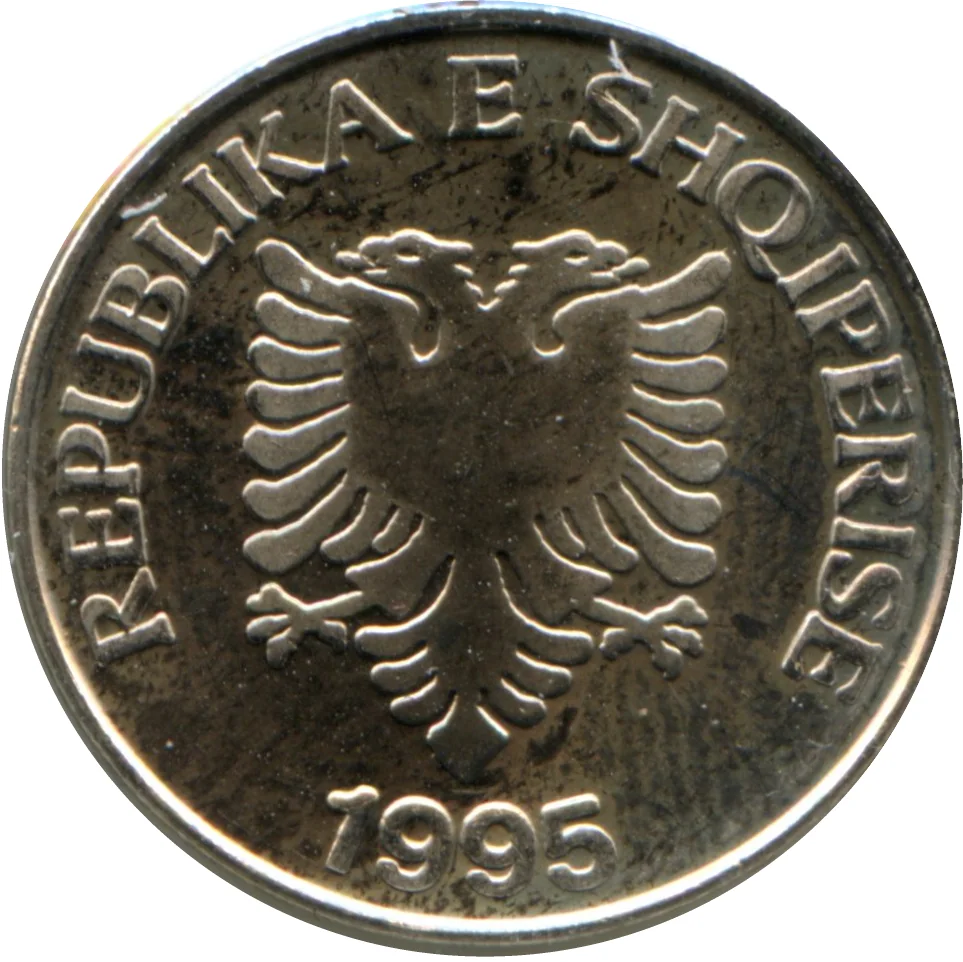
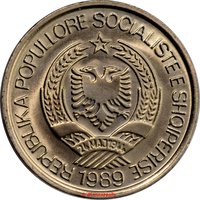
Albania's coat of arms, encircled by the country name above and the date below.
Inscription:
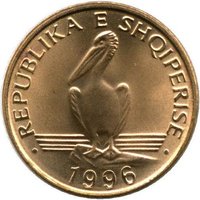
REPUBLIKA E SHQIPERISE
1995
1995
Translation:
REPUBLIC OF ALBANIA
1995
1995
Script: Latin
Language: Albanian
Engraver: Kujtim Qami
Reverse
Edge
Plain
Categories
| Animal> Bird |
| Symbols> Coat of Arms |
| Symbol> Double-headed eagle |
Mints
| Name | Mark |
|---|---|
| Mint of Poland | — |
Mintings
| Year | Mint Mark | Mintage | Quality | Collection |
|---|---|---|---|---|
| 1995 | — | — | ||
| 2000 | — | — | ||
| 2011 | — | — | ||
| 2014 | — | — | ||
| 2020 | — | — | ||
| 2023 | — | — |
Historical background
In 1995, Albania was navigating a fragile and complex monetary transition, emerging from the isolation and rigid central planning of the communist era that ended in 1991. The national currency, the lek (ALL), was not fully convertible and existed in a climate of macroeconomic instability. The country was still recovering from the shock therapy of liberalization, which had initially triggered high inflation and a sharp depreciation of the lek. By 1995, the government, under the Democratic Party, was implementing stabilization policies advised by the International Monetary Fund (IMF) and World Bank, focusing on tightening fiscal policy and controlling money supply growth to bring inflation down from the hyperinflationary peaks of the early 1990s.
The currency situation was characterized by a dual system where the official exchange rate, set by the Bank of Albania, coexisted with a more active and influential parallel market rate. While the gap between these rates had narrowed since the early transition years due to stabilization efforts, the parallel market remained a significant barometer of public confidence and a source of foreign exchange for many businesses and individuals. The Albanian economy was heavily dollarized, with many large transactions, savings, and real estate deals conducted in US dollars or German marks, reflecting lingering public distrust in the lek's stability despite official progress.
This period was one of cautious stabilization before a looming crisis. The macroeconomic indicators in 5 showed relative improvement, with inflation falling to around 6% for the year, a significant achievement. However, this stability was superficial and built upon unsustainable foundations, including a burgeoning pyramid scheme phenomenon that attracted vast amounts of lek and foreign currency savings. These schemes, which the government failed to curb, created a false sense of prosperity and distorted the money supply. Consequently, the relative calm of the lek in 5 was the deceptive prelude to the catastrophic financial and social collapse of 7, when the pyramid schemes imploded, wiping out savings and causing the lek to plummet amidst widespread civil unrest.
The currency situation was characterized by a dual system where the official exchange rate, set by the Bank of Albania, coexisted with a more active and influential parallel market rate. While the gap between these rates had narrowed since the early transition years due to stabilization efforts, the parallel market remained a significant barometer of public confidence and a source of foreign exchange for many businesses and individuals. The Albanian economy was heavily dollarized, with many large transactions, savings, and real estate deals conducted in US dollars or German marks, reflecting lingering public distrust in the lek's stability despite official progress.
This period was one of cautious stabilization before a looming crisis. The macroeconomic indicators in 5 showed relative improvement, with inflation falling to around 6% for the year, a significant achievement. However, this stability was superficial and built upon unsustainable foundations, including a burgeoning pyramid scheme phenomenon that attracted vast amounts of lek and foreign currency savings. These schemes, which the government failed to curb, created a false sense of prosperity and distorted the money supply. Consequently, the relative calm of the lek in 5 was the deceptive prelude to the catastrophic financial and social collapse of 7, when the pyramid schemes imploded, wiping out savings and causing the lek to plummet amidst widespread civil unrest.
🌱 Very Common