

1 riksdaler (Gustav Vasa's Liberation War and political and religious freedom) – Sweden
Add to wishlist
Circulating commemorative coins
Commemoration: 300th Anniversary of Gustav Vasa's Liberation War and 300th Anniversary of political and religious freedom
Sweden
Context
Year: 1821
Issuer: Sweden
Ruler: Charles XIV John
Currency:
(1798—1830)
Demonetized: Yes
Total mintage: 7,339
Material
References
KM: #
Numista: #64142
Value
Bullion value: $64.15
Obverse
Description:
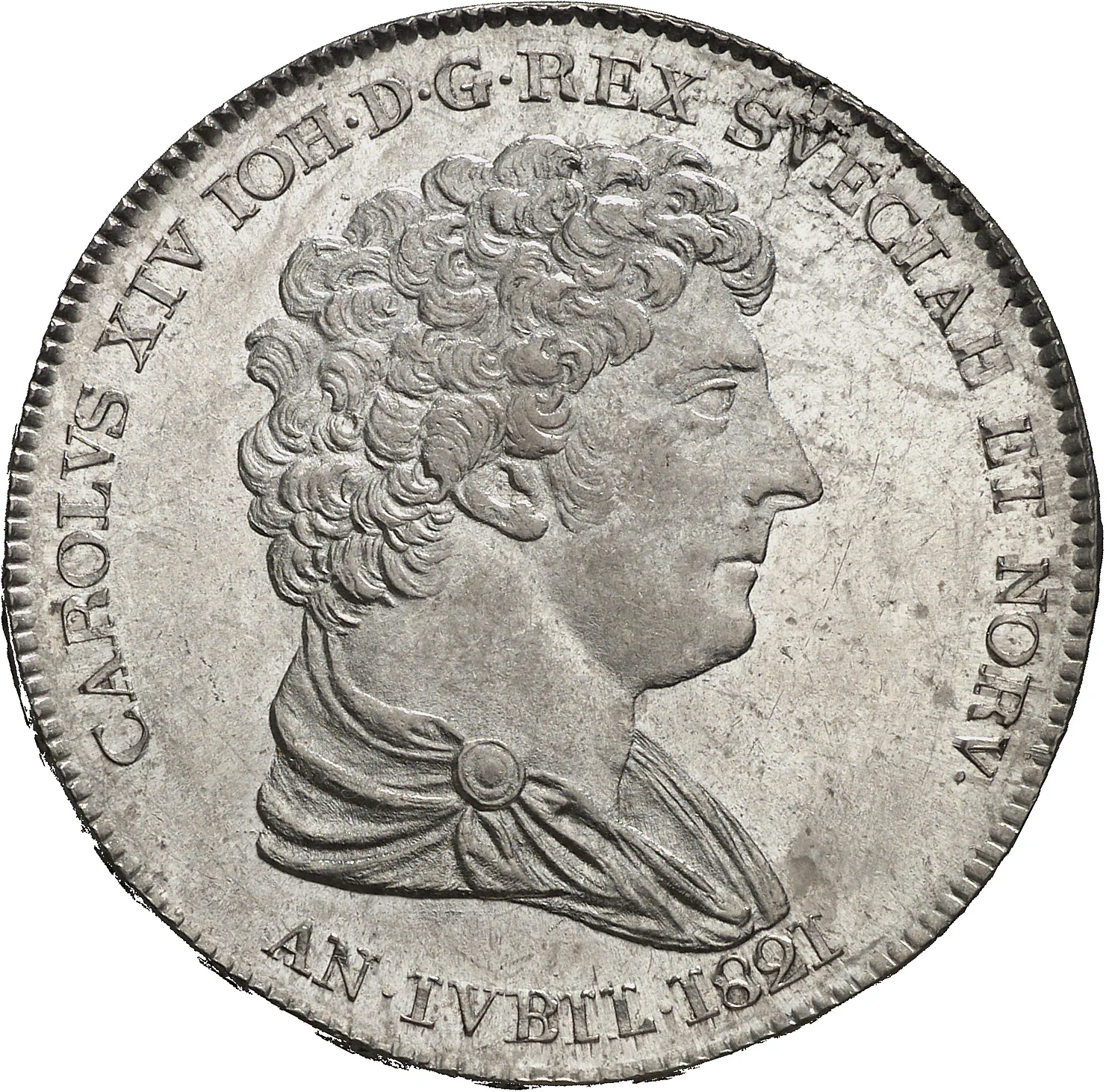
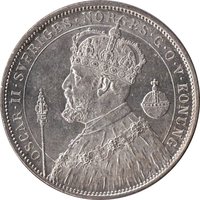
Bust of Karl XIV Johan facing right, with surrounding lettering.
Inscription:
CAROLVS XIV IOH·D·G·REX SVECIAE. ET NORV·
AN·IVBIL·1821
AN·IVBIL·1821
Translation:
Charles XIV John, by the Grace of God, King of Sweden and Norway.
In the Jubilee Year 1821.
In the Jubilee Year 1821.
Script: Latin
Language: Latin
Engraver: Lars Grandel
Reverse
Description:
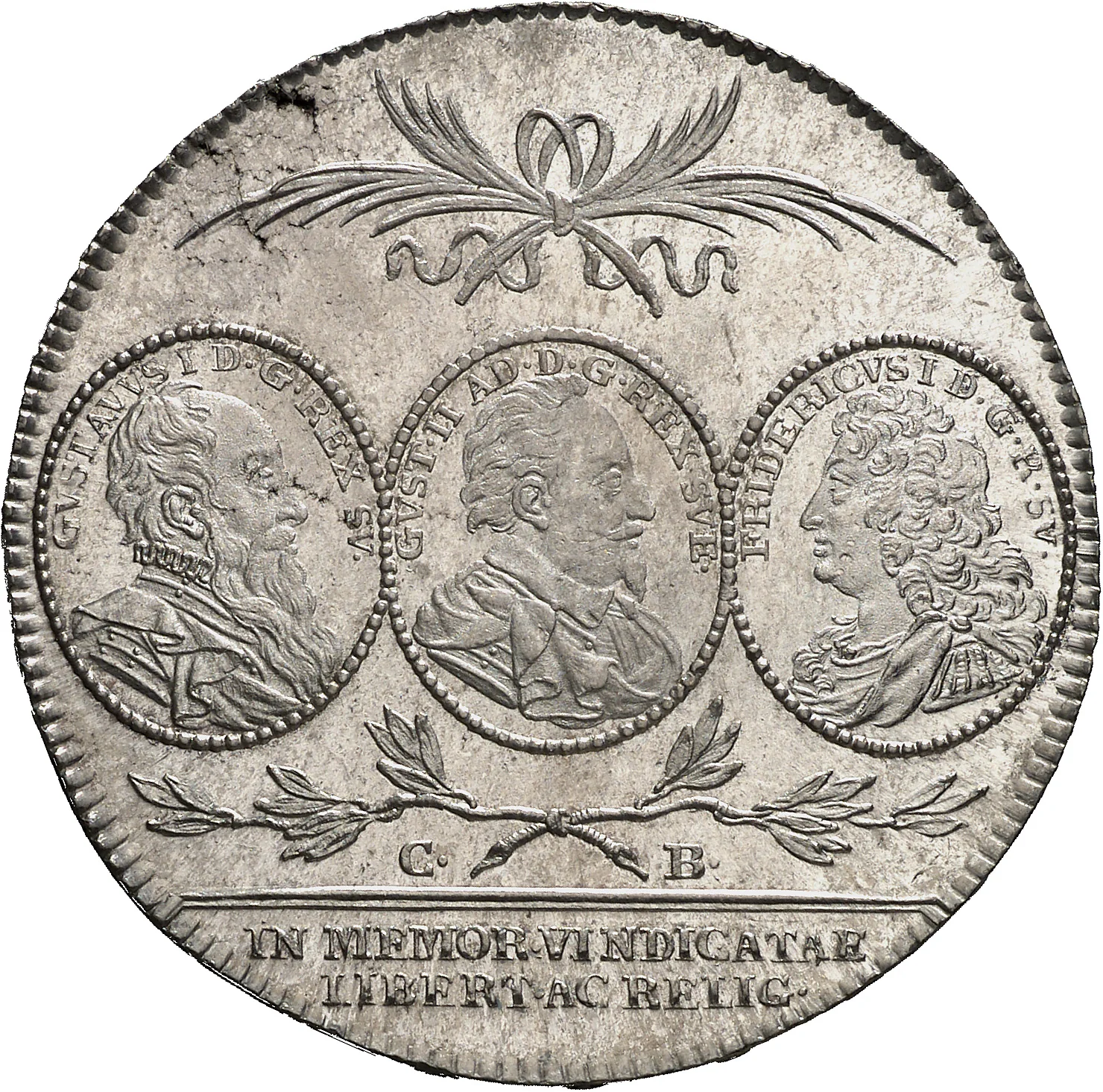
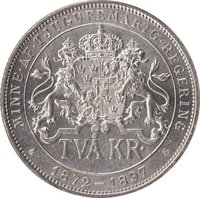
Three oval pearl-framed portraits: Gustav Vasa, Gustav II Adolf, and Frederick I. Above, two bonded palm branches; below, crossed laurel branches and the mint master's initials. In the exergue, a two-line inscription.
Inscription:
GVSTAVVS•I•D•G•REX•SVECIÆ•
GVST•II•AD•D•G•REX•SVE•
FRIDERICVS I•D•G•R•SVE
C•B•
IN MEMOR•VINDICATAE
LIBERT•AC RELIC•
GVST•II•AD•D•G•REX•SVE•
FRIDERICVS I•D•G•R•SVE
C•B•
IN MEMOR•VINDICATAE
LIBERT•AC RELIC•
Translation:
Gustavus I, by the Grace of God, King of the Swedes;
Gustavus II Adolphus, by the Grace of God, King of the Swedes;
Fredericus I, by the Grace of God, King of the Swedes;
C[arolus] B[rochner];
In memory of vindicated liberty and the relics.
Gustavus II Adolphus, by the Grace of God, King of the Swedes;
Fredericus I, by the Grace of God, King of the Swedes;
C[arolus] B[rochner];
In memory of vindicated liberty and the relics.
Script: Latin
Language: Latin
Engraver: Lars Grandel
Edge
Lettered
Legend:
GLORIA IN EXCELSIS DEO
Mints
| Name | Mark |
|---|---|
| Stockholm | — |
Mintings
| Year | Mint Mark | Mintage | Quality | Collection |
|---|---|---|---|---|
| 1821 | CB | 7,339 |
Historical background
In 1821, Sweden was in the final stages of a significant monetary transition, moving away from a complex and unstable system. For centuries, the country had used the Riksdaler Riksmynt as its primary unit of account, but its value had been eroded by repeated wars, deficit financing, and the issuance of excessive paper money known as Riksgäldssedlar. These notes, issued by the National Debt Office (Riksgäldskontoret), had effectively become a forced currency and circulated at a heavy discount to silver, leading to inflation and public distrust.
The pivotal reform came in 1830 with the establishment of the Riksens Ständers Bank (precursor to the modern Riksbank), but the groundwork was laid in the preceding decade. The Riksdag of 1821 passed a crucial law that mandated a return to a silver standard. This act formally defined the new Riksdaler Riksmynt as a specific weight of pure silver and committed to the eventual redemption of all paper notes for specie. The goal was to restore monetary stability and credibility by tethering the currency to a tangible asset.
Consequently, the currency situation in 1821 was one of cautious anticipation and preparation. The old, depreciated paper notes remained in wide circulation, but their future was now legally bound to conversion into silver. The state was grappling with the practical challenges of accumulating enough bullion reserves to back the promised conversion, a process that would take several more years to complete. Thus, Sweden stood at a crossroads, having legislated for sound money but still operating within the fragile system it was determined to replace.
The pivotal reform came in 1830 with the establishment of the Riksens Ständers Bank (precursor to the modern Riksbank), but the groundwork was laid in the preceding decade. The Riksdag of 1821 passed a crucial law that mandated a return to a silver standard. This act formally defined the new Riksdaler Riksmynt as a specific weight of pure silver and committed to the eventual redemption of all paper notes for specie. The goal was to restore monetary stability and credibility by tethering the currency to a tangible asset.
Consequently, the currency situation in 1821 was one of cautious anticipation and preparation. The old, depreciated paper notes remained in wide circulation, but their future was now legally bound to conversion into silver. The state was grappling with the practical challenges of accumulating enough bullion reserves to back the promised conversion, a process that would take several more years to complete. Thus, Sweden stood at a crossroads, having legislated for sound money but still operating within the fragile system it was determined to replace.
💎 Extremely Rare