

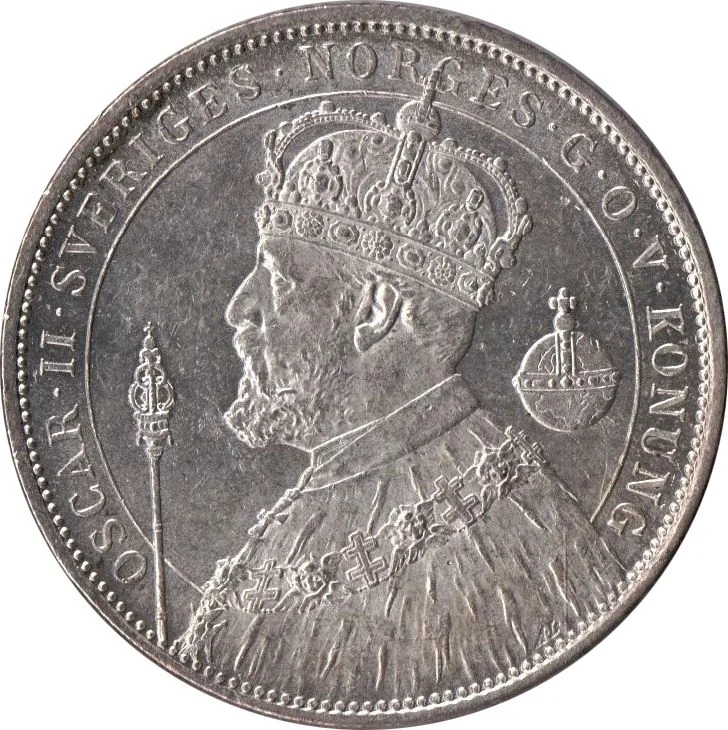
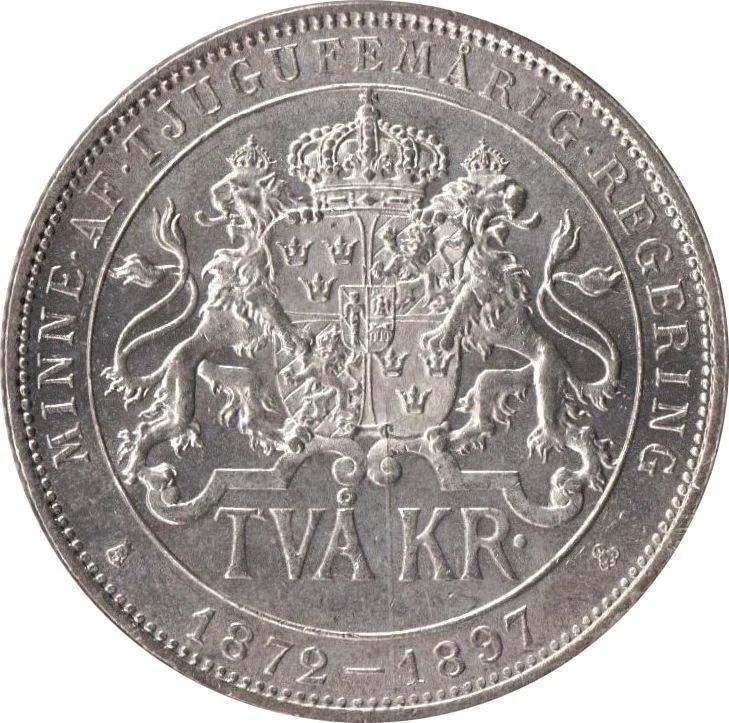
2 kronor (Reign of King Oscar II) – Sweden
Add to wishlist
Circulating commemorative coins
Commemoration: 25th Anniversary of the Reign of King Oscar II
Sweden
Obverse
Description:
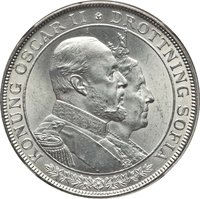
King Oscar II in profile, crowned and robed, holding the scepter with the Seraphim chain and orb.
Inscription:
OSCAR·II·SVERIGES·NORGES·G·O·V·KONUNG
A·L·
A·L·
Translation:
Oscar II, Sweden's and Norway's G. O. V. King
A. L.
A. L.
Script: Latin
Engraver: Adolf Lindberg
Reverse
Description:
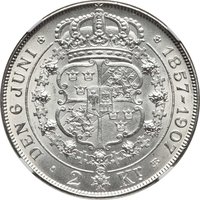
National coat of arms with lion supporters inside a circle, value below. Legend and reign anniversary dates outside.
Inscription:
MINNE·AF·TJUGUFEMÅRIG·REGERING
TVÅ KR·
1872 - 1897
TVÅ KR·
1872 - 1897
Translation:
In Memory of the Twenty-Five Year Reign
Two Crowns
1872 - 1897
Two Crowns
1872 - 1897
Script: Latin
Language: Swedish
Engraver: Adolf Lindberg
Edge
Milled
Mints
| Name | Mark |
|---|---|
| Kungliga Myntet | — |
Mintings
| Year | Mint Mark | Mintage | Quality | Collection |
|---|---|---|---|---|
| 1897 | — | 246,100 |
Historical background
In 1897, Sweden was operating under a de facto gold standard, having suspended the convertibility of its silver riksdaler in 1873 to join the Scandinavian Monetary Union (SMU) with Denmark. This union, established in 1873 and joined by Norway in 1875, created a unified currency system based on gold. The new common currency was the krona (crown), subdivided into 100 öre, which replaced the older riksdaler. While each country issued its own coins and banknotes, they were legally accepted at par across all three nations, facilitating trade and economic integration.
However, by the 1890s, strains within the Monetary Union were beginning to show. The system functioned without a central coordinating bank, relying on the mutual acceptance of each other's coins. This led to practical problems, as high-value Swedish coins often circulated in Denmark and Norway, while lower-value Danish coins flooded into Sweden, causing minor domestic inconvenience. More critically, the onset of the First World War would later expose fatal flaws, but in 1897, the system was still perceived as largely successful and a symbol of Scandinavian cooperation and modern financial stability.
The year 1897 itself was one of economic confidence and international exposition, most notably marked by the Stockholm World's Fair. This event showcased Sweden's rapid industrialization and required substantial financial transactions, underscoring the practical utility of a stable, gold-backed currency. The Riksbank, Sweden's central bank, held gold reserves to back the circulating money supply, and the krona's value was firmly pegged to gold. Thus, the currency situation in 1897 was characterized by stability, international alignment, and a widespread belief in the enduring strength of the gold-based Scandinavian Monetary Union.
However, by the 1890s, strains within the Monetary Union were beginning to show. The system functioned without a central coordinating bank, relying on the mutual acceptance of each other's coins. This led to practical problems, as high-value Swedish coins often circulated in Denmark and Norway, while lower-value Danish coins flooded into Sweden, causing minor domestic inconvenience. More critically, the onset of the First World War would later expose fatal flaws, but in 1897, the system was still perceived as largely successful and a symbol of Scandinavian cooperation and modern financial stability.
The year 1897 itself was one of economic confidence and international exposition, most notably marked by the Stockholm World's Fair. This event showcased Sweden's rapid industrialization and required substantial financial transactions, underscoring the practical utility of a stable, gold-backed currency. The Riksbank, Sweden's central bank, held gold reserves to back the circulating money supply, and the krona's value was firmly pegged to gold. Thus, the currency situation in 1897 was characterized by stability, international alignment, and a widespread belief in the enduring strength of the gold-based Scandinavian Monetary Union.
🌱 Common