

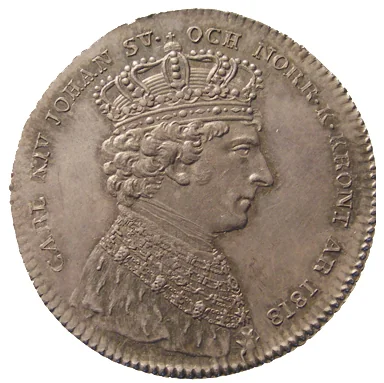
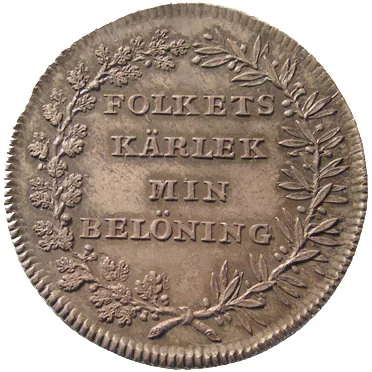
⅓ Riksdaler – Sweden
Circulating commemorative coins
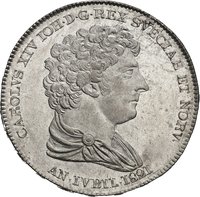
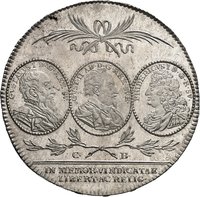
Commemoration: Largesse money for the king's coronation in 1818.
Sweden
Context
Year: 1818
Issuer: Sweden 
Ruler: Charles XIV John
Currency:
(1798—1830)
Demonetized: Yes
Total mintage: 11,676
Material
References
Numista: #186186
Value
Bullion value: $24.02
Obverse
Reverse
Edge
Mints
| Name | Mark |
|---|---|
| Stockholm | — |
Mintings
| Year | Mint Mark | Mintage | Quality | Collection |
|---|---|---|---|---|
| 1818 | — | 11,676 |
Historical background
In 1818, Sweden was navigating a complex and challenging currency situation, largely a legacy of the Napoleonic Wars. To finance its military involvement, the state had heavily relied on issuing inconvertible paper money known as Riksgäldssedlar from the National Debt Office (Riksgäldskontoret). This led to a severe depreciation of the paper currency against silver, creating a system of two parallel currencies: the silver riksdaler and the much less valuable paper riksdaler. By 1818, the paper money had lost approximately three-quarters of its face value in silver, causing inflation, economic uncertainty, and hindering both domestic and international trade.
The response to this crisis was the landmark Currency Act of 1834, but its foundation was laid in 1818. In that year, the influential economist and politician Johan Gustaf Richert presented a seminal report to the Riksdag of the Estates, which would guide future policy. Richert's report definitively established that the silver riksdaler was the legitimate and fundamental unit of account, rejecting proposals to devalue the currency's metal standard. His principle was that the paper debt must eventually be redeemed at its full face value in silver, a commitment aimed at restoring state creditworthiness, though it promised a difficult and deflationary path ahead.
Therefore, 1818 represents a pivotal turning point, marking the end of ad-hoc wartime finance and the beginning of a deliberate, if arduous, journey toward monetary stability. The political decision to honour the pre-war silver standard, despite the immense short-term cost, set Sweden on a course of deflationary austerity that would last for decades. The actual implementation, including the formal decision to redeem paper money at a discounted rate and the eventual return to convertibility, would unfold in the subsequent years, culminating in the laws of the 1830s that finally resolved the "money question."
The response to this crisis was the landmark Currency Act of 1834, but its foundation was laid in 1818. In that year, the influential economist and politician Johan Gustaf Richert presented a seminal report to the Riksdag of the Estates, which would guide future policy. Richert's report definitively established that the silver riksdaler was the legitimate and fundamental unit of account, rejecting proposals to devalue the currency's metal standard. His principle was that the paper debt must eventually be redeemed at its full face value in silver, a commitment aimed at restoring state creditworthiness, though it promised a difficult and deflationary path ahead.
Therefore, 1818 represents a pivotal turning point, marking the end of ad-hoc wartime finance and the beginning of a deliberate, if arduous, journey toward monetary stability. The political decision to honour the pre-war silver standard, despite the immense short-term cost, set Sweden on a course of deflationary austerity that would last for decades. The actual implementation, including the formal decision to redeem paper money at a discounted rate and the eventual return to convertibility, would unfold in the subsequent years, culminating in the laws of the 1830s that finally resolved the "money question."
✨ Legendary