

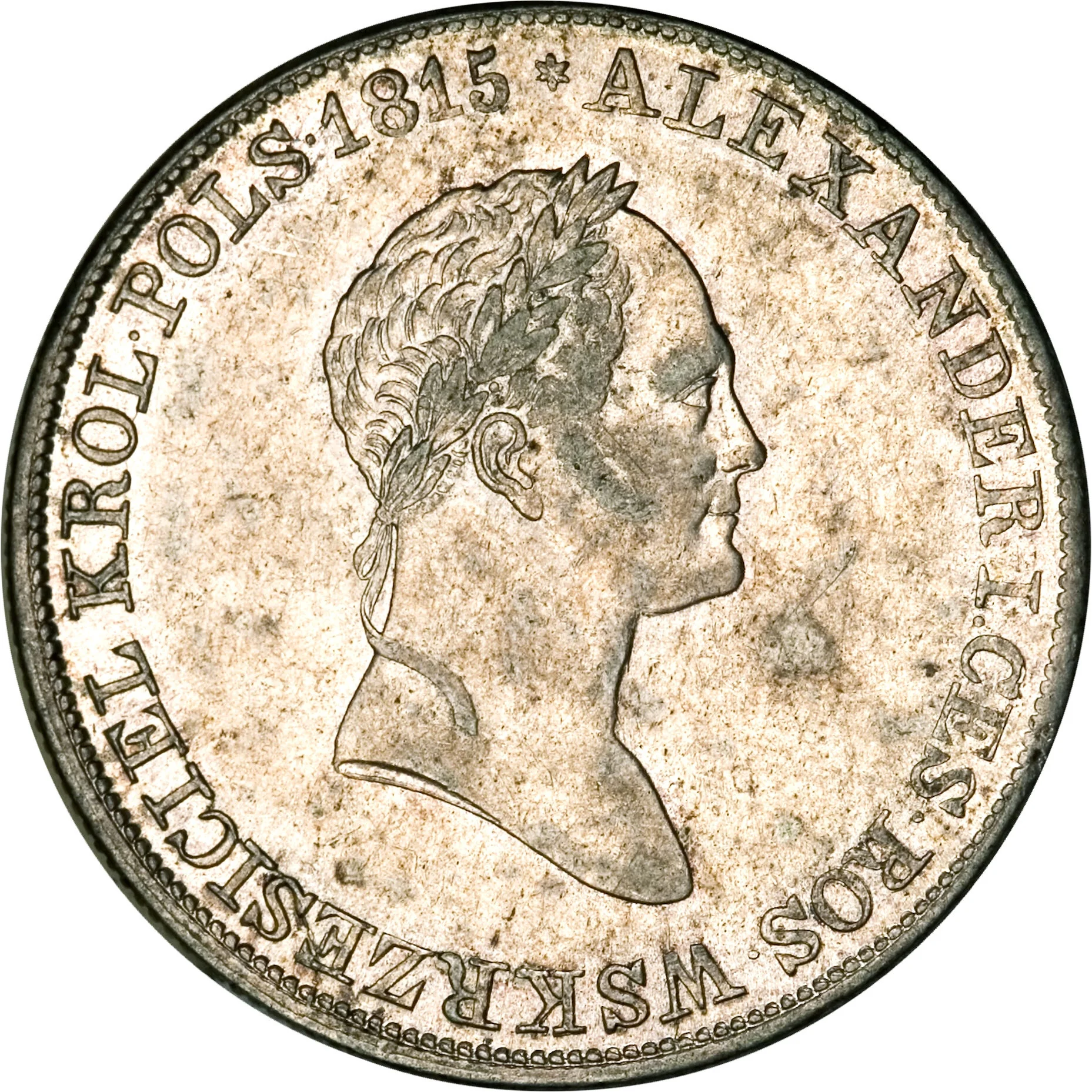
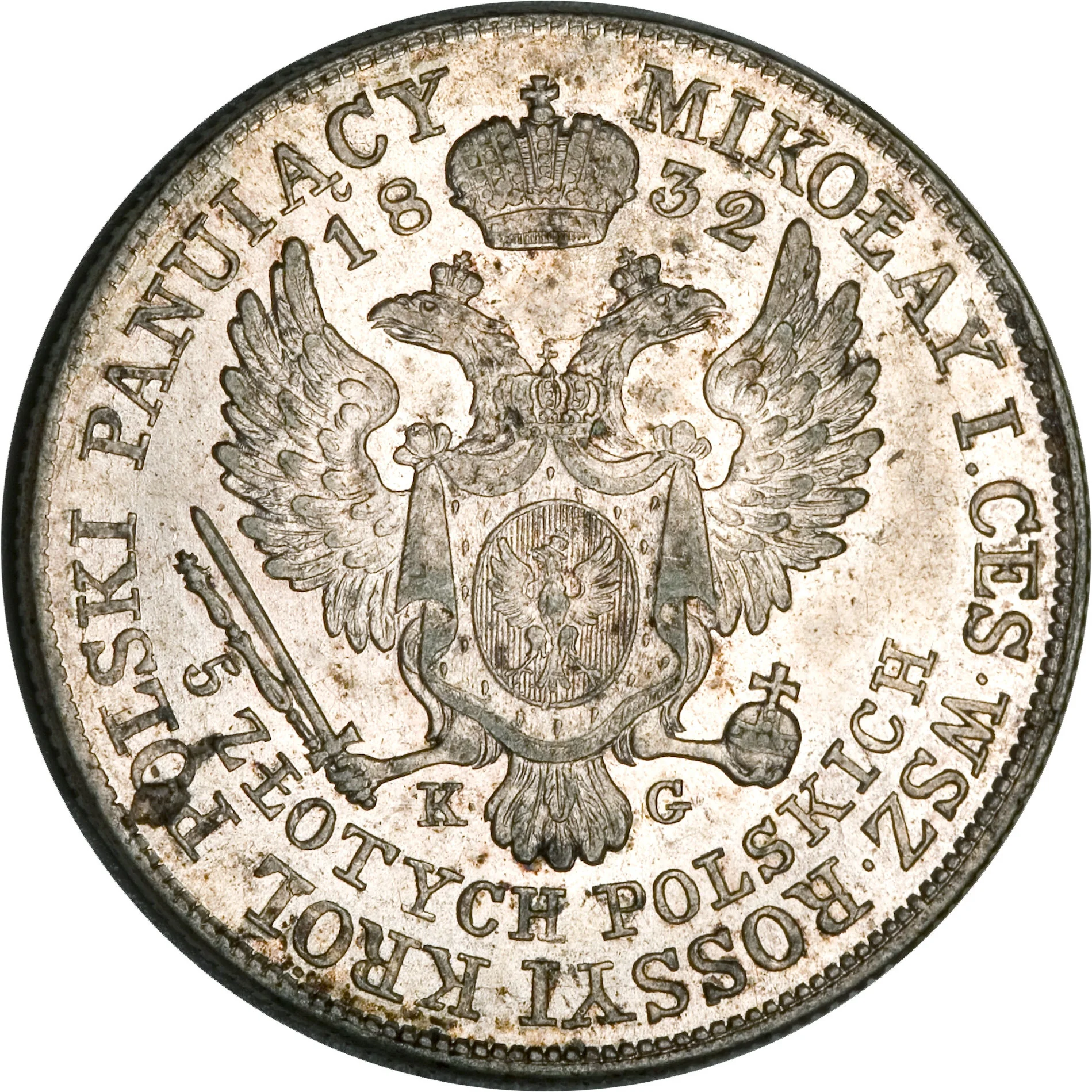
5 zlotys – Congress Kingdom of Poland
Add to wishlist
Poland
Context
Years: 1830–1834
Country: Poland
Issuer: Congress Kingdom of Poland
Ruler: Nicholas I
Currency:
(1815—1841)
Demonetized: Yes
Total mintage: 2,501,616
Material
Diameter: 31 mm
Weight: 15.4 g
Silver Weight:: 13.37 g
Shape: Round
Composition: 86.8% Silver
Standard: Silver half ounce
Magnetic: No
Technique: Milled
Alignment: Medal alignment
flip
References
Numista: #63674
Value
Bullion value: $34.20
Obverse
Reverse
Description:
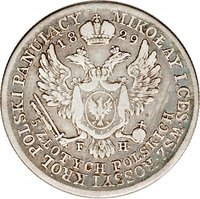
Double-headed eagle with crown, sceptre, and orb. Legend surrounds. Crown divides date above.
Inscription:
1832
5 ZŁOTYCH POLSKICH
K G
MIKOLAY I WSZ ROSSYI KROL POLSKI PANUIACY
5 ZŁOTYCH POLSKICH
K G
MIKOLAY I WSZ ROSSYI KROL POLSKI PANUIACY
Translation:
1832
5 POLISH ZŁOTYCH
K G
NICHOLAS I EMPEROR OF ALL RUSSIA KING OF POLAND REIGNING
5 POLISH ZŁOTYCH
K G
NICHOLAS I EMPEROR OF ALL RUSSIA KING OF POLAND REIGNING
Script: Latin
Edge
Reeded
Mintings
| Year | Mint Mark | Mintage | Quality | Collection |
|---|---|---|---|---|
| 1830 | KG | — | ||
| 1831 | KG | 1,003,678 | ||
| 1832 | KG | 638,815 | ||
| 1833 | KG | 445,054 | ||
| 1834 | KG | 414,069 |
Historical background
The currency situation in the Congress Kingdom of Poland in 1830 was a direct reflection of its complex political subordination to the Russian Empire. Following its creation in 1815, the Kingdom maintained a distinct monetary system with its own currency, the Polish złoty, which was introduced in 1816. The złoty was tied to the Russian monetary system at a fixed rate of 1 złoty = 15 kopeks, and it circulated alongside Russian coins and banknotes. This arrangement symbolized the Kingdom's nominal autonomy while firmly anchoring its economy within the Russian sphere.
By the eve of the November Uprising in 1830, this system was under significant strain. The Kingdom's central bank, the Bank Polski, established in 1828, held the right of note issue, but the financial demands of maintaining a large Polish Army and extensive state investments had led to budgetary pressures. Furthermore, the fixed exchange rate and integrated economy meant that financial policies were increasingly dictated by Saint Petersburg, limiting Warsaw's fiscal independence. Economic discontent, including grievances over currency and taxation, contributed to the rising tensions that would erupt into revolution.
The outbreak of the uprising in November 1830 immediately triggered a monetary crisis. The rebel Polish National Government desperately needed funds to finance the war against Russia. It seized the bullion reserves of the Bank Polski and began issuing large quantities of paper money, known as bilety skarbowe (treasury notes), without adequate metallic backing. This led to rapid inflation and a sharp decline in confidence in the currency. The złoty's fate became inextricably linked to the military success of the uprising; its ultimate collapse was sealed with the Russian victory in 1831, after which the Kingdom's separate monetary system was gradually dismantled and fully integrated into the Russian imperial one.
By the eve of the November Uprising in 1830, this system was under significant strain. The Kingdom's central bank, the Bank Polski, established in 1828, held the right of note issue, but the financial demands of maintaining a large Polish Army and extensive state investments had led to budgetary pressures. Furthermore, the fixed exchange rate and integrated economy meant that financial policies were increasingly dictated by Saint Petersburg, limiting Warsaw's fiscal independence. Economic discontent, including grievances over currency and taxation, contributed to the rising tensions that would erupt into revolution.
The outbreak of the uprising in November 1830 immediately triggered a monetary crisis. The rebel Polish National Government desperately needed funds to finance the war against Russia. It seized the bullion reserves of the Bank Polski and began issuing large quantities of paper money, known as bilety skarbowe (treasury notes), without adequate metallic backing. This led to rapid inflation and a sharp decline in confidence in the currency. The złoty's fate became inextricably linked to the military success of the uprising; its ultimate collapse was sealed with the Russian victory in 1831, after which the Kingdom's separate monetary system was gradually dismantled and fully integrated into the Russian imperial one.
💎 Very Rare