

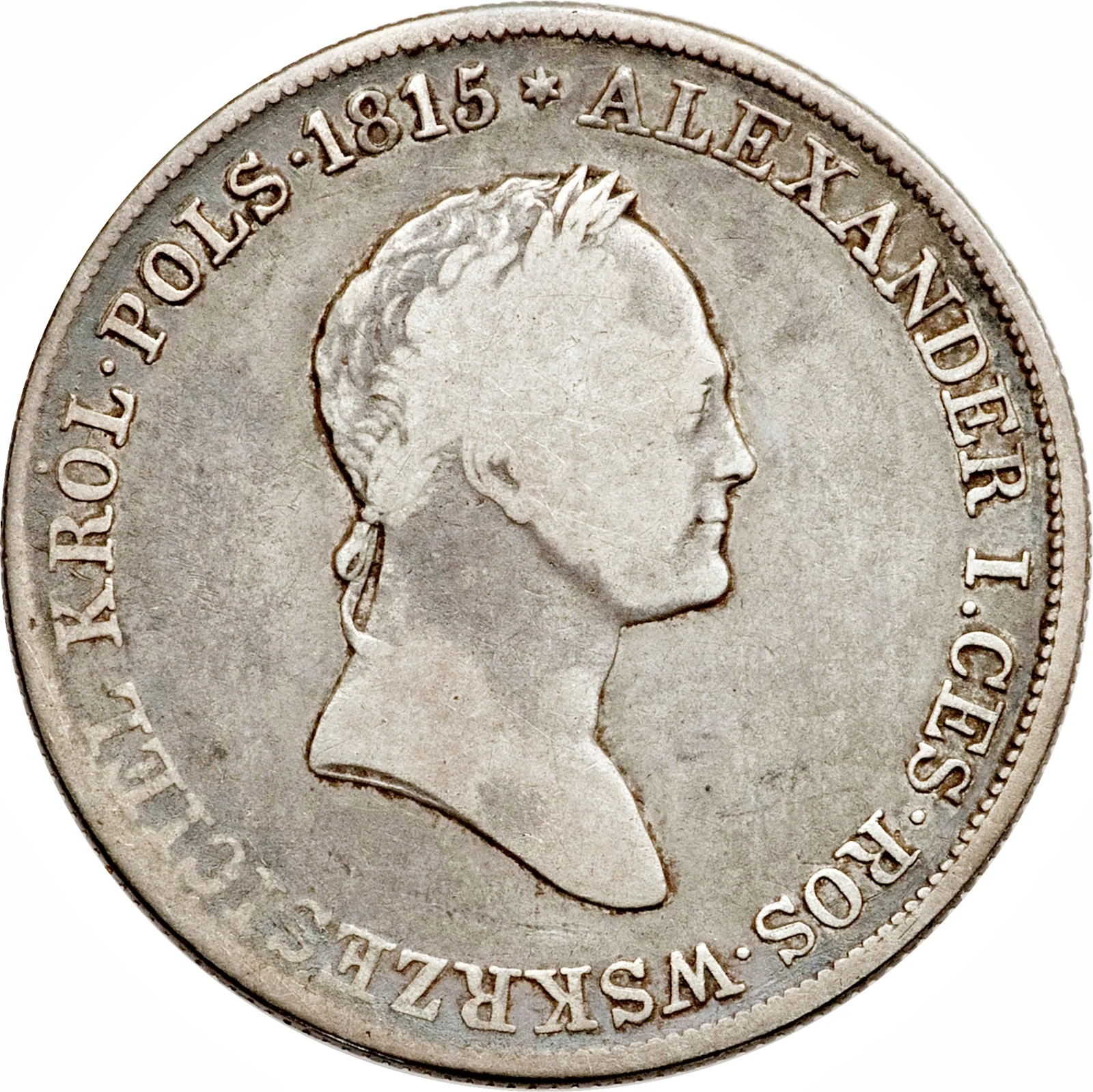
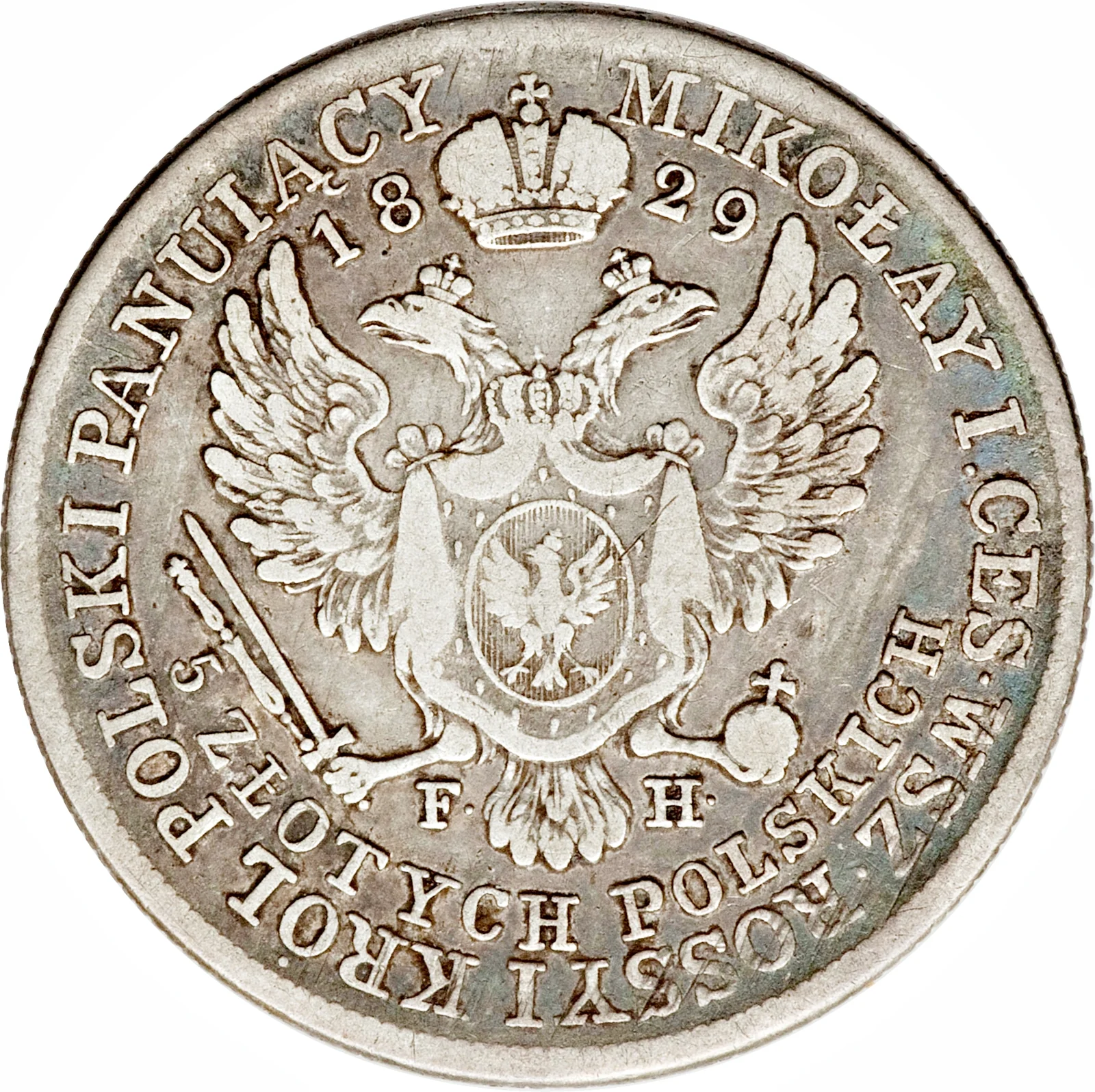
5 zlotys – Congress Kingdom of Poland
Add to wishlist
Poland
Context
Years: 1829–1834
Country: Poland
Issuer: Congress Kingdom of Poland
Ruler: Alexander I
Currency:
(1815—1841)
Demonetized: Yes
Total mintage: 1,520,789
Material
Diameter: 31 mm
Weight: 15.4 g
Silver Weight:: 13.37 g
Shape: Round
Composition: 86.8% Silver
Standard: Silver half ounce
Magnetic: No
Technique: Milled
Alignment: Medal alignment
flip
References
Numista: #33480
Value
Bullion value: $34.20
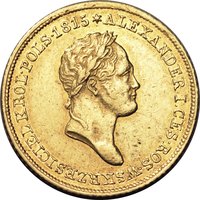
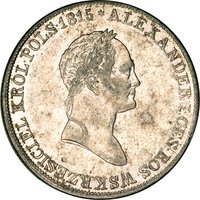
Obverse
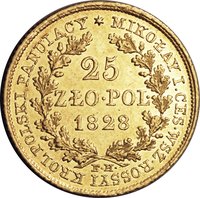
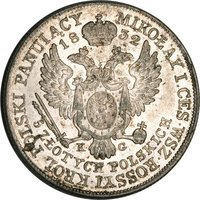
Reverse
Edge
Reeded
Mintings
| Year | Mint Mark | Mintage | Quality | Collection |
|---|---|---|---|---|
| 1829 | FH | 1,234,000 | ||
| 1830 | FH | 286,789 | ||
| 1834 | IP | — |
Historical background
In 1829, the currency situation in the Congress Kingdom of Poland was defined by its complex relationship with the Russian Empire, of which it was an autonomous part. The Kingdom operated under a distinct monetary system established by its 1815 constitution, centered on the Polish złoty, which was minted locally at the Warsaw Mint. This currency was intended to symbolize the Kingdom's self-governance, yet its value was firmly pegged to the Russian monetary system at a fixed rate of 1 złoty = 15 kopeks, creating a dependent, bimetallic standard tied to the silver ruble.
Economically, this period was one of relative stability but underlying strain. The fixed parity provided predictability for trade with Russia, the Kingdom's dominant economic partner, and facilitated the integration of the Polish economy into the broader imperial market. However, the system also exposed the Kingdom to Russian monetary policy and the inflationary pressures affecting the ruble. Furthermore, the coexistence of Polish and Russian coins in circulation, alongside a limited supply of small-denomination currency, caused occasional practical inconveniences in daily commerce.
Politically, the currency symbolized the tension between Polish autonomy and Russian control. While the złoty was a visible marker of the Kingdom's separate status, its subordination to the ruble reflected the reality of Imperial oversight. This monetary arrangement would soon be tested, as the economic discontent, partly fueled by the constraints of the system, contributed to the growing unrest that culminated in the November Uprising of 1830. Following the uprising's defeat, Russia would dismantle this autonomous monetary system entirely, abolishing the Polish złoty in 1841 and fully integrating the Kingdom into the Russian imperial currency space.
Economically, this period was one of relative stability but underlying strain. The fixed parity provided predictability for trade with Russia, the Kingdom's dominant economic partner, and facilitated the integration of the Polish economy into the broader imperial market. However, the system also exposed the Kingdom to Russian monetary policy and the inflationary pressures affecting the ruble. Furthermore, the coexistence of Polish and Russian coins in circulation, alongside a limited supply of small-denomination currency, caused occasional practical inconveniences in daily commerce.
Politically, the currency symbolized the tension between Polish autonomy and Russian control. While the złoty was a visible marker of the Kingdom's separate status, its subordination to the ruble reflected the reality of Imperial oversight. This monetary arrangement would soon be tested, as the economic discontent, partly fueled by the constraints of the system, contributed to the growing unrest that culminated in the November Uprising of 1830. Following the uprising's defeat, Russia would dismantle this autonomous monetary system entirely, abolishing the Polish złoty in 1841 and fully integrating the Kingdom into the Russian imperial currency space.
💎 Very Rare