

2 francs – Monaco
Add to wishlist
Monaco
Context
Material
Diameter: 27 mm
Weight: 8 g
Shape: Round
Composition: Copper-aluminium
Technique: Milled
Alignment: Coin alignment
flip
References
KM: #
Numista: #6365
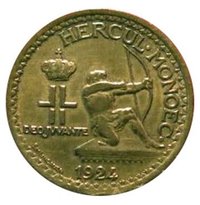
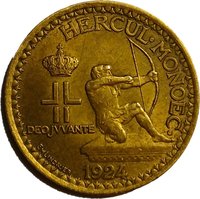
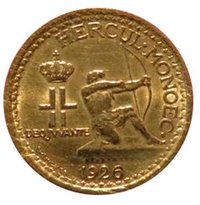
Obverse
Description:
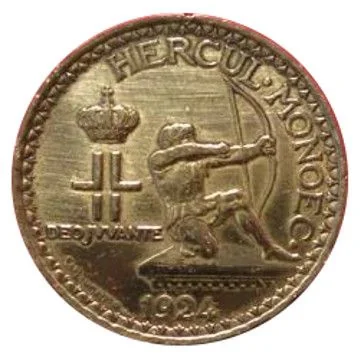
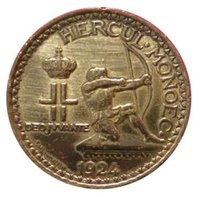
Hercules aiming right with bow.
Inscription:
HERCUL·MONOEC·
DEOJVVANTE
EMLINDAUER
1924
DEOJVVANTE
EMLINDAUER
1924
Translation:
BY THE GRACE OF GOD
HERCUL·MONOEC·
EMLINDAUER
1924
HERCUL·MONOEC·
EMLINDAUER
1924
Script: Latin
Engraver: Edmond-Émile Lindauer
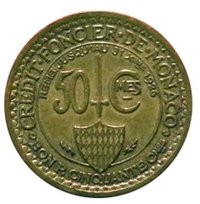
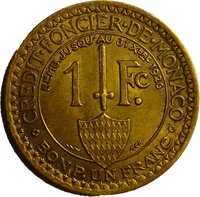
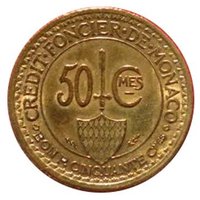
Reverse
Description:
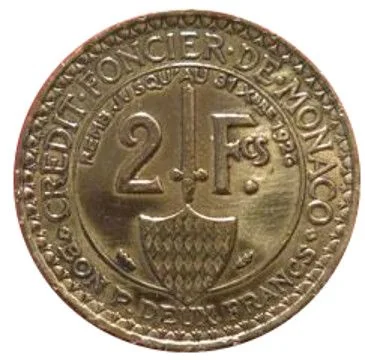
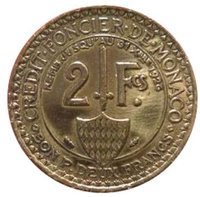
Shield below value, Poissy thunderbolt mintmark left.
Inscription:
CREDIT·FONCIER·DE·MONACO
REMB.JUSQU'AU 31XBRE 1926
2 FCS .
BON P. DEUX FRANCS
REMB.JUSQU'AU 31XBRE 1926
2 FCS .
BON P. DEUX FRANCS
Script: Latin
Engraver: Edmond-Émile Lindauer
Edge
Reeded
Mints
| Name | Mark |
|---|---|
| Société Française de Monnayage | — |
Mintings
| Year | Mint Mark | Mintage | Quality | Collection |
|---|---|---|---|---|
| 1924 | — | — |
Historical background
In 1924, Monaco's currency situation was intrinsically tied to that of France, operating under the provisions of the 1865 Latin Monetary Union (LMU). This treaty, which initially included France, Belgium, Italy, and Switzerland, established a bimetallic standard based on gold and silver, with the French franc as its anchor. Monaco, due to its special customs and political union with France formalized by the 1918 Treaty, had no independent currency. The Monégasque franc was legally at par with the French franc and circulated interchangeably, though the principality did issue its own coinage (franc and centime pieces) featuring the effigy of Prince Louis II, which held legal tender status within its borders.
The broader international context, however, was one of severe strain for the LMU. The system had been effectively suspended at the outbreak of World War I, as member nations abandoned gold convertibility to print money for wartime financing. By 1924, the Union existed in name only, a hollow framework awaiting formal dissolution. France, burdened by reconstruction debts and inflation, was grappling with a depreciating franc. Consequently, Monaco's currency was directly exposed to these French monetary instabilities, having no separate central bank or independent monetary policy to act as a buffer.
Therefore, the background of Monaco's currency in 1924 is one of complete dependency amidst regional monetary disorder. The principality enjoyed the technical ability to mint its own coins as a symbol of sovereignty, but their value was wholly contingent on the fragile and faltering French franc. The stability of the Monégasque economy was thus directly subject to the success or failure of French efforts to stabilize its own post-war finances, a situation that would persist until the final collapse of the Latin Monetary Union in 1927.
The broader international context, however, was one of severe strain for the LMU. The system had been effectively suspended at the outbreak of World War I, as member nations abandoned gold convertibility to print money for wartime financing. By 1924, the Union existed in name only, a hollow framework awaiting formal dissolution. France, burdened by reconstruction debts and inflation, was grappling with a depreciating franc. Consequently, Monaco's currency was directly exposed to these French monetary instabilities, having no separate central bank or independent monetary policy to act as a buffer.
Therefore, the background of Monaco's currency in 1924 is one of complete dependency amidst regional monetary disorder. The principality enjoyed the technical ability to mint its own coins as a symbol of sovereignty, but their value was wholly contingent on the fragile and faltering French franc. The stability of the Monégasque economy was thus directly subject to the success or failure of French efforts to stabilize its own post-war finances, a situation that would persist until the final collapse of the Latin Monetary Union in 1927.
🌱 Fairly Common