

50 centimes – Monaco
Add to wishlist
Monaco
Obverse
Description:
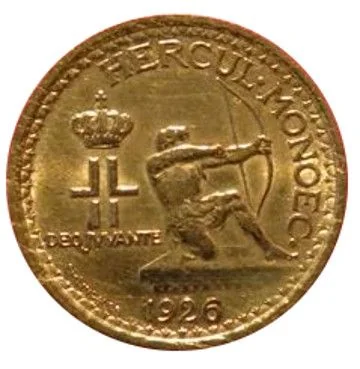
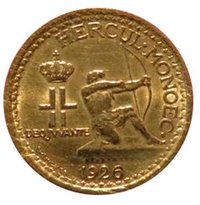
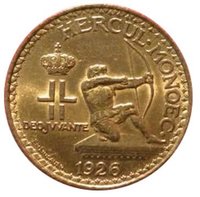
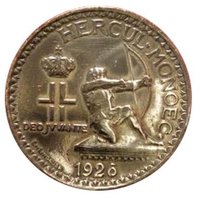
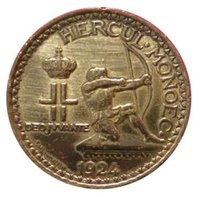
Archer Herakles kneeling right, shooting a bow, on a base with the date. Left field: arms of Prince Louis II under a crown. Edge: alternating points and arrowheads.
Inscription:
HERCUL·MONOEC·
DEOJVVANTE
EMLINDAUER
1926
DEOJVVANTE
EMLINDAUER
1926
Translation:
HERCULES·MONOECUS·
WITH GOD'S HELP
E(ugen) M(aria) LINDAUER
1926
WITH GOD'S HELP
E(ugen) M(aria) LINDAUER
1926
Script: Latin
Engraver: Edmond-Émile Lindauer
Reverse
Description:
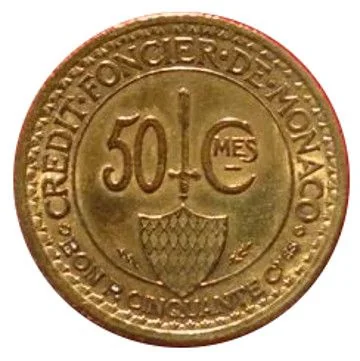
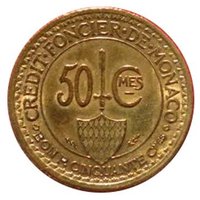
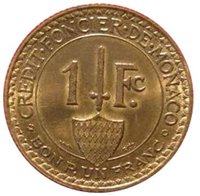
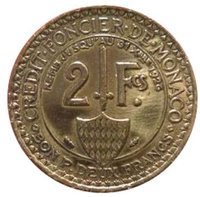
Thunderbolt mintmark of Poissy left of shield.
Inscription:
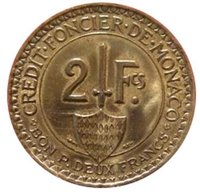
CREDIT·FONCIER·DE·MONACO
50 C MES
BON P. CINQUANTE C MES
50 C MES
BON P. CINQUANTE C MES
Script: Latin
Engraver: Edmond-Émile Lindauer
Edge
Reeded
Mints
| Name | Mark |
|---|---|
| Société Française de Monnayage | — |
Mintings
| Year | Mint Mark | Mintage | Quality | Collection |
|---|---|---|---|---|
| 1926 | — | 150,000 |
Historical background
In 1926, Monaco's currency situation was intrinsically linked to that of France due to the monetary conventions established in the previous century. Since the 1865 Latin Monetary Union (LMU), which Monaco joined in 1866, the Principality's currency, the Monegasque franc, was legally pegged at par with the French franc and circulated interchangeably. However, by the 1920s, the LMU had effectively collapsed due to the economic turmoil following World War I, leaving bilateral agreements as the foundation for monetary relations. For Monaco, this meant its financial stability remained entirely dependent on the strength and policies of the French franc.
The year 1926 was a point of crisis and reform in France, directly impacting Monaco. The French franc suffered from severe inflation and speculation, losing nearly 80% of its value between 1925 and 1926. This instability threatened Monaco's economy, which was heavily reliant on tourism and capital from French residents. The crisis culminated in France with the "Poincaré stabilization" in July 1926, named after the newly appointed Prime Minister and Finance Minister Raymond Poincaré. His government implemented rigorous fiscal reforms, restored confidence, and effectively devalued and stabilized the franc.
In direct response to this French stabilization, Monaco formally renewed and solidified its monetary dependency. On May 31, 1927, the two states signed a new monetary convention, which came into force in 1928. This treaty legally confirmed the fixed 1:1 parity between the Monegasque franc and the French franc, granted legal tender status to French currency in Monaco, and placed Monegasque coin minting under French oversight. Therefore, the situation in 1926 was one of acute vulnerability, prompting the decisive action in 1927 that would anchor Monaco's currency to the stabilized French franc for decades to come.
The year 1926 was a point of crisis and reform in France, directly impacting Monaco. The French franc suffered from severe inflation and speculation, losing nearly 80% of its value between 1925 and 1926. This instability threatened Monaco's economy, which was heavily reliant on tourism and capital from French residents. The crisis culminated in France with the "Poincaré stabilization" in July 1926, named after the newly appointed Prime Minister and Finance Minister Raymond Poincaré. His government implemented rigorous fiscal reforms, restored confidence, and effectively devalued and stabilized the franc.
In direct response to this French stabilization, Monaco formally renewed and solidified its monetary dependency. On May 31, 1927, the two states signed a new monetary convention, which came into force in 1928. This treaty legally confirmed the fixed 1:1 parity between the Monegasque franc and the French franc, granted legal tender status to French currency in Monaco, and placed Monegasque coin minting under French oversight. Therefore, the situation in 1926 was one of acute vulnerability, prompting the decisive action in 1927 that would anchor Monaco's currency to the stabilized French franc for decades to come.
🌱 Fairly Common