

200 Euro – Greece
Non-circulating coins
Commemoration: Philosophers Series
Greece
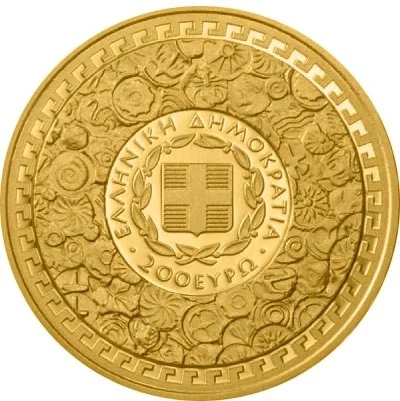
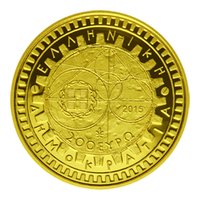
Obverse
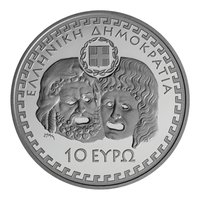
Description:
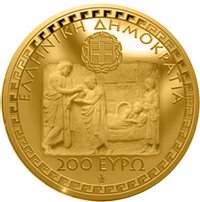
Greek national emblem
Inscription:
ΕΛΛΗΝΙΚΗ ΔΗΜΟΚΡΑΤΙΑ
200 ΕΥΡΩ
200 ΕΥΡΩ
Translation:
HELLENIC REPUBLIC
200 EURO
200 EURO
Script: Greek
Language: Greek
Engraver: Geórgios Stamatópoulos
Reverse
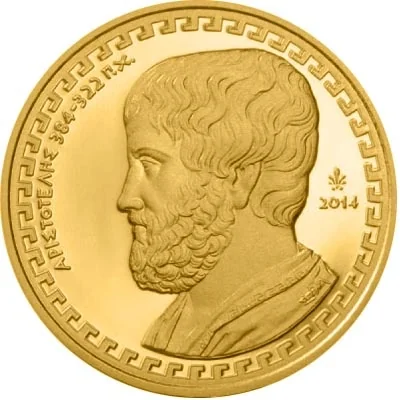
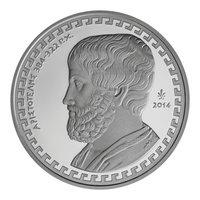
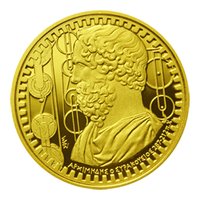
Description:
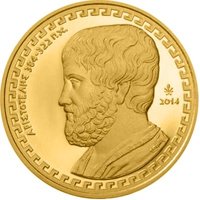
Aristotle portrait
Inscription:
ΑΡΙΣΤΟΤΕΛΗΣ 384-322 π.Χ.
2014
2014
Translation:
Aristotle 384-322 BC
2014
2014
Script: Greek
Language: Greek
Engraver: Geórgios Stamatópoulos
Edge
Categories
| Symbols> Coat of Arms |
| Person> Philosopher |
Mints
| Name | Mark |
|---|---|
| National Mint of the Bank of Greece | — |
Mintings
| Year | Mint Mark | Mintage | Quality | Collection |
|---|---|---|---|---|
| 2014 | — | 600 | Proof |
Historical background
By 2014, Greece was in the sixth year of a profound economic and social crisis, but its currency situation was defined by a critical paradox: it remained a member of the Eurozone. The intense speculation and fear of a "Grexit" (a Greek exit from the euro) that had peaked in 2012 had subsided somewhat after the European Central Bank's pledge to do "whatever it takes" to preserve the euro. However, the underlying pressures were severe. The country was operating under its second international bailout program, requiring strict austerity measures that had shrunk the economy by over 25% since 2008 and pushed unemployment above 27%. The primary concern was not a formal currency change but a potential bank run and capital flight that could force the country into a chaotic exit and the reintroduction of a devalued national currency.
The currency stability was entirely dependent on external financial support from the "Troika" (the European Commission, ECB, and IMF). Greece's banking system was fragile and reliant on Emergency Liquidity Assistance (ELA) from the Bank of Greece, sanctioned by the ECB, to stay solvent. This created a tense standoff where euro membership was conditional on the government's compliance with austerity and reform targets. Public and political resentment towards these conditions was growing, setting the stage for a political showdown. The currency was physically still the euro, but its continuity was perceived as increasingly precarious, tied directly to the success of fraught negotiations with international creditors.
Ultimately, 2014 was a year of simmering tension rather than immediate currency rupture. The government successfully exited the bond markets for the first time since the crisis with a small issuance, offering a glimmer of hope. However, this proved fleeting. The political landscape was shifting dramatically, with the anti-austerity Syriza party gaining momentum. By the end of 2014, political instability forced early elections, setting the stage for the explosive crisis of 2015 when the "Grexit" threat and capital controls became a stark reality. Thus, 2014 served as the fragile and deceptive calm before the final, most dramatic storm over Greece's place in the euro.
The currency stability was entirely dependent on external financial support from the "Troika" (the European Commission, ECB, and IMF). Greece's banking system was fragile and reliant on Emergency Liquidity Assistance (ELA) from the Bank of Greece, sanctioned by the ECB, to stay solvent. This created a tense standoff where euro membership was conditional on the government's compliance with austerity and reform targets. Public and political resentment towards these conditions was growing, setting the stage for a political showdown. The currency was physically still the euro, but its continuity was perceived as increasingly precarious, tied directly to the success of fraught negotiations with international creditors.
Ultimately, 2014 was a year of simmering tension rather than immediate currency rupture. The government successfully exited the bond markets for the first time since the crisis with a small issuance, offering a glimmer of hope. However, this proved fleeting. The political landscape was shifting dramatically, with the anti-austerity Syriza party gaining momentum. By the end of 2014, political instability forced early elections, setting the stage for the explosive crisis of 2015 when the "Grexit" threat and capital controls became a stark reality. Thus, 2014 served as the fragile and deceptive calm before the final, most dramatic storm over Greece's place in the euro.
💎 Extremely Rare