

6 pence – Fiji
Add to wishlist
Fiji
Context
Years: 1953–1967
Issuer: Fiji
Ruler: Elizabeth II
Currency:
(1873—1969)
Demonetization: 30 June 1969
Total mintage: 3,600,000
Material
Diameter: 19.5 mm
Weight: 2.83 g
Thickness: 1.3 mm
Shape: Round
Composition: Copper-nickel
Technique: Milled
Alignment: Medal alignment
flip
References
KM: #
Numista: #6268
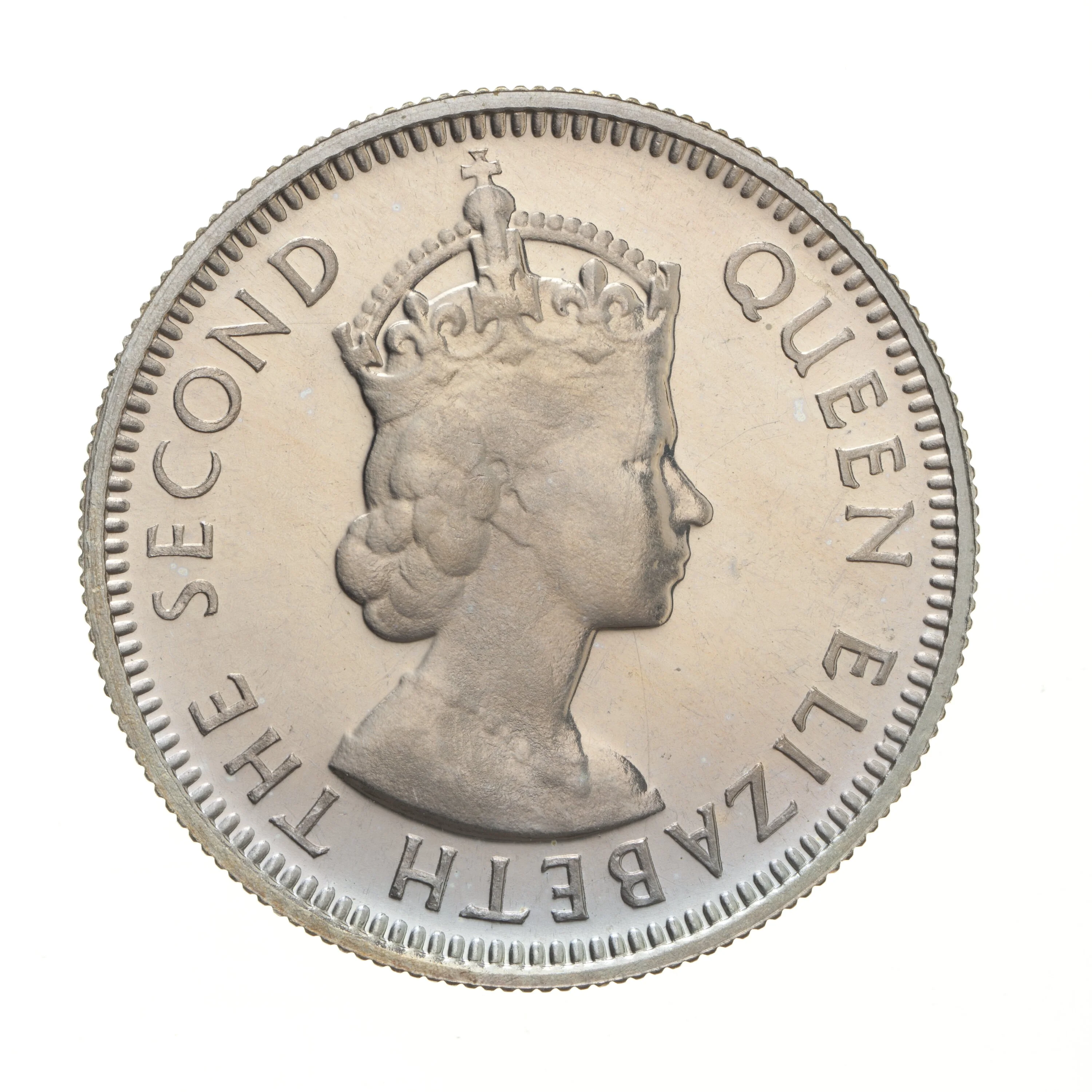
Obverse
Description:
King facing right
Inscription:
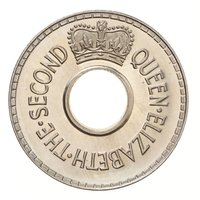
QUEEN ELIZABETH THE SECOND
Script: Latin
Engraver: Cecil Thomas
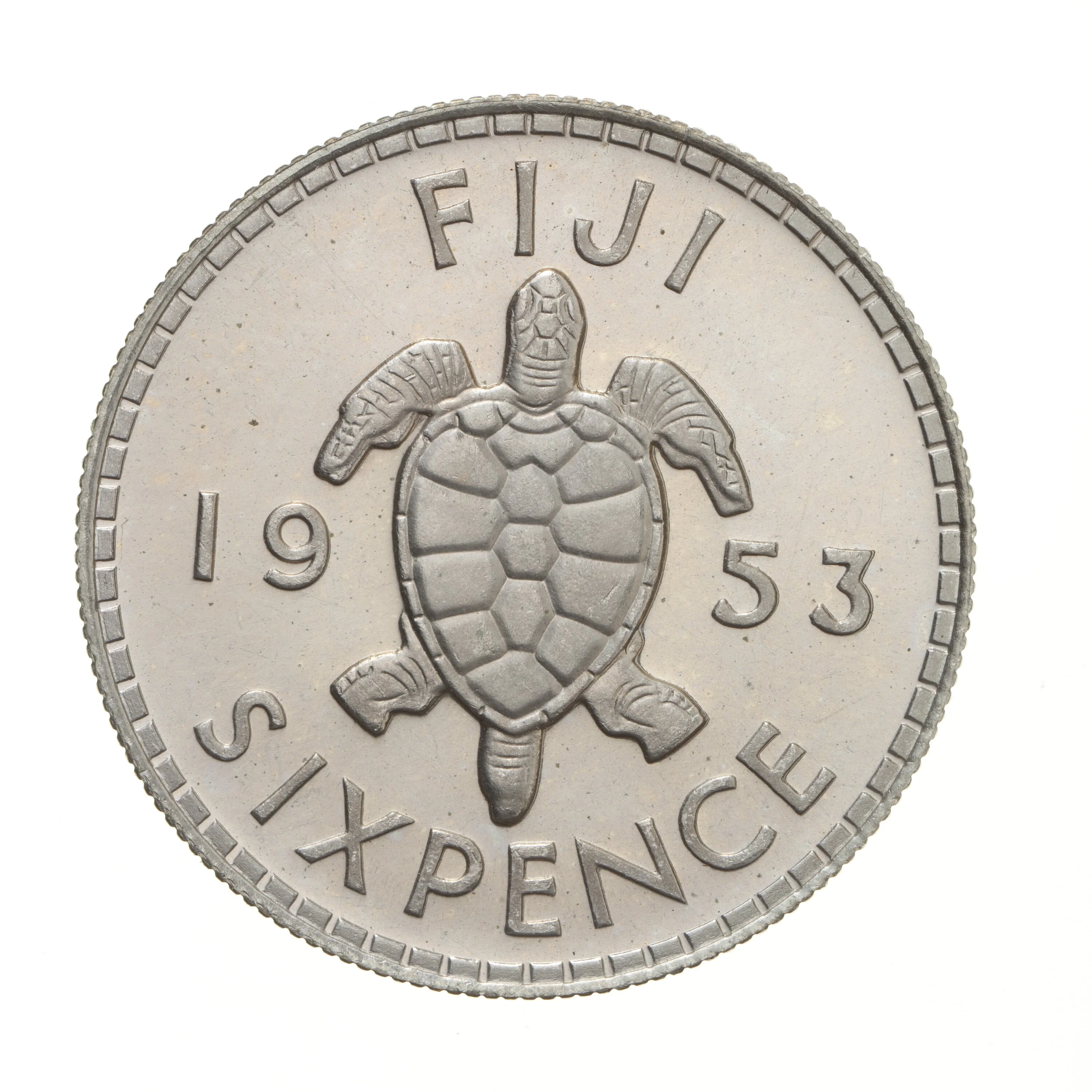
Reverse
Description:
Sea turtle coin, date below.
Inscription:
FIJI
19 62
SIXPENCE
19 62
SIXPENCE
Script: Latin
Engraver: Percy Metcalfe
Edge
Reeded
Categories
| Animal> Turtle or tortoise |
Mints
| Name | Mark |
|---|---|
| Royal Mint (Tower Hill) | — |
Mintings
| Year | Mint Mark | Mintage | Quality | Collection |
|---|---|---|---|---|
| 1953 | — | 800,000 | ||
| 1953 | — | — | Proof | |
| 1958 | — | — | Proof | |
| 1958 | — | 400,000 | ||
| 1961 | — | 400,000 | ||
| 1961 | — | — | Proof | |
| 1962 | — | 400,000 | ||
| 1962 | — | — | Proof | |
| 1965 | — | 800,000 | ||
| 1967 | — | 800,000 |
Historical background
In 1953, Fiji’s currency system was firmly under the administration of the colonial government, operating as a sterling exchange standard. The official currency was the Fijian pound (FJ£), which was pegged at par with the British pound sterling (GB£). This meant that the value of Fiji's money was directly and rigidly linked to the UK's currency, with the colony holding sterling reserves in London to fully back the local currency in circulation. The physical notes and coins were issued by the Fiji Board of Currency, established in 1934, but the system was designed to ensure that Fiji’s monetary conditions were essentially an extension of Britain’s.
The economy was heavily dependent on sugar exports, dominated by the Colonial Sugar Refining Company, and coconut products. This peg to sterling provided stability for foreign trade and investment, most of which was conducted with the United Kingdom, Australia, and New Zealand. It eliminated exchange rate risk for British businesses and simplified government accounting. However, it also meant that Fiji had no independent monetary policy; interest rates and money supply were largely dictated by economic conditions in Britain rather than local needs. The system worked to facilitate colonial economic integration but offered little flexibility for Fiji to respond to its own domestic economic fluctuations.
Socially, the currency in circulation reflected the colony's hierarchical structure. Banknotes featured portraits of the British monarch, King George VI, until his death in February 1952, after which notes bearing the image of the new Queen, Elizabeth II, were introduced. The use of cash was increasing, but a significant portion of the indigenous Fijian population, particularly in rural areas, still engaged in a subsistence economy and barter. The currency situation in 1953 was thus a symbol of colonial control—stable and integrated into the British Empire's financial architecture, yet not tailored for an autonomous or diversified national economy, a structure that would remain largely unchanged until decimalization and the introduction of the Fijian dollar in 1969, several years before independence.
The economy was heavily dependent on sugar exports, dominated by the Colonial Sugar Refining Company, and coconut products. This peg to sterling provided stability for foreign trade and investment, most of which was conducted with the United Kingdom, Australia, and New Zealand. It eliminated exchange rate risk for British businesses and simplified government accounting. However, it also meant that Fiji had no independent monetary policy; interest rates and money supply were largely dictated by economic conditions in Britain rather than local needs. The system worked to facilitate colonial economic integration but offered little flexibility for Fiji to respond to its own domestic economic fluctuations.
Socially, the currency in circulation reflected the colony's hierarchical structure. Banknotes featured portraits of the British monarch, King George VI, until his death in February 1952, after which notes bearing the image of the new Queen, Elizabeth II, were introduced. The use of cash was increasing, but a significant portion of the indigenous Fijian population, particularly in rural areas, still engaged in a subsistence economy and barter. The currency situation in 1953 was thus a symbol of colonial control—stable and integrated into the British Empire's financial architecture, yet not tailored for an autonomous or diversified national economy, a structure that would remain largely unchanged until decimalization and the introduction of the Fijian dollar in 1969, several years before independence.
🌱 Common