

1⁄16 Rupee – Madras Presidency
India
Context
Year: 1817
Islamic (Hijri) Year: 1172
Country: India 
Issuer: Madras Presidency
Currency:
(1691—1835)
Demonetized: Yes
Total mintage: 8,684,254
Material
References
KM: #Click to copy to clipboard411
Numista: #62278
Value
Bullion value: $2.03
Obverse
Description:
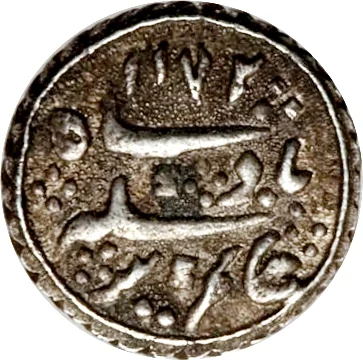
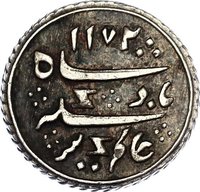
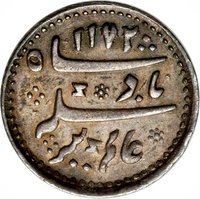
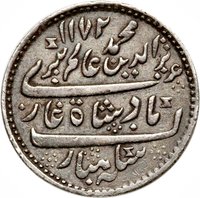
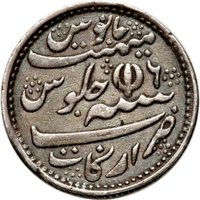
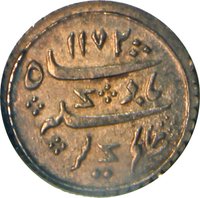
Alamgir coin, Persian legend, 1172, circular border.
Inscription:
١١٧٢
Translation:
One thousand one hundred seventy-two
Language: Arabic
Reverse
Edge
Oblique milling (grained right ///)
Mintings
| Year | Mint Mark | Mintage | Quality | Collection |
|---|---|---|---|---|
| 1817 | — | 8,684,254 |
Historical background
In 1817, the Madras Presidency was navigating a complex and often chaotic currency situation, a legacy of its pre-colonial past and the ongoing consolidation of British East India Company rule. The monetary system was a fragmented mix of indigenous, Company, and foreign coins. The primary unit was the silver Star Pagoda, but the most ubiquitous coin in daily circulation was the gold fanam, with 42 fanams equalling one pagoda. Alongside these, a plethora of silver and copper coins of various origins, including Arcot rupees, Madras rupees, and coins from neighbouring Indian states, circulated at fluctuating exchange rates, creating confusion and facilitating fraud.
The East India Company administration was actively attempting to impose order and assert its monetary authority. A key reform was the introduction of the Silver Rupee as the official standard of value, aiming to displace the gold-based pagoda. However, this transition was incomplete and met with public resistance, as the populace remained deeply attached to the familiar fanam and pagoda for both commerce and religious offerings. The Company's own mint in Madras struggled with the dual challenges of producing sufficient quantities of the new rupees and managing the recall and recoinage of the old, heterogeneous currencies.
Consequently, the year 1817 represented a period of significant monetary transition and friction. While the Company sought to create a uniform, silver-based currency to simplify revenue collection and trade within its expanding territories, the practical reality was a dual-system of overlapping currencies. This instability caused hardship for peasants and merchants alike, complicating tax payments and commercial contracts, and highlighted the tension between colonial economic designs and the entrenched financial habits of the local population.
The East India Company administration was actively attempting to impose order and assert its monetary authority. A key reform was the introduction of the Silver Rupee as the official standard of value, aiming to displace the gold-based pagoda. However, this transition was incomplete and met with public resistance, as the populace remained deeply attached to the familiar fanam and pagoda for both commerce and religious offerings. The Company's own mint in Madras struggled with the dual challenges of producing sufficient quantities of the new rupees and managing the recall and recoinage of the old, heterogeneous currencies.
Consequently, the year 1817 represented a period of significant monetary transition and friction. While the Company sought to create a uniform, silver-based currency to simplify revenue collection and trade within its expanding territories, the practical reality was a dual-system of overlapping currencies. This instability caused hardship for peasants and merchants alike, complicating tax payments and commercial contracts, and highlighted the tension between colonial economic designs and the entrenched financial habits of the local population.
💎 Very Rare